One Sure Thing

In this slippery tilting world 
your heart is one sure thing.
You love me always, whether
I am striding in the right direction
or fallen in a patch of thorns,
listening raptly to your voice
or indulging my addictions,
desperately trying to feel good.

Unfailing love: hesed, the Hebrews said.
This is what we long for all our lives,
and this is Who you are!

We cannot shatter, disillusion,
wear away your tenderness.
You are true love with no beginning
and no ending, always potent,
always steady, always ready to receive
the bullheaded son or daughter
who returns to you, and finds at last
where the source of meaning is.

Your heartbeat never falters,
never skips a beat, won’t race
or turn erratic. You are love,
and I can crawl into your lap
or batter you with angry fists
or crucify you, tearing at your heart.
I've done it all, and more,
unfaithful to the core.

Yet you keep right on loving,
though I know you’re disappointed
with this inner instability
and all the hurt it means for me;
though you would be sad
if I would turn away from all that's good
and choose instead what turns to rot
and spreads infection through my soul.

The perfect Parent, you forgive your child
when I run to you for pardon,
acknowledging my fault.
And finally I am ready to accept
your loving smile when I succeed,
your loving hand-up when I fail,
your totally consistent love.
I cannot make you love me more.

Your love just IS, and I will dive into
the wonder of it all and live inside
unfailing love.

During my last year in seminary my husband and I took out a loan to buy tickets and joined the group of students traveling to Israel to fulfill a course requirement. I learned a lot as we visited sites where key biblical events took place long ago.

One afternoon we were sitting at an outdoor table when a craftsman came around to see who might want to order a silver ring with a name or name abbreviation carved into it, whatever you might choose. He was speaking English, obviously used to working with tourists. When he came to me I told him that yes, I would order a ring. On it, would he please carve this: חֶסֶד !

Hesed!” he exclaimed. “How do you know that word?”

“Well, we are seminary students,” I answered. “We study Hebrew!”

He was startled but obviously delighted. And so was I. That ring is still on my hand, 19 years later. It is a constant reminder of a precious truth that comforts me.

When our Hebrew professor had introduced that word hesed to us, I had been stunned. It was the word used for God’s love, a word so full of meaning in Hebrew that no one word by itself in English could match it. Suddenly many biblical texts had new meaning for me.

Of course the context of a word matters. Think about this:  do you love coffee? Do you love going to concerts? Do you love your spouse? Do you love that best friend who is your safe place? Do you love the difficult neighbor next door?

That key Hebrew word hesed can have a slightly different connotation depending on the context, too. But even in the same context our great English translations have chosen different ways to communicate its meaning. Compare these:

ESV Psalm 36:7 How precious is your steadfast love, O God! The children of mankind take refuge in the shadow of your wings.

NAS Psalm 36:7 How precious is Thy lovingkindness, O God! And the children of men take refuge in the shadow of Thy wings.

NET Psalm 36:7 How preciousis your loyal love, O God! The human race finds shelter under your wings.

NIV Psalm 36:7 How priceless is your unfailing love, O God! People take refuge in the shadow of your wings.

NJB Psalm 36:7 how precious, God, is your faithful love. So the children of Adam take refuge in the shadow of your wings.

We struggled to find a way to translate this into Nyarafolo! The one that worked best was  bànguɔ dɛnigɛ,  “love without end”. The word for love, dɛnigɛ, had been created by new Nyarafolo believers, adding a noun suffix to the verb that means “to please or delight, to like”. This concept of a love that never ends, never changes when its object does wrong—is always ready to forgive when repentance is there—was astonishing to them. And working through this made it deeply astounding to me.

I realized that I had not grappled with the depth and breadth of God’s love. Just referencing the various translations noted above, it is steadfast, lovingly kind, loyal, unfailing and faithful. When you look up hesed in the Holladay lexicon, this is a summary of what you get as a definition: a) obligation to the community—loyalty, faithfulness, b) kindness, grace. The word “love” does not even appear! Others add these qualities to their definition: goodness, mercies, fidelity, lovingkindness.

You can see the challenge that it is for us to try to understand and express the incredible goodness and multiple facets of God’s love. Human love (between husband and wife, family members, friends) is expressed by a different word, even when it refers to loving God—there, it is אהב  (ahab/ahav) which can mean: like, love, feel affection for (depending on the context). It is the one that tells us, humans, to love God:

You must love the LORD your God and do what he requires . . . (NET Deuteronomy 11:1a)

As the ISBE Bible Dictionary says of these terms for love:

“Love, whether used of God or man, is an earnest and anxious desire for and an active and beneficent interest in the well-being of the one loved.  Different degrees and manifestations of this affection are recognized in the Scriptures according to the circumstances and relations of life.”

Now let’s think about the boundless mercy and grace that is included in hesed, the love that God has for us humans. Why should we trust it? Because it is the reason why he pays attention to us, earnestly desiring our well-being—even to the point of becoming human to rescue us by paying the penalty for our wrong-doing. And his love is trustworthy, with no end or beginning, completely good, and loyal to those who belong him to him.

So how are we to “love” God? As I said in the poem above, one way is to respond to him by living inside his love. We open ourselves up to all that he wants to pour into us. We do what he wants us to do, as Deuteronomy 11:1 and many other verses remind us. Living that way shows that we appreciate his goodness and love, that we trust his infinite wisdom. It shows that we care about him and his plans for us. We do not want to disappoint him.

It’s like when, as children, we looked up to someone who truly showed love for us and then did what we could to make them know that they were appreciated. My dad was delighted in my avid reading when I was only seven, and gave me a notebook; I was supposed to make a list in it of every book I read. I knew that I was missing putting quite a few into the notebook, just racing to the next story I could find. The list didn’t matter much to me personally, but I wanted to make him happy. So when we evacuated from Congo a year later, sneaking out of our area at night, and I was only allowed to take a small backpack stuffed with a change of clothing and one precious object I wouldn’t want to lose, I chose that notebook! Why? Because I loved Dad and wanted him to know it, to be pleased.  When we love Abba God, we obey him like that—not just to escape punishment but to delight him.

God’s unending lovingkindness, his firm concern shown in loving attention, this is a treasure beyond words. So we show it by our commitment to him and our respect for his wishes that we love him in return. We live in a way so attached to him that it impacts everything we do and say. And we rest inside that constant goodness, like a child that crawls onto his parent’s lap, knowing he is welcome there—in fact, invited to be close to them always. That is what it means to belong to our Heavenly Father and live inside his love.

So turn to him now, thank him for his hesed, and rest in the best peace ever!

Share that Light!

I live in darkness, 
a world that snuffs out
lamps and candles
wherever it can.
But your Light dawns
on those who wait,
who keep looking up
not down. And then

you reveal your plans
in the network of sky
and clouds, tree limbs
reaching and touching,
your soft light glowing
on water as well as
on busy streets and
through my windows.

I am commissioned
to share that light
while my life melts away
like a candle, still bright,
glowing in its designated
sphere, right here—
loving you, Yahweh,
and those around me.

I was setting the table for Easter dinner, trying to put together a centerpiece that would speak a theme vibrating in my heart: sharing the Light. I love candles, so of course I grabbed some. But this time they were unique, two candles in glass mugs made for me by my daughter years ago, saved for some special occasion. I added other candles in holders that had been revamped. And to evoke what Easter is about, I added a cross-stitched cross (empty, of course) that she had also made—it had accompanied me at my desk in Ferkessédougou where I worked in Bible translation. The cross and candles were set on a cutting board engraved with a heart. The messages were merging in my heart: Jesus died for us all because he loves us, and he is the Light of the world who shines in the darkness. Unaccepted by many, he still became the revered Rescuer of millions of humans, and he expects them to be lights in their dark world too. That includes me. I need to be sharing that light!

Do you dread the turmoil already beginning to boil around us as this year moves forward? Are you still dealing with hurts that have come from people you thought were your brothers and sisters? Are you able to shine like pure light?

Becoming a light that neither flickers nor burns your neighbor is a process of growing in intimacy with Jesus, with the Trinity, and allowing God to refine you so that you can fulfill his purpose for you. This is what Paul wrote to believers in Philippi:

. . . for it is God who works in you, both to will and to work for his good pleasure. 14 Do all things without grumbling or disputing, 15 that you may be blameless and innocent, children of God without blemish in the  midst of a crooked and twisted generation, among whom you shine as lights in the world, (Phil. 2:13-15 ESV)

We just witnessed the solar eclipse, and here in Detroit we were in the path that observed 99.2% totality. When the moon gradually came between earth and the sun there was growing darkness all around, then potent darkness at the moment of full eclipse. But as the moon moved on and the crescent of the sun began to increase in size, the power of sunlight began changing everything around us. It lit up the Detroit River (we were sitting on rocks on its shoreline) as well as the sky. Just a tiny sliver of more sun made a huge difference!

We noticed that because of its effect on the darkness. Which makes me wonder: how can I shine as light that shines in the darkness?

Those verses in Philippians make a strong point: “do all things without grumbling or disputing” so “that you may be” pure, like God wants—then “you shine as lights in the world!” The following verses amplify the positive ways that we should be acting when it is God’s Spirit that is accomplishing the Lord’s purposes through us:

But the Holy Spirit produces this kind of fruit in our lives: love, joy, peace, patience, kindness, goodness, faithfulness, 23 gentleness, and self-control. There is no law against these things! (Gal. 5:22 NLT)

When we have allowed the Spirit to produce this fruit in us, we can then do all things without grumbling or arguing.  Gentleness, self-control, peace, patience, kindness—these all moderate our behavior. The point is not that we should never speak out against injustice; no, that is necessary. We are not to be passive, retreating from all interaction in the world. The point is that we should speak and act in a way that reflects the true Light, with loving self-control for instance! Then we “shine as lights in the world.”

A little artifact that I added to the centerpiece was a tree with multi-colored stones as its fruit. This reminds me of the different ways our actions can have impact for good. Our light in this world will be temporary, since our lives here on earth will not go on forever. But it can have effects we don’t even know about. I just read a story about how the kindness of a little boy to another kid who had been bullied prevented him from committing suicide. I know of a case where sharing life with a loving Christian family convinced a university student that relationship with Jesus was possible, something she then wanted to choose. The fruit has all kinds of colors!

And last of all, there is a little clay pot sitting by the candles on the board. What is inside it? I have always related to the imagery of believers being like clay pots being formed by the Potter, each one useful in the way chosen for it. The pot may look empty. But if a person is filled with the Spirit, who cannot be seen, they can be empowered to fulfill the purpose they were made for.

I just finished reading The Challenge of Jesus: Rediscovering Who Jesus Was and Is,” by N.T. Wright. Many sections impacted me powerfully. I love key notes in his summary near the end of the book:

“The way of Christian witness is neither the way of quietist withdrawal, nor the way of Herodian compromise, nor the way of angry militant zeal. It is the way of being in Christ, in the Spirit, at the place where the world is in pain, so that the healing love of God may be brought to bear at that point.”[1]

Yes, we are each in a place where “the world is in pain.” We may be groaning. What to do?

 “The Christian vocation is to be in prayer, in the Spirit, at the place where the world is in pain, and as we embrace that vocation, we discover it to be the way of following Christ, shaped according to his messianic vocation to the cross, with arms outstretched, holding on simultaneously to the pain of the world and to the love of God.”[2]

When we live like that, in communication with and submission to the Spirit, we can grow in our ability to shine Light in the very spot where we have been placed, impacting the darkness. I am a candle in my “designated sphere, right here—loving you, Yahweh, and those around me.”


[1][1][1] Wright, N.T. The Challenge of Jesus: Rediscovering Who Jesus Was and Is. (Downers Grove, Illinois: InterVarsity Press, 1999), 189.

[2] Ibid., 189-190.

Hope Rises

Hope rises in your Presence 
like the misty vapors 
gently swirling off lake waters 
as dawn glows golden in the east. 
It is the warm light streaming 
from the essence of You 
that deletes the hopelessness 
of darkness, and reminds us that 
a new day is coming, 
one overseen by your loving care 
and faithfulness. 

I wrote this poem at Piatt Lake in the Upper Peninsula, exulting in the soft cloud of mist rising before me. I sat in darkness, in the shade of pines. There was no wind, but the white essence of slow movement upward was fascinating.

Today I was walking in the city of Detroit, the streets quiet before the rush of daytime. The sky was covered with thick clouds—except on the eastern horizon, where gold as rich as pure butter was shining through a crack.

Both of these scenes are pictures of hope, confident hope. The glimmer of dawn signals that soon the sun will be shining brightly. The warm air over lake water hits the colder air left by night and condenses. The steam hovers there, waiting for full sunlight to appear and warm the world. In the city, you know that even though there is complete cloud cover, the sun will indeed move higher than that gold lining and light up the streets.

The sun is not yet visible, but we know it will rise. That is a confident expectation, and to me it defines the kind of hope that we Jesus-followers have. It is not a “maybe-it-will-happen” or “I hope so.” It is recognition of truth that has not yet been fully revealed to our sight (like the sun behind clouds).

At Easter I was impacted by how many times contemplation of the resurrection led to discussion of what is next in the line-up: Jesus’ Second Coming and the New World. I see this springing from the “living hope” in this verse:

Praise be to the God and Father of our Lord Jesus Christ! In his great mercy he has given us new birth into a living hope through the resurrection of Jesus Christ from the dead, (1 Peter 1:3 NIV)

Because the Father loves us, he has caused us to be born into a new life, a life that does not stay stagnant but that keeps on growing. The reason that we have access to this life is the fact that Jesus is alive. Yes, he was nailed to a tree and he died there in agony. He was buried in a tomb. But death could not hold him! He is alive forever, and he brings us into that same new kind of life when we accept his merciful offer of access to it. We do not yet experience the full reality; our bodies are temporary. Death comes. But our person, our essence, is made new spiritually. And although we are not yet fully “resurrected” like Jesus, it is coming! As surely as the sun rises, that New Day will come and all the darkness around us will be gone.

Yes, this world is dark. I have been to funerals lately and keep hearing of other ones. You read today’s headlines and there are always too many that refer to war, murder, famine, tyranny, epidemics, destruction. If you do not know that there is a perfect world coming, a place where true goodness rules and evil is completely eradicated, then there is only temporary hope in some political figure’s promises or some new invention. None of it is sure.

In the verse above, when Peter says that this hope is “living” what does he mean? For one thing, it does not shrivel up and die. Once planted, it keeps getting stronger. As Wayne Grudem says: ”it grows and increases in strength year by year. If such a growing hope is the expected result of being born again, then perhaps the degree to which believers have an intense, confident expectation of the life to come is one useful measure of progress toward spiritual maturity.[1]

How can my hope keep growing? What Peter said in his second letter gives the answer:

17 Therefore, dear friends, since you have been forewarned, be on your guard so that you may not be carried away by the error of the lawless and fall from your secure position. 18 But grow in the grace and knowledge of our Lord and Savior Jesus Christ. To him be glory both now and forever! Amen. (2 Peter 3:17-18 NIV)

It is easy to get distracted by voices in the darkness around us. It is easy to get led in the wrong direction when they do not follow our Father’s principles. It is easy to fix our heart’s gaze on the temporary world around us and put all our efforts into success or pleasure according to its standards.

But if we keep our heart tuned in to what our Master says and get to know him better and better through increasing intimacy with him, he continues to graciously work in us to produce greater spiritual maturity. He has promised us that he lives in us through his Spirit, who counsels and encourages us. We do need to listen. We do need to keep our inner person focused on Jesus, just like so many others have done before us. It is deeply encouraging to read biographies of Jesus’ servants who went through tough times and yet stood firm and made impact on the community where they lived and on us. When we study certain characters in the Bible we can be encouraged this same way. We can even see their imperfections and failures, but also God’s grace in forgiving them and helping them move ahead. The writer to the Hebrews makes it clear that this can help us to push forward in our lives towards that joy that is waiting for us. This is our living hope, that gets stronger as we run—as long as we are feasting on the nourishment of God’s Word and the Living Water that gives us the energy we need to reach our goal!

Therefore, since we are surrounded by such a great cloud of witnesses, let us throw off everything that hinders and the sin that so easily entangles. And let us run with perseverance the race marked out for us, 2 fixing our eyes on Jesus, the pioneer and perfecter of faith. For the joy set before him he endured the cross, scorning its shame, and sat down at the right hand of the throne of God. (Heb. 12:1 NIV)

The sun rises. The Son rose. Someday we will live surrounded by his pure, lasting light!


[1] Wayne A. Grudem, 1 Peter: An Introduction and Commentary, vol. 17, Tyndale New Testament Commentaries (Downers Grove, IL: InterVarsity Press, 1988), 60.

Man of Sorrows

And this is comfort: 
that when the children cry
the Man of Sorrows
suffers too.
Eternity encircled
and enclosed
the crossbar
of his suffering
with the pain of ages,
all our griefs
and every
ruination
choking out
the Breath of Life.

Heart broken
under awful weight
of every horror,
crime and burden,
he was crushed.
His throbbing lifeblood
spurted down
a tree he sculpted,
soaked into
the soil he made,
soil filled again
with loathing at
the brother’s blood
poured down its gullet.

And so the curse
was nullified,
the gaping break repaired,
innocence and love
the capital
that freed us.
He knows our tears
from inside out;
he cried them all.
And now he holds
the hurting world
in his embrace
and waits for us
to hug him back.

Have you seen “The Passion of the Christ”? That film details the suffering of Jesus in a way that chokes me up. Hearing that “he died on a cross” is easier to take lightly; seeing the agony that those crucified endured is nauseating. It was intensely cruel.

Jesus knew what was going to happen to him—he even tried to prepare his disciples (Matthew 16:21). He knew that his body would be broken, torn like a loaf of bread. He knew he would bleed to death. The Passover Feast that featured a sacrificial lamb was given new meaning as he added these metaphors concerning his role as that sacrifice. His disciples did not understand it at the time. But he did.

Yet he entered Jerusalem willingly, humbly, knowing that the crowd welcoming him would be replaced by crowds booing him. He was being lauded as the one come to save them from colonial rule, their hero and rescuer. They didn’t know that he had in mind a much deeper purpose: saving them and everyone from the rule of sin and death. They thought the main enemy was Rome, and it’s true that Rome did not accept this champion’s challenge to their goals. The true Enemy thought he was going to erase this supposed savior, using Rome’s desire to maintain their power as his weapon, not understanding that he himself was fulfilling God’s purpose by making sure that the Lamb was killed.

Jesus understood. Nevertheless he moved forward. After feasting with his disciples and trying to prepare them, he downloaded his grief and foreboding to the Father in the Garden of Gethsemane. He knew that what awaited him was going to be even worse than physical suffering; he was going to take on himself the blame for all the sins of the world. I think about the violence we see even now, the killing sprees done by nations and by individuals, the oppression of those with no hope or resources, the wounds made by verbal vitriol. And those are only now. He would bear the weight of those future horrors and also all the ones of the past centuries.

Yet he gave himself up, the Messiah whose power came not from resistance or attack but from passively allowing the opposition to insult him, whip him, and nail him to a cross. He was the Word that breathed creation into existence. He was Life. But he had willingly taken on human form in order to take my place, your place, and break the Curse, conquering death and the plans of the Enemy. (For more background on his suffering, see Isaiah 53.)

The title “man of sorrows” paints a picture of that other side of the crucifixion. He suffered incredible physical pain, yes, but the worst part was the weight of our sin. But he obeyed, he did what had to be done. He seemed weak to those tormenting him. His passivity seems beyond belief to those who don’t understand the beauty of his purpose. It was actually not feeble “giving in.” Instead, it was inner strength; he was moving forward to do what needed to be done out of love for the world. So to those who have opened themselves up to receive God’s gift of cleansing love, it is powerful!

For the message about the cross is foolishness to those who are perishing, but to us who are being saved it is the power of God. (1 Cor. 1:18 NET)

And that power not only opened up the Most Holy Place to us so that we have freedom to approach the King of the universe, it also works in us to empower us to be like him.  What? Be like him? I cannot picture myself walking willingly toward suffering the way that he did. I have been through wars; I did not accept the possibility of attack with any kind of peace. Interpersonal conflict is scary enough for me—I dread being misunderstood or being insulted. Jesus knew his self-sacrifice would include all of that: the Almighty would be treated like scum.

So how is it possible that I am supposed to “take up my cross and follow him”? Jesus warned his disciples even before he went to Jerusalem to be crucified that this kind of self-denial would be essential for anyone who wanted to join his cohort!

Then Jesus said to his disciples, “If anyone wants to become my follower, he must deny himself, take up his cross,  and follow me.  (Matt. 16:24 NET)

Here is the context to that warning:

20 Then he instructed his disciples not to tell anyone that he was the Christ. 21 From that time on Jesus began to show his disciples that he must go to Jerusalem and suffer many things at the hands of the elders, chief priests, and experts in the law,and be killed, and on the third day be raised. 22 So Peter took him aside and began to rebuke him:29 “God forbid, Lord! This must not happen to you!” 23 But he turned and said to Peter, “Get behind me, Satan! You are a stumbling block to me, because you are not setting your mind on God’s interests, but on man’s.” 24 Then Jesus said to his disciples, “If anyone wants to become my follower, he must deny himself, take up his cross,and follow me. 25 For whoever wants to save his life will lose it, but whoever loses his life for my sake will find it.  (Matt. 16:20-25 NET)

This happened, of course, before he entered Jerusalem and went toward the agony of Friday. He had his heart and mind set on God’s purpose: rescue for every person who would accept his outstretched hand of love.

Losing my life for Jesus’ sake means to let go of control of my plans and let him be the Master. I need to set my mind “on God’s interests.” That is the only way to be a true follower, a disciple on the Way that leads to unending life and perfect peace. The Way is full of challenges, even suffering. But the goal is worth it all. And along the Way there is this amazing privilege of companionship with the one who pulled me out of the dung heap of meaninglessness.

When I was in college I attended Urbana ’70, the InterVarsity conference that cemented this for me. I realized that I was afraid to trust God to direct my life path. I could say he was “good” but I didn’t trust his goals for me to be what I wanted. Then I released my clinging grip and said, “What you want, may it happen!” And I began to learn what it meant to “lose” my life (my own priorities) and rest in God’s wisdom and purpose. I began to learn because it has been a lifelong journey, one I have increasingly realized means to live life resting in his loving arms, letting him choose the path ahead as he directs each step.

Jesus prayed conderning that self-denial in the Garden, knowing the suffering that was ahead of him. He said, “Father, if you are willing, take this cup away from me. Yet not my will but yours be done.”  (Lk. 22:42 NET)

Not my will, but yours! That is what it means to follow Jesus. It means letting go of my sensitive fears and letting the Good Shepherd direct my path. There are so many ways to illustrate it! That is what the apostle Paul learned, too. Let’s take Paul’s words to heart, let our Lord embrace us—and hug him back!

More than that, I now regard all things as liabilities compared to the far greater value of knowing Christ Jesus my Lord, for whom I have suffered the loss of all things – indeed, I regard them as dung!– that I may gain Christ, and be found in him, not because I have my own righteousness derived from the law, but because I have the righteousness that comes by way of Christ’s faithfulness– a righteousness from God that is in fact based on Christ’s  faithfulness.

            My aim is to know him,to experience the power of his resurrection, to share in his sufferings, and to be like him in his death, 11 and so, somehow, to attain to the resurrection from the dead. 12 Not that I have already attained this – that is, I have not already been perfected – but I strive to lay hold of that for which Christ Jesus also laid hold of me.(Phil. 3:8-12 NET)

“I have not already been perfected”! Amen! What is essential is pursuing what Christ has in mind. I need to put my energy into it—that is what is called “devotion.” It is becoming mature in my faith, learning obedience to the One who suffered to give me unending life, a secure hope. If he himself “learned obedience” through what he suffered, then I know that what comes my way is teaching me that as well. He has an excellent purpose! And he understands my struggle, because he struggled too:

During his earthly life  Christ  offered  both requests and supplications, with loud cries and tears, to the one who was able to save him from death and he was heard because of his devotion. 8 Although he was a son, he learned obedience through the things he suffered. 9 And by being perfected in this way, he became the source of eternal salvation to all who obey him, 10 and he was designated by God as high priest in the order of Melchizedek.11 On this topic we have much to say  and it is difficult to explain, since you have become sluggish in hearing. (Heb. 5:7-11 NET)

And so we must each pray: “Dissolve my sluggishness! Make me like you, Christ, willing to take up my cross and accomplish what my Master wants: his will not mine!”

Like a child running in trust to his father, settling into his loving embrace, we can then show our love by embracing him and his priorities in return. After all:

We love because he loved us first. (1 Jn. 4:19 NET)

If . . . Then!

If I truly crave you 
the way I feel hunger pangs
on a day of fasting,
not forgetting to seek you
like I do when I am “fed”,
satisfied with earthly food,

if I really listen for you,
and let those pangs alert me
to pause, to hear what you say,
hungering for your words,
the bread we undervalue,
and let you satisfy my soul,

then I need to respond,
to turn and put in action
the words that you speak.
What you want me to do
is to help others, be merciful–
it matters more than sacrifice.

And then, you say, I will be
like sunrise breaking through
dark clouds: bright light!
I will be the very water
thirsty souls are looking for,
an orchard full of fruit!

Meaningful celebrations are getting closer every day: Jesus’ triumphal entry into Jerusalem (then his betrayal by the people), his gift of love when he became the sacrifice that saves us, then his resurrection—the grave could not hold him! During these days leading up to those crucial memorial holidays, we are in “Lent,” a season of preparation for them. It has morphed from an exclusively Catholic observance to one that is meaningful to many Protestants as well. The practice that most often comes to mind is fasting during the forty days leading up to Easter. It is self-denial—which could be traditional fasting from food during certain hours or days, or even from social media or some other “addiction” or habit in order to focus more time reflecting on all that Jesus gave up for us. That can be very worthwhile when it is accompanied by digging into the Word and time in prayer. But, as my Master told me when I wrote that poem above, “then I need to respond, to put in action the words” that he speaks.

There is nothing wrong with fasting—Jesus himself fasted for forty days and nights in the wilderness before launching his ministry. It also prepared him to go through intense temptation (Matthew 4). The widowed prophetess Anna fasted and prayed day and night (Luke 2:36-37). Early church leaders fasted so that they could listen more clearly to the Lord’s leading in decision-making (Acts 13:2; 14.23).

The danger is that it can become yet another religious rite. And just giving up something for a few days certainly does not earn us points with God—there is no way we can increase our standing with him just by changing a habit for a short while. It depends on how it is done and for what purpose.

Jesus made it clear that one must never do it to show off (Matthew 6:16-18); only if fasting is done solely in the presence of God will it ever be rewarded. And the reward seems to be mainly spiritual growth, and renewed sensitivity to our Lord’s voice as certain distractions are removed. The yearning for whatever it is that we give up can become an incitement to focus more on him. I tell myself: May each hunger pang turn my heart toward Yahweh, to listen and to converse! This produces the reward’s healthy spiritual fruit that can nourish others.

There is a powerful passage concerning this in Isaiah 58:1-11. Moïse and I were just working through translation of these verses into Nyarafolo last month, and I had to digest it once again. In the context, God is explaining to his people why they have deserved the punishment he has inflicted on them. They wanted him to answer their prayers, to give them a smooth road. success (Isaiah 57:1-18). But their hearts were divided: They also wanted to commit sexual sin, to worship false gods. Many of us could shrug that off as irrelevant to us (depending on how one interprets other ways of adoring physical satisfaction or a seemingly powerful person).

But then Yahweh becomes explicit about another thing that made him truly angry: sinful greed (v.17). Each one was going on “in the way of his own heart.* (Isaiah 57:17 ESV) They wanted to manipulate God to give them what they needed or wanted, but reserved the right to make their own choices, do their own thing.

For day after day they seek me out; they seem eager to know my ways, as if they were a nation that does what is right and has not forsaken the commands of its God. They ask me for just decisions and seem eager for God to come near them. ‘Why have we fasted,’ they say, ‘and you have not seen it? Why have we humbled ourselves, and you have not noticed?'” (Isa. 58:2-3a NIV)

Sound familiar? A person like this could be a faithful church attender, or even one who regularly listens to sermons online. It could be an American who only cares about certain issues that are biblically based, while others are discarded as irrelevant. Let’s consider the principles that Yahweh underlines:

Yet on the day of your fasting, you do as you please and exploit all your workers. Your fasting ends in quarreling and strife, and in striking each other with wicked fists. You cannot fast as you do today and expect your voice to be heard on high. Is this the kind of fast I have chosen, only a day for people to humble themselves? (Isaiah 58:3b-5a NIV)

They were not caring appropriately for those they supervised. And in their own fellowship group they were quarreling, lashing out at each other. In this political season it is all too easy to fall into this latter trap.

So then Yahweh explains that practicing self-denial as a way to get God to act as they please is useless. He goes into detail about the kind of self-giving that matters. It demonstrates an undivided heart, one totally in submission to the Master’s values:

Is not this the kind of fasting I have chosen:

to loose the chains of injustice and untie the cords of the yoke,

to set the oppressed free and break every yoke?

Is it not to share your food with the hungry

and to provide the poor wanderer with shelter-

when you see the naked, to clothe them,

and not to turn away from your own flesh and blood?

Then your light will break forth like the dawn, and your healing will quickly appear; then your righteousness1 will go before you, and the glory of the LORD will be your rear guard. Then you will call, and the LORD will answer; you will cry for help, and he will say: Here am I.

If you do away with the yoke of oppression,

with the pointing finger and malicious talk,

and if you spend yourselves in behalf of the hungry

and satisfy the needs of the oppressed,

then your light will rise in the darkness, and your night will become like the noonday. The LORD will guide you always; he will satisfy your needs in a sun-scorched land and will strengthen your frame. You will be like a well-watered garden, like a spring whose waters never fail.  (Isaiah 58:6-11 NIV)

I propose that in the days of Lent that remain, we consider how we can actually do what Yahweh, the Almighty Sovereign of the Universe, our Father and Master, says we must do—if we really want him to guide us and provide for us, making us shining lights and refreshing sources of food and water for those around us!

Back to Congo

My Congo! 
Oh, to be out in your cold morning air,
To feel the chill bite of your wind,
To see the red sun peeking over your pines
Hear hummingbirds humming a hymn!

I long to be there when the sun spreads her warmth
To the black, rich dirt at my feet,
To walk between violets, and pansies, and moss,
To hear a young lamb’s hungry bleat.

I long to climb into the sheltering cave
Of a giant, loose-hanging vine,
To pick a “matunda” and taste its sour tang--
Oh, I wish you were once more mine!

When the sun says good night at the close of the day,
Turning pink your blue mountains of snow,
I’ll wait for your stars and your moon to come out,
And watch for your sky’s midnight glow.

The beauty of Congo – there’s nothing can match
Your mountains, your jungles, your plains.
Who can blame me, my Congo, if the one thing I want
Is to see you, be with you, again!

© Linnea Slater (1965)


When I drafted this blog I was sitting in a home in Belgium, but Congo was all around me. We were visiting Philip (with me in the photo above), someone who had meant a lot to me when I lived there where my parents served as missionaries until we were evacuated in 1961. I felt like I was going back to Congo as memories and a key relationship were renewed.

When I was yearning for my first childhood homeland and wrote that poem, I was just 13 and it was the landscapes that I focused on. War had forced us to change countries, and although Côte d’Ivoire was beginning to work its way into my heart, I was longing for the beauty of my Congo nature playground. My new “home” was so dry and flat, such a contrast. It took some years of digging, of letting my feet run in the dust, to uncover new treasures. Later I began to realize that what I missed even more about Congo was my friends.

It was much harder as a child to find African playmates in Côte d’Ivoire where we moved in 1961. The hospital compound was outside the town and children were not encouraged to come our way. In Congo we not only had many comrades from the village right next door, but there was also the close relationship with Philip, our big “brother.” He was sent to our family during the vacations from his boarding school from 1957-59, when I was 5-7 years old. Our mission had started the school for mixed-race kids, called “métisse” there in Belgian Congo. They were denigrated by both whites and blacks in that culture and usually ended up abandoned, like orphans. We found it a delight to welcome Philip. He was eight years older than I was, so already a teen, but had a gentle fun way with us kids.

When independence came to Congo in 1960 unrest was rising all around, especially in the eastern region where we lived. My dad and his brother, Dwight and John Slater, had taken our families out of Katwa, Congo, to spend some of the summer in Kampala, Uganda, for safety; they had stayed behind to continue their medical work. The missionaries working with the métisses had evacuated those kids to Kampala as well, given the dangers heating up. They were given the choice of going to America or Belgium. Philip and his younger brother chose Belgium, and off they flew. It was the beginning of many long-distance separations.

I didn’t see Philip again until December of 1978, when Glenn and I were studying French before heading to Côte d’Ivoire as missionaries ourselves. We left Albertville, France, to travel to Brussels, Belgium, to meet up with Philip. It was refreshing for me, and the immersion in French really helped Glenn’s language facility take off.

Then life took over for us all. Philip was now a high school math teacher, and a couple of years later he married a widow who was also from Congo, Léontine. Family became a wonderful, major focus for each of us. We were focused on our new ministries: the hospital in Ferkessédougou, Nyarafolo learning and linguistic endeavors, church development in “our” village, Tiepogovogo, and our children. Philip and his wife ended up with five children.

After a while we lost touch with Philip. Mom and Dad Slater visited him, but the last time he saw them was when they were retired and returning from a visit to Uganda—Mom was hospitalized in Brussels with severe malaria. Then their retirement life in the Upper Peninsula of Michigan, followed by the challenges of old age, quieted their communication with him as well.

Glenn and I retired in 2019, not ever having stopped by to see Philip all those years. I so wish that we had; I had lost all of his contact information. I was astonished and delighted when I suddenly got a WhatsApp message from him last August! He had been trying to contact Mom and Dad by their email address, not realizing they had already passed away in 2017. Then he got in touch with the daughter of other former Congo missionaries and she gave him my phone number, so he reached out to me on WhatsApp! When he urged us to stop by the next time we traveled the U.S./Côte d’Ivoire/U.S. route, it really hit home. “Home” in more ways than one! Here was my “big brother,” lost to me for so many years, longing to see me and get family news. So this time, we chose to spend a week in Belgium with him as we returned from our two months in Africa.

I was so glad we did that! We caught up on details I didn’t remember, since I had been so young back when he spent time with us in Congo. He says it was my mom who really made the Good News about Jesus clear to him, and who made sure that Pastor Berg was the contact he had in Belgium when he evacuated there. The Bergs took him in, as well as his brother, giving them the support they needed as they finished high school and took further training. Philip was baptized at his church. His brother is no longer alive, and neither are the Bergs. But Philip’s faith has stayed strong over all the years.

I have never been back to Congo, physically. But Philip and Léontine went back in 2000 for a visit. Some of their children have also gone to visit, and even to work there for a time. Philip has become a connector for other métisses  and Congolese immigrants in the Brussels area, so they are constantly receiving gifts from Congo from any who travel back to visit. Here in their house there is Congolese art all around, in addition to all the family photos. And Léontine keeps sharing delicious food treasures given to them—like smoked chicken!

They took us to the Matonge quarter in Brussels, a basically Congolese-style market area with so many stalls and shops with Congolese goods that, if it weren’t for the ancient European buildings, one could find themselves with feet back on the ground, back there. I felt it. And Léontine came alive. It was “home.”

So there we were, “family” reunited, sharing our Third Culture life stories. Probably most of you are familiar with the term “Third Culture Kid (TCK),” which describes especially a child who grows up in a culture different than his parents’ original culture and develops a personal mixture of those cultures. I am one of those, I was born to American parents and was periodically re-entering the U.S. but spent most of my growing-up years in Congo and then Côte d’Ivoire. Philip was born to a Belgian father and Congolese mother (that he didn’t know), raised by Americans in his boarding school and our Slater family home, then transferred to life in Belgium.

Having this kind of mixture can be challenging, because you don’t fit completely into any one of those cultures that have formed you. You are different. But it can be viewed as a rich treasure that brings unique understandings of different cultures, often with skills about living cross-culturally. And I see the same kind of Third Culture development in adults that adapt to different cultures that they integrate into this way—like in my husband Glenn.

It is very evident in Philip. There is constant African music playing in the dining room. When their toddler grandson comes over for the day, French/Lingala/Swahili children’s programs play on the tv. The phone rings, and the conversation might be French, might be Swahili. But the house is Belgian in furniture and equipment. The neighborhood stores are Belgian, so most food is as well. Philip had taught high school math there in public high schools until retirement.

I was not only delighted to be found by my brother again, but to be able to tie our bonds more firmly now that we are in the evening of our lives. It was amazing to discover how many ways we share the same values and worldviews!

A psalm that has spoken to me in a personal way concerning this kind of multi-cultural lifestyle is Psalm 139. Ever since a friend studied it with me while we were both at Wheaton Graduate School in 1977, I have resonated with its strong message that Yahweh is present no matter where his people are, in the far east (where the sun rises) or the far west (where it sets). For me, that was Africa and America.

5 You fence me in, behind and in front, you have laid your hand upon me. 6 Such amazing knowledge is beyond me, a height to which I cannot attain. 7 Where shall I go to escape your spirit? Where shall I flee from your presence? 8 If I scale the heavens you are there, if I lie flat in Sheol, there you are. 9 If I speed away on the wings of the dawn, if I dwell beyond the ocean, 10 even there your hand will be guiding me, your right hand holding me fast. (Psalm 139:5-10 NJB)

I can’t escape his accompanying presence, and that is great comfort for me. He will always guide me and hold me securely in his grip. He has done that for me in the 46 years since I last saw Philip, He has held Philip in the same way. And he made both of us, created us, with our life stories in mind. Philip, who had no close relationship with his original father or mother, learned to deal with that trauma by sharing life with other kids who had the same experience. He says that boarding school experience was healing for him, and it shows up now in the way that he reaches out to others to be sure that they feel familial love. God knew him and shaped him, bringing healing even after he had gone through so many wrenching losses.

13 You created my inmost self, knit me together in my mother’s womb. 14 For so many marvels I thank you; a wonder am I, and all your works are wonders. You knew me through and through, 15 my being held no secrets from you, when I was being formed in secret, textured in the depths of the earth. 16 Your eyes could see my embryo. In your book all my days were inscribed, every one that was fixed is there. 17 How hard for me to grasp your thoughts, how many, God, there are! 18 If I count them, they are more than the grains of sand; if I come to an end, I am still with you. (Psalm 139:13-18 NJB)

Yahweh has used Philip in Belgium to help other immigrants find their way forward, and to keep close connections to those in his expanding family (many who now live in several other countries!). He who had no relationship with his birth parents found acceptance in Mom and Dad Slater, and then the Bergs. Now he fervently lives out family love.

Yahweh formed me to live my life in Congo and Côte d’ivoire, preparing me to reach out to the Nyarafolo, and in retirement to live out his truth in Detroit. He also put that same extended family love in my heart through my parents’ open arms and open home.

Father Yahweh knows our days and what he has planned for us. And that is true whether we grow up in a strong, stable family or go through the kind of challenges that Philip faced all his life. Our part in the story is how we respond to his guidance, whether we trust him and his unending love! How can you trace his design?

That Long Climb

(My hand held by my young friend while climbing–photo credit to Josh Wohlgemut)

“The joy of the Lord is my strength.” 
And how does that work out?
I’m tired, dragged down by all the brokenness:
women scrounging far and wide for water,
youth without a future, men distressed.
Marriages are fragmented, replete
with selfishness, misunderstanding, pain.
Wars and crime are headlines every day.
I cannot make it go away.

“The joy of the Lord is my strength.”
I turn away from the huge mess
and try to focus all on him:
my eyes, my inner being, frenzied mind.
What I see is goodness: pure and strong,
healthy, wise, courageous, tender,
understanding, pulsing love --
love that gives itself completely for the other,
and for me and for my good as I press on.

May I remember this: it is a long climb!
There is joy in the journey: new views,
victories, signs of transformation,
friends who care, numerous blessings
way beyond what I deserve.
If I just take time to notice.
He holds my hand, and goals are met,
slippery slopes avoided, treasures found.
Remember these, tired soul; keep pushing on!

And grab the hands of others, give them hope,
especially one stumbling on the path.
But while you keep on serving,
hold tightly to that one strong hand
that always pulls you through.
Feel his goodness coursing through your veins
to give you joy, and strength to climb
to the sweet goal that lies ahead:
renewal on the mountaintop, and rest.

That climb up Ferke Mountain over a week ago reminded me of so much that I have been learning all my life. Let me share a few of the symbolic moments that are reminders of truth.

All the slippery gravel coating the climb made it essential to find what looks like a solid rock for your next step. I thought I was doing pretty well, even though the others in our company (all much younger than me) were making headway much more quickly. Then it happened: my left foot slipped a few inches on clustered pebbles and I fell. My left hand caught hold of a rock, and although my palm looked red there was no blood, not even a scrape. I was not hurt. No bruises even! But everyone turned to check on me, and young Fouyahaton (one of the two teen Nyarafolo boys with us) scampered back to me and grabbed my right hand. He held onto it all the way up to the solid rock that covers the mountain top, making sure that kaceliɛwɛ (the respectful term for “elderly lady” in Nyarafolo) was safe. When we were climbing back down, Josh Wohlgemut held my hand for a while, then Fouyahaton took over again. I couldn’t help but think of these verses:

9 If I live at the eastern horizon or settle at the western limits,1 10 even there Your hand will lead me; Your right hand will hold on to me. (Ps. 139:8 CSB)

Wherever I am, wherever you are, in the U.S. or in some other land, Yahweh our Good Shepherd is with us. He is not just passively beside us; when we come to tricky places on the path that he’s put before us, he will grab us and hold us with his right hand. Why his right hand? Because in the Hebrew world view, the right hand is the hand for good action and blessing; the left hand is reserved for doing necessary dirty work. West Africans have that same cultural understanding. We had to learn never to give a gift or pay for something with our left hand, since that is offensive. Your left hand is what you use to wipe your nose (no tissues available) and other places where body fluids exit. The right hand reaches out with respect and to do clean work. You only eat with your right hand! My husband Glenn, who is left-handed, had to learn to do that in public spaces.

While translating the Old Testament I kept running into the wonders of God’s right hand:

Your right hand, LORD, was majestic in power. Your right hand, LORD, shattered the enemy. (Exod. 15:6 NIV)
I keep my eyes always on the LORD. With him at my right hand, I will not be shaken. (Ps. 16:8 NIV)

So whether my friend was holding my right hand with his left or my left hand with his right hand, I was firmly held and did not slip again. It was a firm picture of this verse:

The LORD makes firm the steps of the one who delights in him; though he may stumble, he will not fall, for the LORD upholds him with his hand. (Ps. 37:23,24 NIV)

Yes, climbing that mountain there were a couple of times when the next rock was too far away for my foot to reach, and I slipped a little bit. But the support of that hand holding mine kept me from falling! This “song of ascents” is very relevant:

A song of ascents. I lift up my eyes to the mountains-- where does my help come from? 2 My help comes from the LORD, the Maker of heaven and earth. 3 He will not let your foot slip-- he who watches over you will not slumber; 4 indeed, he who watches over Israel will neither slumber nor sleep. 5 The LORD watches over you-- the LORD is your shade at your right hand; 6 the sun will not harm you by day, nor the moon by night. 7 The LORD will keep you from all harm-- he will watch over your life; 8 the LORD will watch over your coming and going both now and forevermore. (Ps. 121:1-8 NIV)

Right now the “mountains” we are probably climbing are more like those mentioned in the poem above: lament over world conditions, compassion fatigue, difficult choices, hearts broken by harsh words, concern for suffering or wandering loved ones. Whatever we are facing, we can be aware of Yahweh’s hand holding us and hold onto him! He is King of the Universe, and nothing is too hard for him. It may be a long climb to finally reach the mountain top where we can gain new perspective, looking all around to the horizons. We may be out of breath, but once there we can sit on a big solid rock and rest. Even now our Shepherd will give us rest as needed and show us the path to take, the one that brings honor to him and to his purposes:

The LORD is my shepherd, I lack nothing. 2 He makes me lie down in green pastures, he leads me beside quiet waters, 3 he refreshes my soul. He guides me along the right paths for his name's sake (Ps. 23:1-3 NIV)

Sometimes that path leads up a mountain, or into a deep valley, but no matter where, he is with us. Always. All the way to that mountain top where we will find our eternal peace and rest—he has promised this. As the psalmist wrote:

23 Yet I am always with you; you hold me by my right hand. 24 You guide me with your counsel, and afterward you will take me into glory. 25 Whom have I in heaven but you? And earth has nothing I desire besides you. 26 My flesh and my heart may fail, but God is the strength of my heart and my portion forever. (Ps. 73:25-26 NIV)

It may be a long climb, but we can make it with him holding us. And he even will give us promptings to run over to someone and hold their hand when life is tough, just like he does for us—and just like Fouyahaton literally did for me. With God's good love pulsing through us, we are strengthened and moved to reach out to share his strength and love with others!

Prayer for Ferke Mountain

We stand here on a rock 
you pushed out of the earth,
a mountain of granite
and colorful quartz,
cracking apart over centuries
so that trees take root,
spread out, grow tall,
and bushes thrive.

Creator, your art is magnificent!
The wind blows across it
singing your praise!
And yet there are remnants
of desperation, humans begging
for intervention from a god
who made nothing,
who has no love.

He can’t wipe away tears,
and has no intention
of bringing healing—
just grabbing attention
with constant pretention
that a dark spirit
can calm their fears
and answer prayers.

Take back your mountain,
Great King of the World!
Sweep away strongholds
of demons exulting
in food that is offered,
snidely chuckling as these,
their slaves, come
begging for peace.


We were at the rounded summit of Ferke Mountain, relishing the cool breeze and sunrise on the horizon. The six of us had conquered the slope of broken rock and slippery gravel, some grassy areas burned to facilitate the climb. I was now searching for a certain spot where four of us teens had left a memorial of our eleventh-grade year, studying by correspondence in Ferke: we had gathered stones and lined them up as “FHS,” for “Ferke High School.” I’ve heard that some other MKs later wrote their names with stones up there too.

I had not known it when I was young MK (missionary kid) growing up in the area, but after years of studying the local Nyarafolo culture I had learned that this was a “sacred high place.” Just like the Canaanites who worshiped the gods of land areas, mountains (high places), and certain trees, the traditional religion here required the same practices. So when I had climbed the mountain with my family as an adult, accompanied by some Nyarafolo friends, I was intrigued when I saw a strange object hanging from the limb of a tree. One of the young men explained that it represented a kind of pact with the local god.

Later another friend told me that when he’d been in elementary school his teacher had taken the class on a field trip up there. The kids had found stones laid out like words, and the teacher had told them never to touch them: those were “sacred stones”! What had we done?!!

When I found the extended flat rock area where some of the lines of stones still existed, a sacrifice offering was nestled there, a bowl (one-half of a calebasse gourd) that had once held something liquid and a line of cowrie shells and kola nut shells. The bowl was leaning against some of those stones once forming letters put in place by us ignorant foreigners.

On the other end of the summit we saw chicken feathers near a dip in a rock that would have cradled the sacrifice. And hanging from a tree there was a string that had once held a piece of cloth; another tree had a small can left balanced between branches coming out of the trunk. Yes, they all represented sacrifices.

Pastor Fouhoton Pierre, our long-term friend from Tiepogovogo, had climbed the mountain with us this time. I asked him to refresh my memory about this “god” that people came to worship and to beg for help. He said his name is Weliefoli, and is believed to be a god of protection and provision. Each different offering we had seen represented a certain kind of petition.

Right now I am working on translating the Book of Isaiah into Nyarafolo with Moïse, and Yahweh God warns his people repeatedly that the idols they worship represent false gods who cannot predict the future or do them any good:

28 I look but there is no one– no one among the gods to give counsel, no one to give answer when I ask them. 29 See, they are all false! Their deeds amount to nothing; their images are but wind and confusion. (Isa. 41:1 NIV)

Yahweh warned them about the trap they were in because he was calling them back to himself, to the Almighty God who was indeed the Sovereign One and could protect and help them.

Here we were, on Ferke Mountain, seeing the evidence of ongoing worship of a useless “god.” There are certain trees considered sacred spiritual portals as well, and villages or clans make annual sacrifices to the god of their specific property in order to renew their covenants with whatever god “owns” that area. I’ve heard so many stories of the spiritual oppression that results from this kind of worship, and of how Jesus is the one Rescuer who changes everything.

So the six of us gathered in a circle there on the summit, and prayed to the Creator to take back this mountain he had put in place, to show himself to the people who live around it, to sweep away these agents of the Enemy who love to keep people in bondage to useless rites.

Then we scattered to enjoy the beauty of the ancient trees that stretch long branches across the rock face, almost as if they were roots above ground, and to look out over the countryside at the villages and Ferke town in the distance. I couldn’t help but think about how when Glenn and I arrived as missionaries in 1979 there were so few Nyarafolos who knew Jesus—just one small group out in the village of Pisankaha. And yes, God has been at work calling this people group to himself. Now there are five village churches and multiple other small group gatherings, and in Ferke town there are three churches using Nyarafolo in services, and others making plans to do so. Here beside me on the mountain was Fouhoton, rescued from spiritual oppression as a young teen by coming to Jesus, now a leading pastor in town. The Lord has indeed been revealing Truth to them, bringing them out of darkness into the Light of the Good News!

There are still many who do not know Jesus yet. The Nyarafolo qualify as “least-reached.” But they are “engaged.” Churches are reaching out in new ways, using their language and the Jesus Film in Nyarafolo. Teens are being organized to be missional and go to villages that have not heard the Good News. Certain Nyarafolo leaders are making videos of their testimonies so that the power of the Savior can become known. One is a pastor who used to be a thief, another is a pastor’s wife who once had to hide from her first husband to save her life, others are getting ready to tell their stories of how Jesus set them free.

They have two-thirds of the Nyarafolo Bible in print and available on phones. And we are working on the remaining books of the Old Testament! The God of the Universe truly loves all peoples, including those looked down on as irrelevant—which was formerly true of the Nyarafolo! He says these powerful words to foreigners in Isaiah, long before Jesus came to save us all:

This is what the LORD says: “Maintain justice and do what is right, for my salvation is close at hand and my righteousness will soon be revealed. 2 Blessed is the one who does this– the person who holds it fast, who keeps the Sabbath without desecrating it, and keeps their hands from doing any evil.” 3 Let no foreigner who is bound to the LORD say, “The LORD will surely exclude me from his people.” . . .  6 And foreigners who bind themselves to the LORD to minister to him, to love the name of the LORD, and to be his servants, all who keep the Sabbath without desecrating it and who hold fast to my covenant– 7 these I will bring to my holy mountain and give them joy in my house of prayer. (Isa. 56:1 NIV)

And Jesus said:

“All authority in heaven and on earth has been given to me. 19 Therefore go and make disciples of all nations, baptizing them in the name of the Father and of the Son and of the Holy Spirit, 20 and teaching them to obey everything I have commanded you. And surely I am with you always, to the very end of the age.” (Matt. 28:18-20 NIV)

I am one of those foreigners, now a child of the King. So are these precious Nyarafolo believers who have joined the royal Family. Our Father is not only taking back something like a misused mountain, he is also calling to himself whoever will listen and come. May there be many many more!

Dry Season Hope

Water my soul, Lord!
I know there was a rain
a while back
but in the interim
the sun has walloped me
with vicious rays
I’m shriveled
thirsty and dry

I know that when you come
you will bring a goblet
full of your choice drink
liquid that refreshes
all my roots
and in the morning
I’ll wake up to the miracle
of golden blossoms
then fresh green shoots

Waiting for refreshment? Everywhere I look here in northern Côte d’Ivoire, the earth is dry, heaps of leaves cover the ground where there are trees. Where there are no trees, withered plants and dust reign.

But as we came home from Tiepogovogo church on Sunday we noticed that the golden rain trees along the road were beginning to bloom. There has not been rain for weeks, but suddenly they show up and brighten the landscape with their blooms. They bring hope, because we know that they are a sign that dry season is ending; soon rain will fall. There is hope!


If this were your first time going through dry season here in Côte d’Ivoire, you would not recognize the signs. But if someone could point them out to you, you could look forward to rain and more green coming to life.  It’s like when you’re going through tough times but you can trust that good things are coming because you know who is in charge of the seasons.

The last two Sundays at Tiepogovogo the messages have underlined our need to trust God to supply what we need. He is the Sovereign King, the one who reaches down to provide.

Glenn spoke on the 10th, telling the story from 1 Kings 2 about the severe drought that God had sent on Israel to punish them. The prophet Elijah had been hiding in the wilderness where there was still a little water, ravens bringing him food. But even that source of water dried up. Then Yahweh sent him to a widow in Zarephath, in a foreign country, and provided for him and for her there:

So he got up and went to Zarephath. When he went through the city gate, there was a widow gathering wood. He called out to her, “Please give me a cup of water, so I can take a drink.” 11 As she went to get it, he called out to her, “Please bring me a piece of bread.” 12 She said, “As certainly as the LORD your God lives, I have no food, except for a handful of flour in a jar and a little olive oil in a jug. Right now I am gathering a couple of sticks for a fire. Then I’m going home to make one final meal for my son and myself. After we have eaten that, we will die of starvation.” 13 Elijah said to her, “Don’t be afraid. Go and do as you planned. But first make a small cake for me and bring it to me; then make something for yourself and your son. 14 For this is what the LORD God of Israel says, ‘The jar of flour will not be empty and the jug of oil will not run out until the day the LORD makes it rain on the surface of the ground.'” (1 Ki. 17:10 NET)

And that is what happened! Her flour and oil kept on being replenished right there in the jar and the jug! This was the result of her willingness to give up the last tiny bit of food that she had, sharing it with a man she had never met before. She had to trust his astonishing prediction of provision as not merely coming from a man.

The point is this: we have to put our trust in God and do what he says to do, even when we are running out of resources.

Pastor Brahima, the new pastor at Tiepogo, picked up on this theme again on the 17th. He started by asking the congregation: what was the teaching you heard here last week? A young man raised his hand and repeated the story and application—that in itself was proof that the message had been heard and digested! Brahima then underlined our need to trust God, that when we give what we have so that his purpose is accomplished, he will provide what is needed and we get JOY! Jesus himself said:

You did not choose me, but I chose you and appointed you to go and bear fruit, fruit that remains, so that whatever you ask the Father in my name he will give you. (Jn. 15:16 NET)

Brahima then shared another story of faith in Yahweh that once again took place in a foreign nation with an amazing outcome. “Neither the one about Elijah nor this one are in your Nyarafolo Bible yet,” he said, so he told it to them. It is in 2 Kings. The commander of the Syrian army, Naaman, had a severe skin disease:

Raiding parties went out from Syria and took captive from the land of Israel a young girl, who became a servant to Naaman’s wife. 3 She told her mistress, “If only my master were in the presence of the prophet who is in Samaria! Then he would cure him of his skin disease. (2 Ki. 5:2-3 NET)

This little girl had been removed from her home and family, and was now a slave in the home of an extremely powerful man. She dared to share her faith in the healing power of the prophet in her home country. So Naaman, desperate, traveled there, and of course went to the most powerful person there: the king! The Syrian king had sent a letter telling the king to heal Naaman, sending along payment for the service. The king of Israel was really upset—he knew that he was not God, he could not heal him! Elisha heard of the issue and sent a message to remind the king that there was a prophet of God in Israel! So the king gladly sent Naaman away. Now Elisha would have to deal with this problem.

But Elisha was not going to let it seem like he was the one who had the power to heal. He had to get Naaman to obey the washing ritual assigned to him, so that he would learn to trust a word that came through the prophet but was actually from Yahweh, the God he did not know. And although Naaman’s servants had to convince him to actually take this unexpected trip to the Jordan to bathe, once he did it and was healed, he confessed that now he knew the truth:

He said, “For sure  I know that there is no God in all the earth except in Israel! Now, please accept a gift from your servant.” 16 But Elisha  replied, “As certainly as the LORD lives (whom I serve),  I will take nothing from you.”  (2 Ki. 5:15-16 NET)

All the credit was to go to God!

Elisha had faith that what the Lord had given him as a message for Naaman would result in his healing. The little enslaved girl had that faith too. And Jesus even put this miracle together with the case of Elijah and the widow of Zarephath  to point out to those in the synagogue in his hometown, Nazareth, that faith is necessary or there is no miracle taking place (Luke 4:24-27).

It was intriguing to watch the congregation at Tiepogo drink in this preaching—they probably had not heard those biblical stories before.

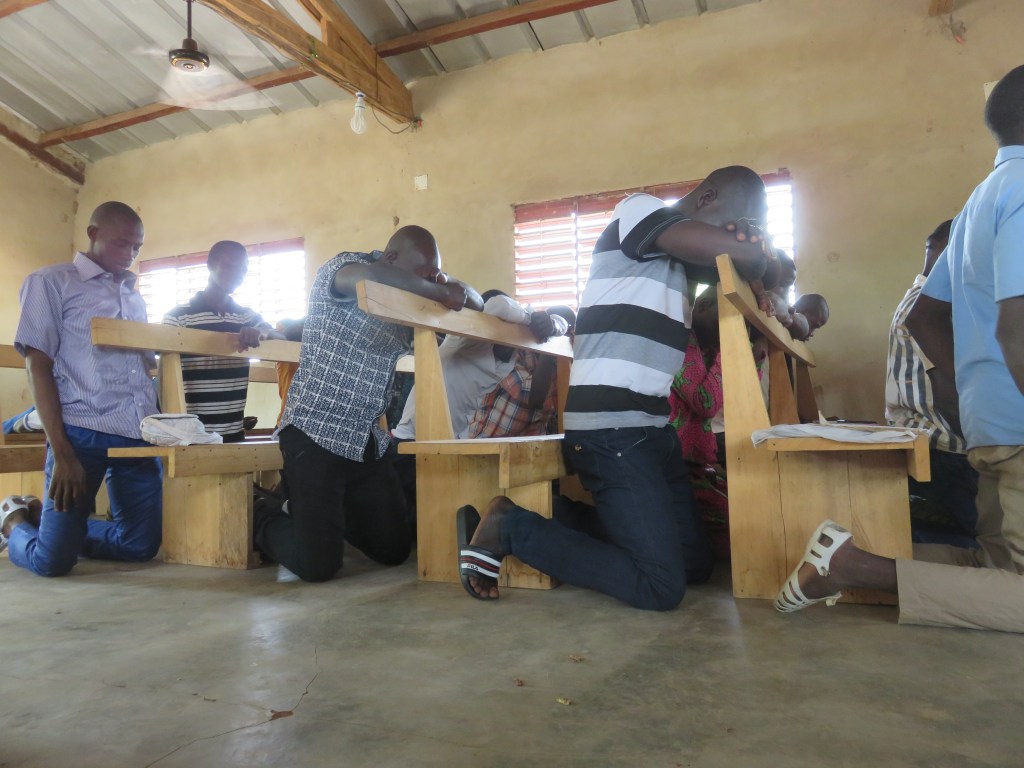
And then a stunning conclusion happened: one of the singers, Koufanhawori, stood and said that he had a song to share. He hummed the tune to the balafon players, who launched a rhythmic flow of notes, and Koufanhawori sang the story he had just heard, a new song composed on the spot! What a way to underline the need for faith in the one and only God!

Most of you know those stories; you have them in your complete Bibles. And most of us are not living out an economic situation where we have nothing left. But put yourself in the place of poor farmers whose crops failed to bring in a profit last year–the cotton was diseased so did not yield, and the price paid for their cashews dropped significantly. They are now waiting for the rains to come so that they can plant the summer crops again. Think of the faith required to give the little money you have into an offering basket so that the pastor and his family can eat too. Think about how desperation can turn our heart eyes away from looking up to the Sovereign God in trust!

This may be a dry season for you, whether it is financial, physical, emotional or situational. But turn your eyes away from the dust and withered leaves to Yahweh, his promises, and trust that the rains will come! He will give signs of hope, of changing seasons—like the golden blossoms suddenly appearing on the dry branches of a leafless tree!

Make Me Ready


Keep a towel on my arm!
Keep me ready to kneel
before my tired friend
to lovingly rinse the dirt glued on
as they kept trudging
through thick and thin,
the rut and puddle,
the stuff that sticks
from where they’ve been,
a long and painful road.

Give my eyes the knack to catch
weariness, hurt within
a gesture or a sigh.
Give me kindness that
moves my fingers, strength
to knead tight tendons loose,
massage sore soles,
de-tense cramped muscles
always leaping up,
sweeping up the dust.

Make me Just like You --
You, who gently bathes
my own tired feet
in balm of Gilead!
You wipe dust away,
cleansing pores
now clogged with grime.
Show me now who needs
their dry feet bathed, who
longs for comfort and relief!

We are in northern Côte d’Ivoire in the dry season, when months pass with no rainfall. The harmattan wind blows down from the Sahara over West Africa, picking up fine dust and sand particles as it goes. A dusty haze covers the landscape and muffles the brightness of the rising sun. Dust drops onto everything: leaves look brown, furniture needs constant dusting.

So during this season dirty feet are the norm, unless you are wearing socks and closed shoes—then those get covered with dust. Of course we want to leave shoes at the door rather than take that extra dust into the house! Washing shoes, at least dusting them off, becomes routine. If you’re wearing sandals then your feet change color, your skin color only showing through where a strap was tightly wrapped around them.

We wash our own feet, and it feels SO good to get them clean. Experiencing this dusty world makes the examples of foot-washing in the Bible very real. Throughout the Old Testament it is part of welcoming visitors (see Genesis 18,19,24,43). Water was supplied for visitors to use to wash their feet. and omitting that showed a lack of hospitality (1 Sam. 25:41; Luke 7:40–50; 1 Tim. 5:10). If servants were present they got the job. Wives were to wash their husband’s feet. It was a demonstration of care and humility.

When Jesus washed his disciples feet (John 13:1-13) he definitely shocked them. He was showing them that he loved them deeply (verses 1-2) as well as giving them an object lesson they would never forget:

2 When Jesus had washed their feet and put on His robe, He reclined 1 again and said to them, “Do you know what I have done for you? 13 You call Me Teacher and Lord. This is well said, for I am. 14 So if I, your Lord and Teacher, have washed your feet, you also ought to wash one another’s feet.1 15 For I have given you an example 1 that you also should do just as I have done for you. 16 ” I assure you: A slave is not greater than his master,12 and a messenger is not greater than the one who sent him. 17 If you know these things, you are blessed if you do them. (Jn. 13:1-13 CSB)

Jesus was the Master who was sending his disciples out. What they had not realized was that they were to have the same kind of compassionate heart that their Master had. When they saw someone with “dirty feet” who needed help getting water and cleaning them up, they were never to consider themselves too highly place to bend down and do the work of a servant. They were to be messengers who were ready to serve.

How many times have I not noticed a way that I could serve someone who just walked through some tough stuff and needs relief? The “foot washing” might be actually physical, like offering a shower and a bed to someone on a long trip. It might also be offering a listening ear to someone overloaded with inner stress or distress, “dust” accumulated by compassion fatigue, carrying heavy loads for others. Maybe they just need a safe space where they can rest.

When I’m busy with my own business, it’s easy to overlook the opportunity to offer that attention. Didn’t Jesus say that just a cup of water might be enough?

And if you give even a cup of cold water to one of the least of my followers, you will surely be rewarded.” (Matt. 10:42 NLT)

I was reminded of that this month when a young woman named Tene (ten-eh) came over to show me her newborn baby, and asked how to spell my name “Linn” since she wanted to give it to her daughter. I had known Tene’s mom for a very long time, helping her through many tough situations. But Tene I had mostly known as the little girl who would stop by my house in Ferke town on her way home from school. She and her girlfriends just wanted a drink of water after the long day, in the middle of the long walk home. And now she wanted to name her baby after me.

I was humbled at this thought. I know I could have done more to show her love. But that cup of water had been enough. She remembered. On Sunday we were at her parents’ courtyard to celebrate their wedding anniversary—13 years together, through thick and thin and lots of poverty, always pushing forward. (They had wanted to do this for their 10th anniversary, but that was during COVID.) Many people had said, when they married, that they would never make it, being just too poor. But they had, and they thanked God. I grabbed little baby Linn and held her for a while. I pray that she will grow to faithfully follow Jesus the way that her grandparents have, and that Tene will as well.

And I pray that I will grow ever more aware of how to reach out in a meaningful way to serve those that the Lord brings my way. “Foot washing” is an image for all kinds of service. The main requirement is to do it in love and with humility.