It is only when shafts of light
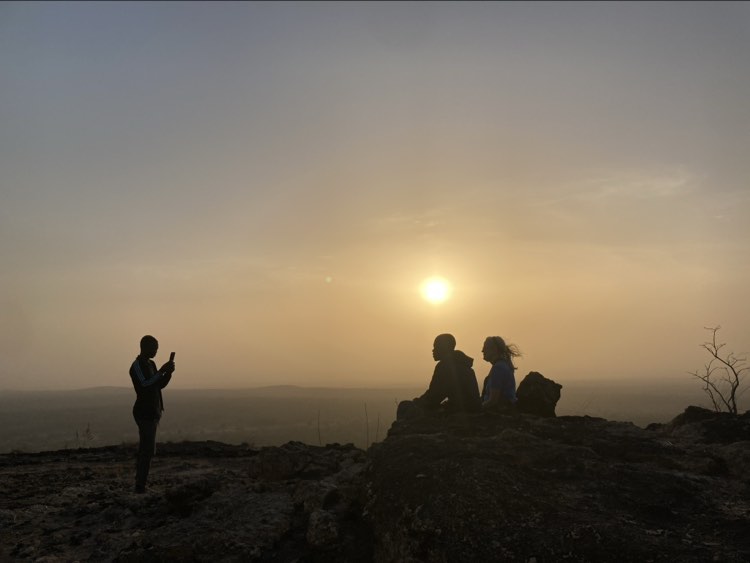
sent from the rising sun
strike the long lean leaf of grass
that you see how finely striped it is:
perfectly paralleled veins tracing
from stem to bowed leaf tips.
Life stripes!

You shine on us, Son, Light
that brings life to your waiting world.
You shine on us and suddenly
we are revealed for who we are:
lithe life-drinking light, soaking foliage
or dried-up worn-out fallen leaves.
Autumn colors are stunning and are made strikingly more glorious when the sunlight hits them. Color tours in Michigan this month have blown me away! But in every season, light “brings to light” what is otherwise hidden, exposing the veins in leaves or a mushroom hidden in fallen leaves. What is in the shadows is less likely to be noticed.
Writing to the Ephesian believers, Paul applied this to the way that God’s light shining in us results in character and actions that demonstrate to those around us that we are his children, “children of the light.” He is light, and when he is living in us his light is also in us and produces the “fruit of the light”:
. . . for you were at one time darkness, but now you are light in the Lord. Walk as children of the light– 9 for the fruit of the light consists in all goodness, righteousness, and truth– 10 trying to learn what is pleasing to the Lord. 11 Do not participate in the unfruitful deeds of darkness, but rather expose them. 12 For the things they do in secret are shameful even to mention. 13 But all things being exposed by the light are made evident. 14 For everything made evident is light, and for this reason it says: “Awake, O sleeper! Rise from the dead, and Christ will shine on you!” 15Therefore be very careful how you live– not as unwise but as wise, 16 taking advantage of every opportunity, because the days are evil. 17 For this reason do not be foolish, but be wise by understanding what the Lord’s will is. (Eph. 5:8-17 NET)
Those who do not belong to God, however, do not want their wicked actions to be revealed. So they do all that they can to hide them. We see this when leaders resist letting files be released that could implicate them, or when a spouse does all they can to keep their partner from discovering what they have been up to in secret. None of this is new:
For everyone who does evil deeds hates the light and does not come to the light, so that their deeds will not be exposed. (Jn. 3:20 NET)
When what we do is in line with God’s truth and goodness, it represents him to the world. This is a high calling! It requires learning what matters to him rather than what comes naturally to us, and results not only in a good testimony to others, but also empowers us to live in loving relationships with others walking in the light:
Now this is the gospel message we have heard from him and announce to you: God is light, and in him there is no darkness at all. 6 If we say we have fellowship with him and yet keep on walking in the darkness, we are lying and not practicing the truth. 7 But if we walk in the light as he himself is in the light, we have fellowship with one another and the blood of Jesus his Son cleanses us from all sin. (1 Jn. 1:5-7 NET)
We still stumble and sin, but we have the assurance that we can be forgiven as we trust in Jesus. If we do not fight the temptations of darkness then we just remain in the dark shadows, “lying and not practicing the truth.” When the light shines on such a person all is revealed—the Lord knows what’s going on, and fake “fellowship with him” is not tolerated. But when he washes us clean, then what the light reveals is his own goodness shining through us as we do what he says and values.
Let’s make every effort to live in the light with him and in harmony with others walking in his light too!
This gargantuan ball we call Earth
twirls on its axis, never stopping.
I’m glued to my point on its surface,
watching as we leave the dark outer universe
and swing slowly, gently into sunlight.
Granulated gray cloud masses
suddenly have rose underbellies—
no! Now they’ve turned to neon gold!

There was a star riding tangent
to the crescent moon; it’s gone,
overwhelmed by greater light.
Gold fades slowly to cream and white
as the last bats fly home,
flecks speckled across the canvas.
The sky turns blue and luminous.

He said that those who walk his path
will shine like the rising sun!
We chase away darkness as we advance,
outshine artificial lights, and gild
reality so that it pumps to life.
We bring growth to plants, winged things.
Space opens up for play and work,
and those who hide in darkness
need to run for cover, sins discovered.

But to shine with power like that
we must have spent time face to face
with Light, the One who lights the world
and makes us radiant, in turn.
We have no light of our own, only
his bright essence of Divine Truth
and Love and Character, completely other.
I sit here in the Presence, begging
to be made absorbent, pleading to become
like that gold orb coming into view,
so full of fire its rays take over
the space between the silhouettes
of tree and walls. Only he can make
a mere mortal shine like that!
Walking around Piatt Lake in the morning brings startling discoveries of beauty, scenes never to be repeated exactly the same way. That’s because the world is turning, wind is blowing, the sky is hosting the rising sun then noonday then eventually evening dusk and night. Each moment is a capture.
Yet the same sun rises each morning! And the same Son is the Light of the world! This is how the disciple John introduced Jesus to his readers:
In the beginning was the Word, and the Word was with God, and the Word was fully God. 2 The Word was with God in the beginning. 3 All things were created by him, and apart from him not one thing was created that has been created. 4 In him was life, and the life was the light of mankind. 5 And the light shines on in the darkness, but the darkness has not mastered it. (Jn. 1:1-5 NET)
We are living in a dark world. But as Isaiah said, alluding to Messiah’s coming:
The people walking in darkness see a bright light; light shines on those who live in a land of deep darkness. (Isa. 9:2 NET)
Light is a powerful image throughout Scripture. Darkness is linked to war, distress, and sin. So after two women, Deborah and Jael, were essential in bringing about victory against Sisera, Israel’s enemy, this line was in the song Deborah and the army’s leader Barak sang:
May all your enemies perish like this, O LORD! But may those who love you shine like the rising sun at its brightest!” (Jdg. 5:31 NET)
This comparison is striking: can those who love the Lord God, Yahweh, shine like the rising sun? There is actually only one way to do that. It is expressed in their song: we must love God! To love him, we must know him. And to know him is to walk with him and follow his lead, to hear his commands and obey them. What he has told us matters and doing what he says is actually living life with him:
Your word is a lamp to walk by, and a light to illumine my path. (Ps. 119:105 NET)
And the person who keeps his commandments resides in God, and God in him. Now by this we know that God resides in us: by the Spirit he has given us. (1 Jn. 3:24 NET)
From the Old Testament to the New Testament it is made clear that God’s word is to be our illumination, showing us how to live and stay on the right path. Then in the New Testament we find that God himself will live in us! We have his light in us, and it can shine through us.
For God, who said “Let light shine out of darkness,” is the one who shined in our hearts to give us the light of the glorious knowledge of God in the face of Christ. (2 Cor. 4:6 NET)
His light fills us with what we need: a life lived knowing God through knowing Jesus Christ. We have his light shining in us, and it can actually shine through us. Consider what Isaiah the prophet said would happen when we actually live out what God the LORD, Yahweh, has been telling us is the essence of becoming a powerful light in the darkness:
“Is not this the kind of fasting I have chosen: to loose the chains of injustice and untie the cords of the yoke, to set the oppressed free and break every yoke? 7 Is it not to share your food with the hungry and to provide the poor wanderer with shelter– when you see the naked, to clothe them, and not to turn away from your own flesh and blood? 8 Then your light will break forth like the dawn, and your healing will quickly appear; then your righteousness will go before you, and the glory of the LORD will be your rear guard. 9 Then you will call, and the LORD will answer; you will cry for help, and he will say: Here am I. “If you do away with the yoke of oppression, with the pointing finger and malicious talk, 10 and if you spend yourselves in behalf of the hungry and satisfy the needs of the oppressed, then your light will rise in the darkness, and your night will become like the noonday. (Isa. 58:6-10 NIV)
Becoming sunrise in this dark world is not a simple step! It requires walking in the light, as our God is in the light, with complete reversal of normal human reactions to the poor and needy, the hungry and the oppressed—ignoring them, letting them suffer. It changes how we interact in the community of other Jesus followers too:
But if we walk in the light as he himself is in the light, we have fellowship with one another and the blood of Jesus his Son cleanses us from all sin. (1 Jn. 1:7 NET)
So think about what happens if we do not walk in the light of Jesus Christ. The poor and vulnerable, the oppressed are neglected. In our churches we ignore each other without intimate communication, or we quarrel. The light does not shine.
May the Savior’s light shine powerfully into each of us and change every dark corner into light! Then we, too, will shine like the rising sun!
Rain slips through the forest
while birch leaves whisper
and earth drinks in sustenance.
God made this day too!
Gray skies absorb the sunshine
to share mild light
with the calm white lake.

The rusty leaf carpet
on the forest floor
sips blessing as it dies
and younger leaves yellow
then swirl gracefully down
like silent charms
to nest and rest in peace.

The Father plans release:
preparation for hibernation
as winter looms ahead.
I am a sponge, too,
soaking in his benediction
as he washes me clean,
made ready for what’s next.
Every year we try to reserve part of October for rest in Michigan’s Upper Peninsula, in the “Chalet Shalom” that my parents built as their retirement home. It is now the legacy they left their descendants. Here we are, now. I sit at an ancient wooden desk in the Pine Room, looking out on forest and Piatt Lake. We just had two days of glorious sunshine. But this morning has instead been drenched with light rain.
The flat gray sky reminds me of the day one of my son’s best buddies, Abou Coulibaly, was visiting me at the translation office in Ferkessédougou, Côte d’Ivoire. I walked him to the door and he fixed his eyes on the sky. “Ce jour est béni ! Le ciel est tout gris !” In English I would say: “It’s a beautiful day! The sky is all gray!”
Would we be likely to say that in American culture? No! We tend to prefer sunshine. Remember that chorus we used to sing:
“There is sunshine in my soul today, More glorious and bright Than glows in any earthly sky, For Jesus is my light. . . (E. E. Hewitt, 1887)
While doing Bible translation among the Nyarafolo people, I found out that a literal translation of that song would communicate something totally different. There in the tropics, the sun beats you up!
I was checking a draft of Mat 5. 45, which says in English: , “so that you may be like your Father in heaven, since he causes the sun to rise on the evil and the good, and sends rain on the righteous and the unrighteous.” (Matt. 5:45 NET) The mother-tongue translator had used a phrase that said: “He causes the sun to shine on the evil and the good.” Those listening to the verse were startled, because to them that wordinig meant he causes punishment to fall on the evil and the good, indiscriminately. He beats them up! We had to change the wording to what was literally in the text: “He causes the sun to rise on the evil and the good.” That was understandable: we all want light to break through!
A few months later at a workshop that brought together multiple translation teams, I was asked to share some of the key issues our team had been addressing. So I brought up this one and threw out an introductory question: “If I were to tell you that I had sunshine in my soul today, what would that mean to you?”
There was confused silence for a moment. Then a man from a neighboring country raised his hand and said: “You’ve got problems, Madame!”
Well, sunshine indicates hardship there, whereas Michiganders get tired of their gray days and long for sunshine!
But here I sit in the cool Michigan autumn, drinking in the peace of quiet rainfall and a haze of gray. I contemplate the way my Lord Yahweh brings the earth its changing seasons and how he has equiped different climates with just the right vegetation—like palm trees and baobabs in West Africa, birches and pines here in northern Michigan. And when the rains come at the right time for each variety of vegetation, they are indeed a blessing.
Let us know, let us strive to know Yahweh; that he will come is as certain as the dawn. He will come to us like a shower, like the rain of springtime to the earth. (Hos. 6:3 NJB)
I love this comparison! When we seek to know Yahweh we can count on him showing up in our lives to shower us with the blessing of nurture. Just as dawn brings sunlight in some form every day, he is right on time, right when we open up to him. And just as the seasonal rains prepare the earth for what comes next, whether it is time for the crop to grow or the dying leaves to fertilized the soil, we can count on him. He comes with what we need, preparing us.
In this space, I need the dissipation of stress and the sense of His presence, renewing me. I am being made ready for whatever is ahead—probably November, which looks like it will be excruciatingly busy. So I rest in this gift. May you also find renewal in the next gray day God sends your way!
It’s the Word that cuts
right through to the quick
to the heart of the matter
through tough scar tissue
and cataract blindness

so that

suddenly the light shines in
healing abscessed recesses
waking somnolent brain cells
pouring nourishment into the soul

and then

exclamations of awe
recognition of truth
delight in the intricate plan
with its certainty of rescue

when heard

for the very first time
in your own heart language
the one your mother spoke
and suddenly you see
Did you know that today, September 30, is officially International Translation Day? In 2017 the United Nations honored language professionals for their devotion to helping connect nations and to pave the way to better mutual understanding and development. It is also recognized by many as World Bible Translation Day ever since the founder of Wycliffe, William Cameron Townsend, and his friend Oklahoma Senator Fred Harris proposed that the House and Senate pass a resolution asking the president to designate September 30 as Bible Translation Day. It never officially passed, but many of those involved in this key facet of translation have been honoring it annually.
September 30th was chosen because it is the “feast of St.Jerome,” the priest who tranlsated most of the Bible into Latin, based on the Greek and Hebrew manuscripts—back in the 400s![1]
Most of you know that the Lord led me into this work of translating his Word into the Nyarafolo language, a ministry I had not expected. I was unaware of the way he was preparing me for this challenge as I grew up, but looking back I see his fingerprints!
One of the earliest preps was my early childhood in Congo, where Kingwana (the “up-country” dialect of Swahili) became not only my second language but my daily language. And my first Bible was a Swahili Bible!
Then my family was evacuated from serious turmoil and we went to Côte d’Ivoire (Ivory Coast). There the multiple languages spoken in our town of Ferkessédougou, and a surprising lack of local friends (they were afraid of Whites after the colonial experience) made language learning rough. I turned to French. But I was intrigued by the different greetings we needed to learn when meeting different people. And when I was in 8th grade, I began accompanying my parents every other Sunday evening to a Nyarafolo village as they helped disciple the first believers in that ethnic group—but they were always using a translator.
Today, September 30, was my mother’s birthday. She has moved to joy in heaven, but this date triggers many memories. And one of them is the way her love for the Bible impacted my own heart. In 7th grade I had made a mature decision to follow Jesus with “no turning back!” Mom was delving into a New Testament translation by J.B. Phillips, and passed one on to me. It was exciting to understand the text and feel it speak to me! I went to boarding school for 8th grade, and my dormparents, Don and Glenna Bigelow, were also sharing that translation with us in devotions. Its English was so clear, so refreshing to my ears!
I realized in college that I was a “word nerd” and majored in journalism, with a cognate in linguistics. My husband and I felt a mutual calling to serve the Lord somewhere overseas, and were appointed by the mission now called WorldVenture in 1977. When they told us that they wanted to send us to Ferkessédougou, where I had spent so many years growing up, I was startled! I would be a “foreign” missionary going back home! The destination was chosen because my husband, a medical technologist, was really needed there to develop a lab for the hospital my parents had helped set up! But the Nyarafolo had been put on my heart, and we chose that language to learn for ministry there.
They were the subsistence farmers living all around the town. The language had never been analyzed linguistically and put in written form. Our Lord led us to relationships in a village where two men were already looking for Jesus, and we began discipling like my parents had: through a translator. I kept studying the language while Glenn was becoming more involved at the hospital, so as I understood more and more what the young man was saying as he tried to translate into Nyarafolo when Glenn preached in French, I realized he had no idea how to communicate key terms in that language about truths they had never heard before, and about places far away that were unknown.
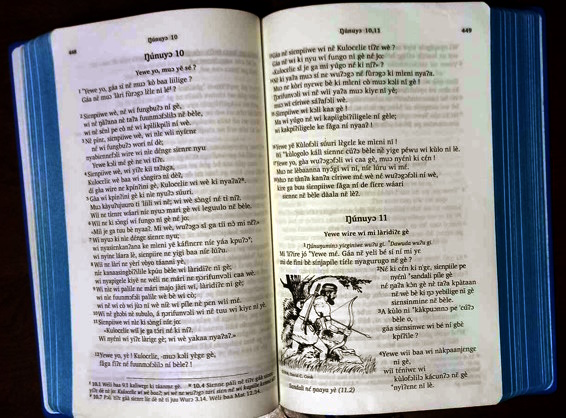
So in addition to plowing through the fascinating linguistic study of the language with help from SIL (Wycliffe) partners Dave and Karen DeGraaf, I eventually plunged into this work we celebrate today: Bible translation! Dave had been instrumental in getting Mark translated, working with young Abdoulaye Ouattara before we then sent him off for training. Convinced that at least the Pentateuch was needed to give the essential background for understanding the Good News of salvation through Jesus, I began translating that with Moise Kone and eventually added the Psalms. We helped Abdoulaye finish the New Testament, and in 2021 we were able to give the Nyarafolo all those sections in print: New Testament, Genesis-Deuteronomy and Psalms.
Working in association with SIL, we were required to test all our drafts in the Nyarafolo community, and then a trained consultant would check our work. That is when “Right Through to the Heart,” the poem above, poured out onto paper. When they heard Luke in their langauge for the first time, the Nyarafolos at the table were astounded, blown away by the messages! And that reaction is constantly ongoing as Moise and I work now on the major prophets. He takes the drafts out to read to people, many of them still locked in traditional worship of other gods—even sacrificing on the “high places” like the people the Lord castigates in his Word. There are many who respond in fear: how does God know about their practices? Believers are astonished that these things are in the Bible, now so very meaningful to them. The Most High God knows all about their practices, yet he is reaching out in love and rescue!
What a blessing that we English-speakers have so much access to the Word! We need to be acknowledging that, digesting the bounty constantly. In addition, we need to support all the active attempts to take the Word to every nation! Pray for the Word to be meaningfully translated and made available to every people group!
LORD, you guide me into right pathways,
chosen for me, leading me home.
You said it.
I believe it.

But LORD, these are mean streets.
The other travelers form cliques,
gossip,
unnerve me.

And you mentioned level paths;
there are potholes here, jagged and deep.
They laugh
when I fall.

Tell them off, LORD -- they are disgracing you.
You sent me here and I wear your name:
Christ-ian,
believer.


The hardest part for me to bear
is that they wear your name too:
Christ-ian,
believer.

The residents of these mean streets
throw dirt into the holes, meaning well.
Temporary.
Useless.

Rain falls and torrents scoop away
the cover-ups.  The pits remain.
We move on
still at risk.

So now, LORD, where am I to go?
I am exhausted and afraid.
It’s dark here
and lonely.

I thought I was a distance runner
With a long, graceful stride.
I’m crawling,
on my knees.

This paradox is too much for me.
I want clean streets, neatly paved,
the company
of friends.


Dear one, I have the map in my hands
but you can’t see it in the dark.
Trust me.
I can see.

This is the one way to get from
here to there, a mean street full of holes
but chosen,
you in mind.

My love hovers, a shelter from storms.
My love covers, protecting from pot shots.
I breathe strength
into your body.

I move your knees (your best feature!)
to worship as they crawl, growing
stronger,
surer.

And just around the corner is relief.
Almost there -- keep pushing on ahead!
It will thrill
your eyes.

So don’t give up! I know it’s hard
But I have plans you won’t want to miss.
These mean streets
are history.
What “mean street” are you on? Suffering comes with life in this broken world: loss, conflict, threats, chaos, disease, pain. The list goes on.
When I wrote this psalm of lament 12 years ago, I was undergoing personal attacks and misunderstandings. I desperately needed my Lord’s sustaining strength. Here are some truths that carried me through that rough journey. Looking back I see that his plans actually were accomplished, in his way and his timing. This increases my energy for navigating this current “mean street.”
When we are working hard to live a life pleasing to Jesus, we need his empowerment. As Paul said, he was actually experiencing joy in the middle of suffering (Col 1:24), just because he was living his life for Christ, accomplishing the mission given him. He was sent to encourage and strengthen the church. So his counsel to the church is essential to all of us who are a part of Christ’s body, the church! His prayers for that community show us what we must pray for ourselves and for our church.
For this reason we also, from the day we heard about you, have not ceased praying for you and asking God to fill you with the knowledge of his will in all spiritual wisdom and understanding, 10 so that you may live worthily of the Lord and please him in all respects– bearing fruit in every good deed, growing in the knowledge of God, 11 being strengthened with all power according to his glorious might for the display of all patience and steadfastness, joyfully 12 giving thanks to the Father who has qualified you to share in the saints’ inheritance in the light. (Col. 1:9-12 NET)
When we unpack that, what we need to navigate the potholes and walk straight includes these key things:
knowing God’s will with spiritual wisdom and understanding
then walking in a way that honors our Lord
producing good results through right actions
knowing God himself more personally, increasingly
gaining patience and perseverance through God’s work in us
strengthened by him, not our own efforts
joyfully thanking him for all he offers us, now and forever
How is it possible to live like this? By unlocking our focus on the problems that surround us and looking up, eyes fixed on him!
Therefore, if you have been raised with Christ, keep seeking the things above, where Christ is, seated at the right hand of God. 2 Keep thinking about things above, not things on the earth, 3 for you have died and your life is hidden with Christ in God. (Col. 3:1-3 NET)
Remember that he is the one who knows what is now and what lies ahead—not only in this life, but he is preparing a perfect world for our forever-life with him! That is our assurance, that he guides us and protects us now, and that he has great plans. And he is “at the right hand of God,” the place of powerful action. When we our lives are “hidden with Christ in God,” we are surrounded by total goodness and sovereign direction.
Life is no longer about ME; it is about HIM: his person, purpose, work, love for me and others.
The road is rough, so we need endurance and patience. He gives us all we need, eyes fixed on him! Converse with him as a way of life, listening for direction and wisdom. He will accomplish his purpose in you and through you!
Be devoted to prayer, keeping alert in it with thanksgiving. (Col. 4:2 NET)
I’m cringing at this growing dump
of insults, hurled in public spaces
or in texts or face-to-face.
Grudges fondled and fermented
could ignite a searing blaze.

Our natural response is fear
and hatred of this “enemy”
whose words and push-back
feed distress, a tangled mess
that leads us toward catastrophe.

But, Yahweh, You have told us this:
“You can walk on waves so high
they crash with stormy energy
 on the unwary passerby!”
--if on you we’ve fixed our eyes.

But can we do this? You said we
must shock a cruel enemy
by answering insults with love!
We need you in our hearts and minds,
empowering us to be this kind!

May eyes be opened, hearts swept clean
as Spirit-wind blows hate away,
and unexpected love reveals
a different world, a Kingdom come
where harsh rejoinders have no sway!
Yesterday I was walking, just after sunrise, down Woodward Avenue here in Detroit with my walking partners. There is a huge metal dumpster parked beside an abandoned building that has been for sale for years. Suddenly I was stunned as I noticed for the first time the words written in bright green on the lower left corner of the dumpster’s back. There it was: “Real Christians LOVE their enemy Matthew 5:44″. Did you see that on the photo above?
I’ve been contemplating that very truth lately and working at applying it in my own life.
When Jesus was preaching his sermon on the Mount, he underlined that doing what he said, what God’s Word says to do, is essential:
17 “Don’t assume that I came to destroy the Law or the Prophets. I did not come to destroy but to fulfill. 18 For I assure you: Until heaven and earth pass away, not the smallest letter or one stroke of a letter will pass from the law until all things are accomplished. 19Therefore, whoever breaks one of the least of these commands and teaches people to do so will be called least in the kingdom of heaven. But whoever practices and teaches these commands will be called great in the kingdom of heaven (Matt. 5:17-19 CSB)
He then went on to list some of those laws and their application, every word shocking to his listeners then and to most of us today as well. Do we even try to live them out? How about this one?
43 “You have heard that it was said, Love your neighbor and hate your enemy. 44But I tell you, love your enemies and pray for those who persecute you, 45 so that you may be sons of your Father in heaven. For He causes His sun to rise on the evil and the good, and sends rain on the righteous and the unrighteous. 46 For if you love those who love you, what reward will you have? Don’t even the tax collectors do the same? 47 And if you greet only your brothers, what are you doing out of the ordinary? Don’t even the Gentiles do the same? 48 Be perfect, therefore, as your heavenly Father is perfect. (Matt. 5:43-47 CSB)
We can only be “perfect” through transformation! And Jesus said that we must love our enemies and pray for those who oppose us in order to be our Father’s children, reflecting him! This requires obedience, doing what goes against our natural grain.
Another section of the Bible that is incredibly difficult to actually obey is chapter 12 of Romans. Why? Because it also contradicts our natural responses and requires us to actually live out that commandment from Leviticus:
“‘Do not seek revenge or bear a grudge against anyone among your people, but love your neighbor as yourself. I am the LORD. (Lev. 19:18 NIV)
19 Do not take revenge, my dear friends, but leave room for God’s wrath, for it is written: “It is mine to avenge; I will repay,” says the Lord. (Rom. 12:1 NIV)
Jesus himself had explained the radical implications of this counter-cultural, counter-natural command. Here the “neighbor” includes even someone you resent and would love to see paid back for what they have said or done. The Old Testament text referenced says we are not to even hold a grudge against them, much less seek revenge. But can we do this?
Paul, understanding the critical importance of this radical love, teaches on it in great depth in chapters 12 and 13 of this letter. First of all he recognizes that loving your neighbor, and also the one who is against you, requires completely giving yourself to God and to his purpose:
Therefore, I urge you, brothers and sisters, in view of God’s mercy, to offer your bodies as a living sacrifice, holy and pleasing to God– this is your true and proper worship. 2 Do not conform to the pattern of this world, but be transformed by the renewing of your mind. Then you will be able to test and approve what God’s will is– his good, pleasing and perfect will. (Rom. 12:1,2 NIV)
Because our God is full of mercy he will empower us to be transformed, completely renewed. It means total surrender to him and his plan, becoming “a living sacrifice.” This is how we become “holy,” sanctified, set apart for him. Our bodily actions are done in surrender to him, and our thinking has entirely different objectives and can discern what God wants.
After discussing many ways in which this can be applied, Paul comes to what is, for many of us, excruciatingly hard. All vengeance must be left to God. We are to do good to the one opposing us, and this results in “burning coals” to be heaped on them!
17 Do not repay anyone evil for evil. Be careful to do what is right in the eyes of everyone. 18 If it is possible, as far as it depends on you, live at peace with everyone. 19 Do not take revenge, my dear friends, but leave room for God’s wrath, for it is written: “It is mine to avenge; I will repay,” says the Lord. 20 On the contrary: “If your enemy is hungry, feed him; if he is thirsty, give him something to drink. In doing this, you will heap burning coals on his head.” 21 Do not be overcome by evil, but overcome evil with good. (Rom. 12:17-21 NIV)
But it is clear: we are not to try to get even! When someone judges us wrongly and hurls an insult at us, we are not to respond similarly. No! Instead, we must meet their need, whatever it is: for nourishment, encouragement, acceptance, hope. If we respond lovingly, the need can be met, like food for the hungry and water for the thirsty.
But what about that person who leaps to an assumption and judges you wrongly? What about those biased words thrown at you that demean your spirituality, ethnicity, your gender, or your social status? How can one respond with “good”?
I recently went through a hailstorm, a few days of being judged as siding with wickedness, all due to a misunderstanding about a point I was trying to make. This is not the first time it has happened—I’m sure you’ve been there too. I felt like those opposing me needed to be put in their place, shown to be the ones who are doing the opposite of building harmony and mutual understanding. These verses in Romans 12 came to mind, and my instinct was to smirk. Hey, if I am kind in return, I can “heap burning coals on their head.” Revenge!
And then I felt that gut-punch from the Holy Spirit that brought remorse. Didn’t the Scripture also say to “not take revenge”? My desire to heap burning coals on them was definitely reeking of revenge. So how does all of this fit together?
I did some digging, and it was worth it. Others have taken time to think this through too. Self-sacrifice (Romans 12:1) is the foundation for being able to live as we should:
“All these commands are rooted in freedom from self-preoccupation and self-infatuation and self-exaltation. And, much more than that—though that is crucial—they are rooted in Christ-preoccupation and Christ-infatuation and Christ-exaltation. “[1]
Living completely devoted to Jesus changes how we view these people who are against us. We see them through his eyes, the eyes of the one who loves them as much as he loves us. We can long for them to be blessed by him, to experience change too, the way we have experienced it. The only way we can get to this goal of wanting the good of that person is to quit focusing on our own need and be totally willing to do what the Spirit guides us to do!
In this case, I knew that I needed to approach a person physically, reach out to them with some gesture of acceptance, acknowledge that my words had not been clearly communicated and try to “speak the truth in love” (Eph. 4:15), then find a way to express personal commitment to caring about their welfare. This time, the Lord actually put me unexpectedly in their presence and empowered me to do it. The result was way better than I had even hoped for: acknowledgement of our need to pursue harmony in the Body of Christ. John Piper again points out how our heart position matters:
“Notice how radical this behavior is. It does not just say: Don’t retaliate. You might use your willpower to do that. You might have all kinds of hateful and resentful and vengeful and prudential motives for not striking back. But the point is not only behavior. The point is your heart, and you can see it in the words, “Bless those who persecute you. Bless and do not curse them.” This is a partial quotation of Jesus’ words in Luke 6:28 where Jesus says, “Bless those who curse you, pray for those who abuse you.” The word “pray” shows that behavior is not the only issue. Prayer is the expression to God of what you long for. So blessing someone is not just the way you treat him. It includes the longings that you have for someone. And Jesus says they are to be longings for good, not longings for a curse. That’s what “bless” means. Bless them and pray for them. Pray for what? Their good—now and forever. And the greatest good is seeing and savoring and showing Christ without end.[2]
It was another learning curve for me, and I left the encounter relieved. I had wanted a positive curve in the ending. I wanted that other person to be relieved that I had not been “on the side of evil.” But how did that have anything to do with “burning coals?”
One possible understanding of the imagery is that showing love to an enemy highlights a contrast to what that person expects. It can be a bit shocking, like “burning coals,” something that puts their own antagonistic words or actions in a different light.
“Nothing pricks the conscience of a hateful person like a soft, forgiving spirit in the one he has wronged (Proverbs 15:1). The “burning coals” that are heaped on his head could be a reference to the burning shame he will feel as his conscience works upon him.”[3]
As these words reveal, the gentle answer is the good that can be the response with a good consequence.
A gentle answer turns away wrath, but a harsh word stirs up anger. (Prov. 15:1 NIV)
On the other hand, one huge thing we do when we return good for cruelty is that we leave the outcome in God’s hands. That is underlined by Paul when he wrote:
19 Do not take revenge, my dear friends, but leave room for God’s wrath, for it is written: “It is mine to avenge; I will repay,” says the Lord. (Rom. 12:1 NIV)
He is the judge, the one with the right to decide what the consequences might be for this person. If they belong to him, he is always in the business of transforming them too, teaching them his way. That is not my job! Here is an example of burning coals used in purification:
Then one of the seraphim flew to me with a live coal in his hand, which he had taken with tongs from the altar. 7 With it he touched my mouth and said, “See, this has touched your lips; your guilt is taken away and your sin atoned for.” (Isa. 6:6-7 NIV)
Yes, burning coals could indicate purification of the wrong that is lurking in the one opposing us. These truths bring us comfort in our growth process. When we do not seek revenge, but the welfare of that person, we are living out the love of our neighbor that is required of us rather than taking revenge or coddling a grudge. This makes our Lord’s heart happy: we are acknowledging him as the one sovereign judge and healer, healing our hurt hearts and also working change in that “enemy.” We may not see it, but faith in him empowers us to let go. And the Spirit empowers us to respond in this unordinary way, and to become transformed too. I am a witness to this process!
But can we do this? You said we
must shock a cruel enemy
by answering insults with love!
We need you in our hearts and minds,
empowering us to be this kind!

May eyes be opened, hearts swept clean
as Spirit-wind blows hate away,
and unexpected love reveals
a different world, a Kingdom come
where harsh rejoinders have no sway!
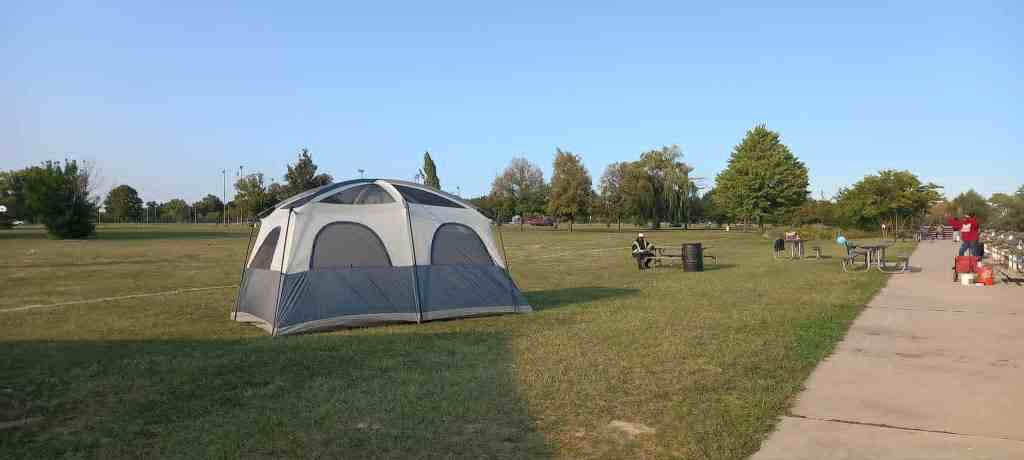
This is my “tent of meeting”
where you meet with me.
No pillar of cloud necessary
because you live in me.
This tent is a protected space
where I pour out my heart
and listen as you respond.
Moses needed time with you,
then left to do your work.
Joshua was being prepared;
he stayed there, meditating
and listening in that solitude.
May I find moments like that!
May I also, like Moses,
be refueled and strengthened
for whatever lies ahead.
And tomorrow I will eagerly
return to our tent of meeting.
No breakfast is as nourishing
as the sound of your voice!
Do you have a “tent of meeting” where you spend time consulting your God, finding direction? I find this picture of a sacred space very applicable to life: a tent is moveable! You can set it up wherever you happen to be. Throughout my life it has often been in my bedroom by a window where the early morning light would incite my love for the Light of my life. But it has also taken on other shapes, like the grove of golden rain trees that was in my courtyard in Ferkessédougou, a “tent of meeting” reserved for Saturday mornings. When traveling, it is wherever I can find solitude, even quietly beside the person sitting next to me on an airplane.
The Israelites had been rescued from slavery and enemy attack and were trecking through the wilderness when God called Moses aside to give him very detailed instructions for building the portable tabernacle that would accompany his people through the desert to their Promised Land. The Israelites had just agreed to the terms of the covenant offered them by Yahweh (Exodus 24), when Moses again climbed Mount Sinai to spend 40 days there with Yahweh, getting the key laws inscribed on tablets and in addition, the detailed instructions for the tabernacle. He came down the mountain with that information and two tablets engraved with the Ten Commandments, but then discovered that his people had given up waiting for him and had disobeyed the terms of the covenant. They had made an idol in the shape of a calf—something visible and tangible to them—and were worshiping it. In order to correct them, Yahweh had to punish them severely. He even had many killed. Moses had to plead with God to forgive them and let them start again; Yahweh graciously agreed and refreshed all the laws and instructions. But it was going to take time to get the beautiful intricately designed tabernacle made.
There was going to be a “tent of meeting” inside the big tent, the space just in front of the curtain that shielded the ark of the covenant law from view. There lamps were burning continually all through the night before Yahweh. It was the place set aside for Yahweh to formally meet with his people. His laws were placed just beyond it, so communication with him would constantly include reminders of what he had already made clear.
But Yahweh had just severely reprimanded the people, saying that their stubbornness and self-devotedness was endangering their relationship with him. Moses needed to make sure that there could be ongoing communication with their God while waiting for the official tabernacle to be completed. He set up a temporary meeting place:
7 Moses took the tent and pitched it outside the camp, at a good distance from the camp, and he called it the tent of meeting. Anyone seeking the LORD would go out to the tent of meeting that was outside the camp. 8 And when Moses went out to the tent, all the people would get up and stand at the entrance to their tents and watch Moses until he entered the tent. 9 And whenever Moses entered the tent, the pillar of cloud would descend and stand at the entrance of the tent, and the LORD would speak with Moses. 10 When all the people would see the pillar of cloud standing at the entrance of the tent, all the people, each one at the entrance of his own tent, would rise and worship. 11 The LORD would speak to Moses face to face, the way a person speaks to a friend. Then Moses would return to the camp, but his servant, Joshua son of Nun, a young man, did not leave the tent. (Exod. 33:7-11 NET)
See, the people were all allowed to go “seek Yahweh” in that tent of meeting, a place of seclusion at a distance from their camp. But they all knew that when Moses himself went to the tent there would be a visible representation of Yahweh meeting with him: a pillar of cloud. They had needed such a sign, something they could see. Each time it appeared it incited each individual to worship right where they were.
Moses was under great strain and he needed that personal intimate meeting with Yahweh, who would actually converse with him. Moses could bring up his questions, God would answer, Moses could ask for clarification or plead for more grace. The Scripture emphasizes that God’s interaction with him was like how “a person speaks to a friend.” This was an invitation to please keep coming! And he did.
Then there is the detail in verse 11 that says that his servant, Joshua, accompanied Moses into the tent, listening. And when Moses finished his conversation with Yahweh, he left the tent, but Joshua stayed! This shows Joshua’s personal dedication to meeting with Yahweh, not just observing. He was being prepared for huge challenges. He desperately needed that personal interaction, and it was given to him.
Some of us are now in positions of leadership; these necessitate personal interaction with the One in charge. He listens, and he responds. We have his Word, and he may point out a passage that speaks to the point. Other times he may use the inner voice of his Spirit convincing us or reminding us of truth that points the way forward. It does not matter where the “tent of meeting” is: it can be anywhere, always available. But it is protected space for intimacy.
Some of us are being prepared for something that the Lord of the Universe has planned for us, and need time set apart with him for renewal and strengthening. For me, those places have often been early mornings by some kind of water, like a river or ocean beach, or in a garden or backyard. When it’s winter and a New Year is coming, you can park your car in a forest or by a river and spend those quiet moments there. When you take a break to prepare for a ministry event or a confrontation, you can take a trip to the nearest park or retreat center and open your heart to sanctuary. Or sit in your bedroom by a window (it reminds you that you are not alone, but part of the Lord’s creation and community), or light a candle in the dark. You can set up your tent of meeting anywhere!
16 Rejoice always! 17 Pray constantly. 18 Give thanks in everything, for this is God’s will for you in Christ Jesus. 19 Don’t stifle the Spirit. 20 Don’t despise prophecies, 21 but test all things. Hold on to what is good. 22 Stay away from every kind of evil. 23 Now may the God of peace Himself sanctify you completely. And may your spirit, soul, and body be kept sound and blameless for the coming of our Lord Jesus Christ. 24 He who calls you is faithful, who also will do it. (1 Thess. 5:16-24 CSB)
Faith:
        which made me your own daughter,
        brings me peace, forgiveness, strength,
        moves the mountains when I trust you,
        coaches me to run the length . . .
Hope:
	which is my light in darkness
	gives me reasons to endure,
	promises you’ll heal what’s broken,
	makes me long for all that’s pure . . .
Love:
	which takes the focus off me,
        reaches out to hug, forgive,
        melts my heart to bow and worship,
        marks the way to truly live!
Are you facing some challenge these days that is a really getting to you? Maybe it’s a dilemma about how to move forward in a relationship in a way that conforms to God’s expectations. Maybe it’s a sudden loss that leaves you spinning. Maybe this world just seems all too dark. We all go through such things.
So it makes sense that the apostle Paul kept referring in his letters to ways to be both protected and ready to fight the battles that come. What intrigues me is the different ways he emphasized three qualities that are essential: faith, hope and love.
In 1 Corinthians 13, Paul explains how no action or ministry that is done without love has any value. Even our confidence in God’s promises for the future will someday find that hope’s work is finished, the day when they are all accomplished. Our current knowledge and hope are important but temporary. And there is that famous last line:
13 And now these three remain: faith, hope and love. But the greatest of these is love. (1 Cor. 13:13 NIV)
Lately it is Paul’s teaching on these same qualities in another one of his letters that has captured my attention: 1 Thessalonians 5:1-11. He begins the section by urging them to be prepared for the return of the Lord. The world is dark and we who are children of light do not belong in this darkness (verse 5). But we are currently stuck here, so we have be alert and ready for battle. If we snooze or get drunk to find comfort, we have no protection and accomplish nothing.
6 So then, let us not be like others, who are asleep, but let us be awake and sober. 7 For those who sleep, sleep at night, and those who get drunk, get drunk at night. 8 But since we belong to the day, let us be sober, putting on faith and love as a breastplate, and the hope of salvation as a helmet. 9 For God did not appoint us to suffer wrath but to receive salvation through our Lord Jesus Christ. 10 He died for us so that, whether we are awake or asleep, we may live together with him. 11 Therefore encourage one another and build each other up, just as in fact you are doing. (1 Thess. 5:6-11)
Here the breastplate, the part that covers our vital organs (lungs, heart, kidneys etc.) is made of two qualities: faith and love. They work together.
Faith keeps our eyes on our Savior, our God, and gives us steadiness when the elements of darkness attack us. In union with our Guide, we know what to do, when to stand firm and when to run with purpose. That is light in the darkness.
Love for the Lord also keeps us firmly attached to him, knowing him more and more, living life together with him (verse 10). It is the energy that empowers us to do the last command in these verses, always doing what is good toward others:
11 Therefore encourage one another and build each other up, just as in fact you are doing. 12 Now we ask you, brothers and sisters, to acknowledge those who work hard among you, who care for you in the Lord and who admonish you. 13Hold them in the highest regard in love because of their work. Live in peace with each other. 14 And we urge you, brothers and sisters, warn those who are idle and disruptive, encourage the disheartened, help the weak, be patient with everyone. 15 Make sure that nobody pays back wrong for wrong, but always strive to do what is good for each other and for everyone else. (1 Thess. 5:11-15 NIV)
Wow! If we would do all that is listed here, we would have amazing harmony in the Family of God, and the love of Jesus would be visible to those not yet in the Family. There would be healing and encouragement. Disagreements over politics or music, for example, would not divide us so easily. Peace and encouragement would lift others up.
And that last line in verse 15, if actually applied, would erase assumptions, impulsive accusations and neglect of needs: “do what is good for each other and for everyone else.” We are to focus on right actions that do good, whether for those in our Christian community or for those outside.
There is yet one other necessary quality in focus: hope. That is our confidence that God’s promises will be accomplished, that he actually is the Sovereign who does everything in his timing and his way to bring about a new world of complete peace and goodness. And not only is that hope for a future that may be distant, but hope that matters right now: assurance that he has saved us, is indeed in us and is guiding us through this darkness. How is it a helmet? It protects our minds, all our thought processes. When we go through times of suffering, we know we are not alone, and that with his presence and empowerment we can endure whatever it is.
These three, faith and hope and love, are a trio that works together in us. This New Jerusalem Bible translation states it clearly in this verse:
7 [Love] is always ready to make allowances, to trust, to hope and to endure whatever comes. (1 Cor. 13:7 NJB)
Love in action changes our relationships, keeps faith our solid foundation, and empowers us to endure due to our assurance, our “hope,” that God is in control and his love will pull us through.
I saw this happen when I was going through a tough phase with a coworker. It was tempting to give up, to avoid seeing him so that I could avoid his judgments, to wonder how this brother in Christ could treat others with such disrespect. The Lord convicted me that I was giving up on love, giving up on doing that tough job of warning someone in such a way that they feel loved, giving up on believing that his Spirit could intervene if I just followed those promptings I wanted to ignore. I finally set up a one-on-one encounter, my own heart trembling, and broached the subject with some gentle questions that had been written on my heart through months of prayer. To my delight, there was difficult but revealing sharing, significant steps toward mutual acceptance and appreciation, forgiveness and encouragement. And it was followed by celebration instigated by my coworker!
Looking back, it was truly faith and love that were covering my heart as I nervously approached that discussion. I am naturally extremely sensitive, but that day my sensitivity turned from me to him, to understand where he was coming from. That was the Spirit at work. And it was the confident assurance that the Lord could bring reconciliation—hope founded on his promises and his character of love—that empowered me to do what I did not want to do, left on my own.
I am still learning how to keep this breastplate and this helmet in place every day. What is key for us all here is this: when we take our focus off self, knowing Jesus better and better, he shows us how to be light in the darkness and alert every moment to what he wants to accomplish through his gifts of faith, love and hope.
Your heartbeat
spins the
galaxies
and pats my back to calm me.
You are so good,
and true,
and I am loved by you.

Compassion is
the constant
instant
outflow of your heart
in perfect sync
with wisdom,
beyond myopic sight.

I’m nesting here,
the shuffling
hush of
angel wings subduing other sound.
This quiet
without answers
is the peace that heals my wound.

And yet your Word
hangs wholly
in the air
and fills my mind with echoes
rippling whispered
and profuse
as they diffuse into my soul.

My waiting place
my chosen
in-between
is here within the everlasting arms.
Do you remember the comfort you felt when you were a toddler sitting on your parentɛs lap? Or maybe you have a recent memory of holding a small child (maybe a son or daughter, or a friend’s toddler) on your lap, their head resting quietly on your chest. I treasure my memory of the last time my son woke up from his nap and ran to me to crawl up on my lap and lay his head against me, because that day his legs were so long they dangled almost to the floor. I was right: it didn’t happen again.
Precious memories like those can help us understand the imagery in the Scriptures about finding comfort in God’s arms, even against the chest of the King. That requires having the same trust and close attachment to him that you had to your parent when you rested on their lap. Consider the implications:
A Song of Ascents. Of David. O LORD, my heart is not lifted up; my eyes are not raised too high; I do not occupy myself with things too great and too marvelous for me. 2 But I have calmed and quieted my soul, like a weaned child with its mother; like a weaned child is my soul within me. 3 O Israel, hope in the LORD from this time forth and forevermore. (Ps. 131:1–3 ESV)
Only a couple of English translations have kept the imagery that is clear in the Hebrew: “a weaned child”! I realized why it gets disregarded when I was in seminary studying Hebrew poetry about 20 years ago, and the professor brought up this psalm.
“It doesn’t really matter that you render it ‘a weaned child,’ he said. ‘What matters here is the relationship of a child and their parent.”
It was a classroom full of men, so as I looked around no one else was showing any reaction. I had raised three children, breast-feeding each one. “Weaned child” said something to me!
I raised my hand. “I think it does matter,” I said. “I see a good reason why the psalmist (David) was so specific. When you are still nursing a child and you hold them against your chest, they tend to root around looking for milk, rather than lying quietly against you. Once they are weaned, they no longer do that. They rest!”
The students looked startled but enlightened. I realized it could be normal for a man not to realize the relevance of the child being weaned. And breast-feeding was not something everyone would have been intimately familiar with in this country, the U.S.
The image is truly full of meaning. It underlines complete submission to the parent, and trust. Here the child of God is not like a baby that is frantic for milk to be calmed down. The psalm is “drawing an analogy between the child which no longer frets for what it used to find indispensable, and the soul which has learned a comparable lesson . . . It is freedom . . . from the nagging of self-seeking, and as verse 3 would add, from the bondange of delusive frets and fears.”[1]
Maybe you are facing a dilemma or a challenge that is wearing you out. You can run to the Father and spend time “on his lap” and find comfort in that safe place. Your heart needs to be like a child’s, not needing instant answers to what is “too great and too marvelous for [you]” (verse 1). As we go to the One who knows everything and loves us beyond understanding, we can give it over to him and wait for him to do his work.
I am currently in such a place: my ministry of Bible translation is hanging by the threads for lack of adequate funding (the entity that has supported us generously for years is now lacking sufficient funds!). I do think about it, wondering how the Lord is going to work things out this time. I remember how over the years he has kept it going in stunning ways, through war and a devastating fire, through severe injuries and illness hindering a worker from engaging for a long while, through the heartbreaking revelation of sin in the life of one team member years ago. It is God’s project. He is in charge.
This recent sudden discovery of our fragile position could have blown me over—and I wondered why it did not. I pray daily, with others. And there is a peace inside me that I cannot explain except by this analogy of resting on my Parent’s chest, sitting on his lap. It sounds risky to think of myself in that position. He is, after all, in charge of millions of other sons and daughters too, and busy with his plans all the time. But he gives me, and you, this gift beyond comprehension: instant access any time to him and his comfort.
I wrote the poem above 24 years ago, and I’m so glad Father God had put it in my heart. One year later war started where we lived, and we were under fire. We evacuated, with no idea what the future would hold. Looking forward at that time, there seemed to be no assurance that any of our plans would ever be accomplished. Looking back we can see how our Almighty God worked out his plan. True, it has been another long stretch of ups and downs. I am so grateful that I can run to him and soak up grace, there in his arms, my head against his chest!
Like Israel back in David’s days, we must“hope in the LORD from this time forth and forevermore” (verse 3). Always! Turn to him in childlike submission and find rest!
You are my shade
when the sun beats down with tropic heat,
when its beams creep in like crafty spies,
when it hides its face but penetrates.
You are my shade.

You are my shade
when the enemy blasts with full attack,
when he sneaks in wearing a new costume,
when he comes behind me to whisper lies.
You are my shade.

You are my shade,
fanning me with your Spirit breeze
and the summer scent of the waving grass,
soothing my heart with love and peace.
You are my shade.
Life in the tropics taught me to treasure shade as grace from God—a grace not ever to be taken for granted!
A crucial moment that underlined this came several decades ago when we were traveling north in Mali, the country across the northern border from our home in Côte d’Ivoire. My daughters were about seven and three years old. In the middle of a desert wasteland our car broke down. Glenn flagged down one of the few passing mini-vans and hitched a ride to the next city to get what was needed. There I was in the middle of “nowhere” with the girls.
It was too hot and stuffy to sit in the car. We saw a tall rock nearby, maybe six feet high and a yard across, and settled in its shadow. My girls grabbed whatever they could find in the sand around it, sticks and stones mostly, and began building an imaginary world. We were there for a few hours, moving slightly as time passed and the shade shifted, oh so grateful for that protection! Finally Glenn returned and fixed the car. We took off, but the powerful imagery of shade as protection had taken on deep meaning for me.
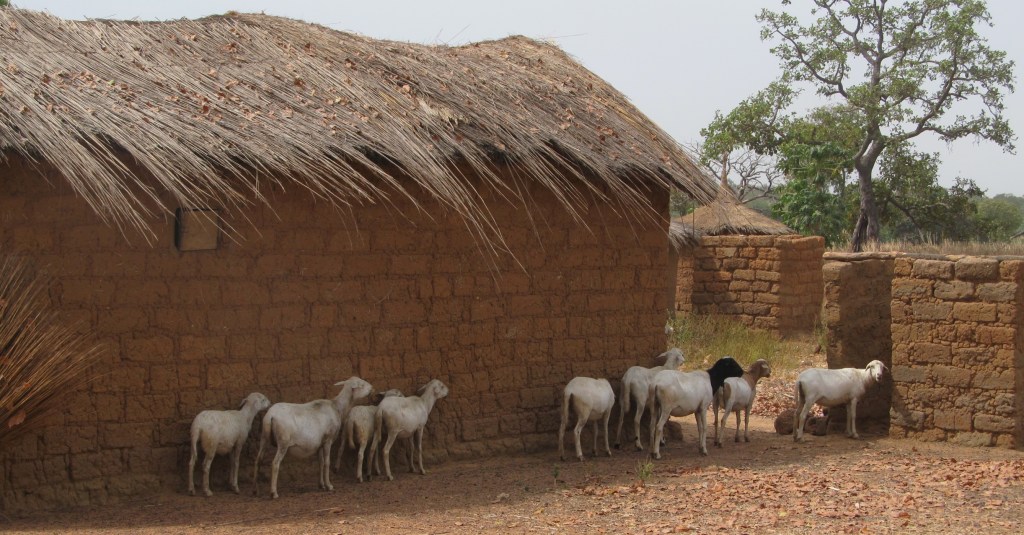
Like the sheep in the village in the photo above, when the sun beats you up you take whatever shade you can get. The sun’s rays are viewed by nationals in that West African area as so vicious that they cannot use Western imagery like what was in a chorus we used to sing: “There is sunshine in my soul today, so glorious and bright!” I asked a group of Bible translators from several different language groups what they understood when I said those words (in French). There was silence, then finally one man raised his voice and said: “You’ve got deep trouble, Madame!” They agreed, though, that when the sun rises and disperses the darkness it is a very good thing, so you just have to be very careful whether you say “the sun shines” (it beats you up!) or “the sun rises.”
That explains the power of the shade imagery used in the Bible to describe God’s protection:
O LORD, you are my God! I will exalt you in praise, I will extol your fame. For you have done extraordinary things, and executed plans made long ago exactly as you decreed. 2 Indeed, you have made the city into a heap of rubble, the fortified town into a heap of ruins; the fortress of foreigners is no longer a city, it will never be rebuilt. 3 So a strong nation will extol you; the towns of powerful nations will fear you. 4 For you are a protector for the poor, a protector for the needy in their distress, a shelter from the rainstorm, a shade from the heat. Though the breath of tyrants is like a winter rainstorm, 5 like heat in a dry land, you humble the boasting foreigners. Just as the shadow of a cloud causes the heat to subside, so he causes the song of tyrants to cease. (Isa. 25:1-5 NET)
That was how Israel felt when they knew God had saved them from tyrants! This psalm also echoes the theme:
I look up toward the hills. From where does my help come? 2 My help comes from the LORD, the Creator of heaven and earth! 3 May he not allow your foot to slip! May your protector not sleep! 4 Look! Israel’s protector does not sleep or slumber! 5The LORD is your protector; the LORD is the shade at your right hand. (Ps. 121:1-5 NET)
Those are just two examples. They speak to those of us who are dealing with some kind of distress, whether it be conflict, loss, danger, overwhelming work, or any other hard situation. If we keep standing where the heat waves beat down on us, we get burned or completely dried up. We need to turn our hearts to the respite of the shade that our Yahweh, shelter and protector, offers us constantly. He is always at our right hand, the hand involved in action. He is constantly beside us. He is our shelter, even when we are active, moving around to do what he gives us to do.
His love reminds the psalmists of the imagery of a mother hen’s wings that gather her chicks in close comfort, the shadow of her wings:
How priceless is your unfailing love, O God! People take refuge in the shadow of your wings. (Ps. 36:7 NIV)
Like sheep thirsty for whatever shade they can get, like chicks scrambling for refuge in the shadow of mama’s wings, like little kids happily playing in the shade of a rock in the desert, we know where to go for the protection we need:
Whoever dwellsin the shelter of the Most High will rest in the shadow of the Almighty. (Ps. 91:1 NIV)
Turn there, live there, and persevere through the heat in his perfect shade!






 Linnea's Lines