Open Home

The travelers walked in the door,
hot and dusty after hours on dirt roads.
Mom always found room at the table,
one built for her by Dad, big enough
to welcome at least a dozen guests.
She added another vegetable, salad, bread—
done! There was always enough.

Then, grown up, it was my turn.
I learned to serve the local friend
who showed up right at mealtime,
thirsty, hungry, startled that we knew
an open home was an essential virtue,
a demonstration of community,
a value held dearly: a test of character.

Our village friends showed us more,
caring for us when we stayed all night.
A brother would move out of his hut
so that we could rest in that space.
Or a sister would open her hut to me
along with other sisters at a long event.

They had little, but love was overflowing.
We were even given names, accepted
as one of them. Open hearts welcomed us.
We kept on learning, opening our own door
to bring in visitors, to honor Family.
It became our way, too, as it should be:
“Love your neighbor as you love yourself!”


We all just had our Thanksgiving holiday here in the U.S., a time that celebrates hospitality—especially in the delights of great food. Many of us traveled long distances just to be reunited with family or special friends, or else we were welcoming them into our homes. It was definitely a season for sharing!

Back in Ferkessédougou, we learned that sharing our space and welcoming visitors had to be far more than seasonal. Our front door was unlocked from 7 a.m. to 8 p.m.—but if we heard that “Ko ko!” call after that, we needed to be ready to go see who was there. The biggest change I felt every time we came back to Detroit was how rare it is to have an unexpected visitor. To be honest, I often needed that respite for a while. Then I would begin to miss it.

I know one thing the Lord was teaching me throughout my childhood as a missionary kid, then as an adult in that same culture, was how to live in community even in my own home. It was a necessity if we were to be accepted as good people. Someone who spent too much time alone behind closed doors was viewed with suspicion. What were they up to, in secret? But someone who had an open door was seen as a safe place.

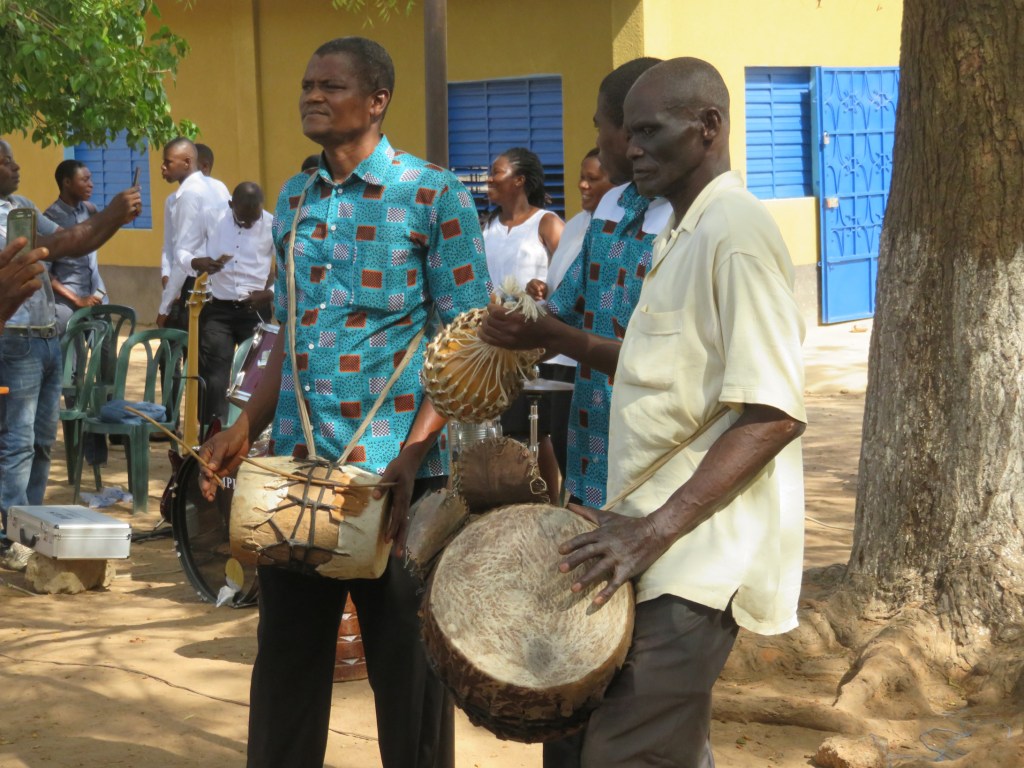
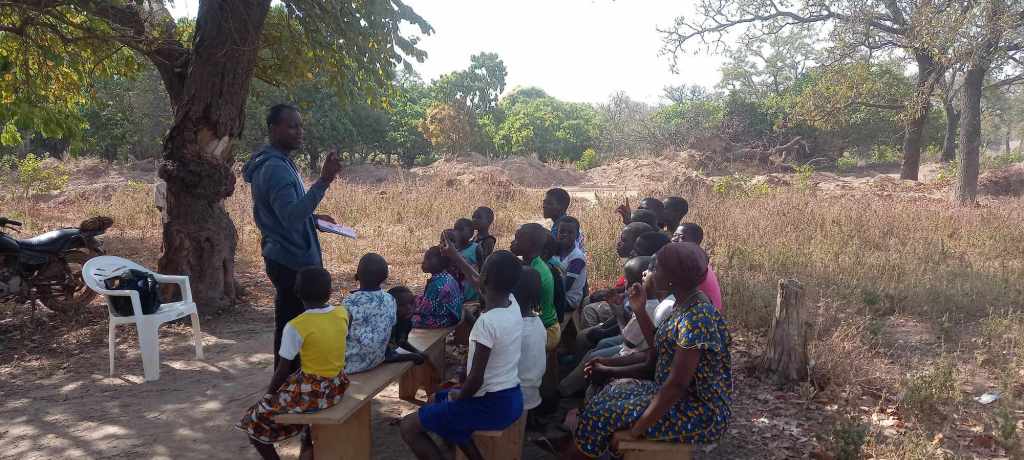
Yes, the Nyarafolo people lived that out for us whenever we were in what became “our” village, the place our in the “bush” where they lovingly taught us more Nyarafolo and welcomed the bumbling strangers into their lives. Then, when many joined the Family of Jesus, they hosted brothers and sisters (including us) for Bible conferences and special events, like baptisms. Staying overnight on a mat on the floor, in the dark, with the latrine across the courtyard, being served hot leftovers for breakfast—it all demonstrated that whatever we have can be shared.

Fortunately God gave me a husband who has a gift of hospitality and found it easy to welcome the visitor. He eventually even handled those who were not real friends, not even “angels” that we might welcome unawares (Hebrews 13:1,2), but were outsiders come to take advantage of us. Those things did happen. It required discernment and a heart ready to accept people. It was a learning curve.

Given all the opportunities, I eventually read Open Heart, Open Home: The Hospitable Way to Make Others Feel Welcome & Wanted, by Karen Mains. It affirmed for me that there are multiple ways to practice the open home, from spontaneous simple opportunities to long-term ones.

There came a time when the first Nyarafolo pastor, a “son” from that village that had welcomed us, was returning for ministry but had not found a place for his family to live. His wife and children moved in with us for a year, a community arrangement that brought us into a kind of intimacy that would have been impossible otherwise. It happened a second time too, with the next village “son” who came back to this least-reached people group to plant a church. The Lord was showing us how he could use an open home for his special purposes. It did not put us out—rather, we gained yet more close relationships, and it taught us more about what an open home could do for his glory:

Therefore welcome one another as Christ has welcomed you, for the glory of God. (Rom. 15:7 ESV)

The culture is different in the States, but we have been shown the same hospitality here. We came back on “home assignment” for a year without a place to stay, and the pastor of our home church took us in. His wife became a close friend, our children became brothers and sisters. Another time, evacuated from war, a family took us in, sharing their home in a lovely lakeside setting. Rest, safety, open home! One of our daughters even had her wedding reception on their front lawn.

And then during our many travels, numerous homes were opened to host us for meals or overnight. Over and over we were blessed by people sharing their space and love for the Lord, with us as travelers in and out of their lives.

All of these experiences only underlined for me what a gift it is when God’s children truly practice the kind of love we are urged to have, love that goes beyond affectionate feelings to actions that demonstrate communal love beyond the “norm”:

May the Lord make your love increase and overflow for each other and for everyone else, just as ours does for you. (1 Thess. 3:12 NIV)

Keep on loving one another as brothers and sisters. Do not forget to show hospitality to strangers, for by so doing some people have shown hospitality to angels without knowing it. (Heb. 13:1,2 NIV)

Yes, we are to show that love to our brothers and sisters. We are also to show it to “everyone else,” even strangers that may land at our door! Of course, we need to have the discernment that is able to turn danger away from our home. But the Lord can give insight so that we know when it is right to invite the stranger in.

Recently a heavy woman lumbered up the steps onto our porch and rang the doorbell. We were at the dining room table. I jumped up and opened the door, wondering if this was another one of those “Witnesses” that occasionally happened by. No! This one introduced herself as someone who had grown up in the house we now live in. She had been visiting a friend down the street, who told her about this family that had moved in, and she wanted to meet us and see how the house had been rehabbed. It turned into four hours of deep sharing on both sides, a bonding that we hope will last. What if we had not opened the door?

Adele Calhoun points out that true hospitality, practiced for spiritual formation, consists of “loving, not entertaining, the guest,” and “sharing your home, food, resources, car and all that you call your own so that another might experience the reality of God’s welcoming heart.”[1]

Who have you known that has shown this to you or your family? How has this impacted you? How is the Lord prompting you to serve him this way? How have you already practiced it? It is different for each of us, depending on our resources and where he has placed us. Yet he wants us to have that love that overflows, that reaches out to others in our community or even to the stranger.

This brings honor to him!


[1] Calhoun, Adele Ahlberg. Spiritual Disciplines Handbook: Practices that Transform Us. (Downers Grove, Illinois: IVP Books, 2005), p. 138.

Thankful for Thanksgiving

simple pleasures
precious treasures
etched into the picture gallery
of my nomad soul
so often elsewhere
but now savoring this moment
soaking up laughter
the fun of spontaneous puns
and crazy card games
twenty-two cards in my hand
while the child on my lap
tells the table what I hold
and we play anyway
truth be told
it's better this way
gluing generations together
with turkey and apple pie
telling stories of days gone by
dancing with a toddler
bouncing in my arms
hugging warmly at the door
knowing we'll have more
of these days of grace together
falling into bed
exhausted and exhaling joy
full of gratitude
enough said—it's all a gift
That was Thanksgiving 2016! Yes, my “nomad soul” was “savoring this moment,” deciding to be grateful even though soon there would be separation. That was the hardest part of missionary life: leaving loved ones, knowing that the next holidays would be drastically different. But that awareness of the gracious gift of time with them was restorative. I was learning how to be grateful for each gift, storing up loving memories instead of only bitter ones.
simple pleasures
precious treasures
etched into the picture gallery
of my nomad soul
so often elsewhere
but now savoring this moment
soaking up laughter
the fun of spontaneous puns
and crazy card games
twenty-two cards in my hand
while the child on my lap
tells the table what I hold
and we play anyway
truth be told
it's better this way
gluing generations together
with turkey and apple pie
telling stories of days gone by
dancing with a toddler
bouncing in my arms
hugging warmly at the door
knowing we'll have more
of these days of grace together
falling into bed
exhausted and exhaling joy
full of gratitude
enough said—it's all a gift

That was Thanksgiving 2016! Yes, my “nomad soul” was “savoring this moment,” deciding to be grateful even though soon there would be separation. That was the hardest part of missionary life: leaving loved ones, knowing that the next holidays would be drastically different. But that awareness of the gracious gift of time with them was restorative. I was learning how to be grateful for each gift, storing up loving memories instead of only bitter ones.

Where are you this Thanksgiving? Maybe you are surrounded by family or friends, enjoying the feast and laughter. Maybe you are glad that one relative is still available to come over for the day. Maybe you are sick, unable to gather with others or have them with you. Maybe you live where “Thanksgiving Day” is unknown, and life just goes on.

What can fill your soul, your inner being, with its own thankfulness? All of us need to contemplate that, even those of us surrounded by our loved ones and enjoying turkey and pie. It is easy to just float through the ritual without remembering what it really is all about.

This became clear a few days ago when I was informing my translation coworker over in Côte d’Ivoire that I would not be available for our long-distance work this Thursday, since it is a national holiday here, “Thanksgiving.” “Wow,” he said. “So does the whole country give thanks to God?”  I had to explain that the original goal, when it was put in place long ago, was to thank God for the harvest. He understood that; harvest is over now in that region, too. But now the holiday is mostly about food and family. Gatherings. Most of the people in the U.S. are not focused on God as Provider. He is not real to them.

For those of us who do know him, Thanksgiving can remain a crucial time for practicing gratitude. The world is truly broken, falling apart through wars, controversies, inhuman hate crimes. But we can turn our eyes away from that and take time to be grateful for what we have. If someone were to ask you what you are grateful, what comes to mind first? It often helps to ask a question like that when you have family or friends gathered at your table:

  • What really good thing happened to you this year?
  • What was a difficult experience that taught you something important, that you are grateful for?
  • What has the Lord been teaching you?
  • What are you thankful for about him, your Father and Master?
  • What do you appreciate about a person at this table?

Depending on who is there, we can choose to guide the conversation appropriately toward gratitude.

We can also reach out to others who are shut in, or far away (given the benefits of technology). We can let people know what we are thankful for when we think of them.

No matter what is going on in our lives, we can thank God for who he is and his gracious love. Here is a psalm that has guided me in thanksgiving. We can personalize it, adding in the ways that we have seen the Creator’s handiwork around us or his sovereignty in current or past world events. He has always been King of the Universe and always will be. And the best part of that is this truth: His love endures forever. It shows up in all sorts of ways, if we pay attention.

Give thanks to the LORD, for he is good. His love endures forever.

 2 Give thanks to the God of gods. His love endures forever.

3 Give thanks to the Lord of lords. His love endures forever.

4 to him who alone does great wonders, His love endures forever.

5 who by his understanding made the heavens, His love endures forever.

 6 who spread out the earth upon the waters, His love endures forever.

 7 who made the great lights– His love endures forever.

 8 the sun to govern the day, His love endures forever.

9 the moon and stars to govern the night; His love endures forever.

10 to him who struck down the firstborn of Egypt, His love endures forever.

11 and brought Israel out from among them, His love endures forever.

12 with a mighty hand and outstretched arm; His love endures forever.

 13 to him who divided the Red Sea1 asunder His love endures forever.

14 and brought Israel through the midst of it, His love endures forever.

15 but swept Pharaoh and his army into the Red Sea; His love endures forever.

16 to him who led his people through the wilderness; His love endures forever.

 17 to him who struck down great kings, His love endures forever.

18 and killed mighty kings– His love endures forever.

 19 Sihon king of the Amorites His love endures forever.

 20 and Og king of Bashan– His love endures forever.

21 and gave their land as an inheritance, His love endures forever.

22 an inheritance to his servant Israel. His love endures forever.

 23 He remembered us in our low estate His love endures forever.

 24 and freed us from our enemies. His love endures forever.

25 He gives food to every creature. His love endures forever.

26 Give thanks to the God of heaven. His love endures forever. (Ps. 136:1-26 NIV)

A Confluence of Soulmates

We believe, she and I, 
so streams of living water 
flow from within
and mingle in profuse display:
splash of sympathy, 
sparkle of delight,
mellow liquid comfort. 
Spirit meets Spirit
and waterfalls rush to embrace, 
clarity leaping with grace
to wash over souls and leave us 
limpid, rippling, blessed.


The gift of a friend who is a true “soulmate” is to be treasured. Sometimes it seems like a gracious blessing from the heavens, unexpected and yet exactly what was needed. Several “sisters” have come alongside me like that; I’ve seen the same thing happen to my husband and other men, although it seems less frequent with them.

What is so special about it? I believe it is based on what Jesus himself said:

Whoever believes in me, as Scripture has said, rivers of living water will flow from within them.”1 39 By this he meant the Spirit, whom those who believed in him were later to receive. (NIV John 7:38-39a)

The Spirit of God lives in the true Jesus-follower, and that means springs of living water are in his inner being. In Jeremiah 2:12 God calls himself “the spring of living water.”

So when he is in us, we ourselves are drenched in unending spring-fed water:

The LORD will guide you always; he will satisfy your needs in a sun-scorched land and will strengthen your frame. You will be like a well-watered garden, like a spring whose waters never fail. (Isa. 58:11 NIV)

We are strengthened, made healthy and fruitful. When two people get together who are living this reality, that connection between them can be so refreshing that it is astonishing. They can share the refreshment that comes from those streams of water! That is what I was writing about in the poem above.

This week I’ve been reminded of that truth while my cousin, Karen Slater Cole, has been living with us. She and her husband came to Michigan to participate in our church’s Global Missions Fest and we grabbed the opportunity to offer them housing. Karen is much younger than I, but we have shared roots from growing up in Ferkessédougou, Côte d’Ivoire, both MKs (missionary kids) whose dads were brothers. And we both love Jesus and have spent our lives growing in him. So in spite of the years we’ve spent in different places without much connection, time together has led to an overflow of those inner springs of living water. I am refreshed, my thirst quenched.

It’s not that I don’t have other friends who are like springs of water to me—I am blessed with some near me and other far off. Each connection is one where “Spirit meets Spirit,” since he lives in both of us, and our own essential beings are encouraged.

But there have been seasons when I was in a literal sun-scorched land, feeling very alone due to dry relationships. Distance and ministry often led to long stretches like that. And sometimes coming back to the United States would seem like entering a desert, especially when friends who had been essential companions before had moved away. I would cry out in desperation to my good Lord to meet my need, and he did. Once it was a sweet older woman in church who came up to me to let me know that the Lord had been prompting her to reach out to me so that we could meet regularly for prayer. Another time it dawned on me that a former acquaintance would probably be one who could be more than just a friend, and I reached out—to my delight, it became far deeper than I ever expected.

What I was learning along the way, with many more instances I could describe, is that our Master treasures those connections too. Reaching out to develop them is actually viewed as another practice in spiritual formation. As Tim Keller puts it, when Jesus told his disciples they were more than servants, they were friends, he meant that their relationship was deeper and stronger, precious to him. It is a discipline of friendship that grows through constancy and intimacy. It doesn’t just “happen,” in most cases it takes work.[1]

We are to help each other carry heavy loads:

Carry each other’s burdens, and in this way you will fulfill the law of Christ. (Gal. 6:2 NIV)

Keller explains that fulfilling Christ’s rule for life is to give yourself for others, like he did for us. It may even feel draining at times when the other needs to debrief after going through tough times, since it includes truly giving away some of your own emotional resources to encourage this spiritual friend.

But it often becomes mutual burden-bearing, opening a door for receiving encouragement as well. That relationship is what I call being “soulmates.” You are spiritual friends when you are both walking in the Spirit and sharing that life together.

It is different from mentoring or discipling someone, which is also a great relationship but involves one leading the other, although those relationships can become truly mutual, on a shared path.

These are five pieces of developing a soulmate relationship that are helpful:

  1. Caring: In healthy friendships, we care deeply for our friends, seeking to hold them up in their weak places.
  2. Accepting: We learn to lovingly accept each person’s heart and gifts.
  3. Serving: We develop the desire to serve those around us.
  4. Offering Hospitality: We reach out in hospitality, providing a safe and warm space for our friends to be with us.
  5. Encouraging: And above all, we learn to live in the rhythm of encouragement, speaking life and hope often.[2]

When we concentrate on living out these elements in a healthy way with a fellow believer, we are “building each other up:”

Therefore encourage one another and build each other up, just as in fact you are doing. (1 Thess. 5:11 NIV)

Sharing those “springs of living water” definitely fills us up in a delightful way that helps us grow stronger! It is worth the effort!


[1] Keller, Timothy. “Spiritual Friendship,” November 22, 2023  https://podcast.gospelinlife.com/e/spiritual-friendship/

[2] Found at https://www.navigators.org/resource/spiritual-friendship/ Content adapted from Becoming Gertrude: How Our Friendships Shape Our Faith by Janice Peterson. Copyright © 2018. Used by permission of NavPress, represented by Tyndale House Publishers, a Division of Tyndale House Ministries. All rights reserved.

Contemplation: Your Love Calls

If you did not love us
we would not exist.
If you did not woo us
we’d not come to you.
If you did not call us,
we’d never find you.

So yes: you do love us!
You woo us with singing,
your voice whipping through
every blast, each storm,
to draw us so close
we can hear your heart.

And you insist that
we love you back!
This is not just
a one-way street;
mutual love is
where we meet!

When we love you
with all that we are,
we’re firmly bonded,
no holds barred—
we are all yours
and you are ours!

When I think back on the years I have spent on Bible translation, I am inexpressibly grateful for the way it forced me to dig into the Word in ways I never would have otherwise. It kept me on a learning curve!

I had an opportunity to share some of that the other night with a community of women, and putting together that message clarified for me how certain themes interlocked. We often had to do intense searches in the commentaries, dictionaries and other resources to fully understand a term. Then we had to look for clear ways to express the meaning of the text in Nyarafolo.

The greatest commandment was one that we had encountered in Mark, the first book translated, then in Deuteronomy. It had been interesting to find out that the “heart” was not the center of emotions or thinking among the Nyarafolo. A literal translation would have meant little to them! And did the Nyarafolo consider a part of a person to be their “soul”? Even English has to wrestle with it:

Love the LORD your God with all your heart and with all your soul and with all your strength. (Deut. 6:5 NIV)

You must love8 the LORD your God with your whole mind, your whole being, and all your strength. (Deut. 6:5 NET)

When the commandment was first given, the Hebrews viewed the heart as the seat of the mind, the place where thinking happened. By the time Mark was written in Greek, the word “mind” was added to the command because the meaning of “heart” was different in Greek so the addition of “mind” underlined the “thinking”:

Love the Lord your God with all your heart and with all your soul and with all your mind and with all your strength. (Mk. 12:30 NIV)

In other words, what is important is to love God with everything that is essentially you! The New English Translation, which includes masses of helpful notes about translation, has this comment with regard to Mark 12:30: “The fourfold reference to different parts of the person says, in effect, that one should love God with all one’s being.” That is essentially the meaning of “soul” as well: it is the person, the part that endures whether the body does or not.

In Nyarafolo the fungo, “stomach,” is the center of the will and decision-making; the heart reflects what the stomach decides and transmits it as feeling. So in the greatest commandment, that word “heart” is translated as fungo, the stomach. Think about how the KJV used the term “bowels of mercy” to connote deep feeling, now translated in modern versions as “heart of compassion” using the same term “heart” as in the Greek (cf. Col. 3:12). Evidently the English culture of the KJV era tied intense emotion to the abdomen! Now those of us from a Western culture that speaks English tie the heart to emotion.

We found a word that essentially connotes “soul” in Nyarafolo, and “strength” was literally easy.

Here is a crucial question: why does God insist that we love him? Contemplating that reminded me of the struggle we had as we looked for a way to translate “godliness” in the New Testament. To summarize our long search, we eventually agreed to follow the solution of a French translation, “attachment to God.” This does not refer to simply feeling attached to someone; rather, it describes a firm bonding.

Think about the imagery of the Vine and the branches in John 15. The branch that is securely attached to the essential trunk of the Vine is healthy and produces fruit. If not, it shrivels and is useless. That deep bonding is essential,

4 Remain in me, as I also remain in you. No branch can bear fruit by itself; it must remain in the vine. Neither can you bear fruit unless you remain in me. 5 “I am the vine; you are the branches. If you remain in me and I in you, you will bear much fruit; apart from me you can do nothing.  (Jn. 15:4-5 NIV)

This is imagery that pictures love, intimate love. His love flows into the one securely attached to him, just as the branch is fed by the Vine. Then the branch is healthy and can produce good fruit. This reinforces the meaning of the word “love” in the greatest commandment, which was the key element of the covenant God made through Moses: its meaning is “covenant love,”[1] a love that binds together the parties in the covenant. How do we become filled with that loyal love that never ends? That is the work of his Spirit, who lives in us.

. . .God’s love has been poured out into our hearts through the Holy Spirit, who has been given to us. (Rom. 5:5b NIV)

As that love flows into us, it is a natural response to love him in return, as well as to love others as ourselves, because that is the kind of love that is his.

We love because he first loved us. (1 Jn. 4:19 NIV)

There it is. If we stay firmly bonded to him, his love fills us, changes us, equips us to love God with everything that is in us—and to love others as well. That is how the entire law is obeyed (cf. Matthew 28:40).

Being firmly bonded means there is intimacy, spending time together, sharing life. Any true love relationship here on earth is characterized by that. So when we want to increasingly experience that mutual love with our God, we need to spend time with him, pay attention to his directives and promptings, and express our love in words and in actions.

We should each take a moment to check our reaction to this great love command and evaluate our progress. Ask: How important is it to me to love God with everything that I am? How is he calling to me, wooing me, to use “all my strength” to develop this relationship?

We need to remember this essential truth: his love calls us to love him back!


[1] NET note on Deut. 6:5:  8 tn The verb ) אָהַב’ahav, “to love”( in this setting communicates not so much an emotional idea as one of covenant commitment. To love the LORD is to be absolutely loyal and obedient to him in every respect, a truth Jesus himself taught (cf. John 14:15).

Breathe, Let Go!

Breathe out your distress,
breathe in my caress,
the nourishing air
of my Spirit’s care
for your soul.

Let your head rest
in peace on my chest
the one place where
you can safely dare
to let go!

That word from my Father has comforted me over and over. He truly wants us to come to him, lie against him in trust, and let go.

“Let it Go” is even a very popular song with kids, especially little girls, right now. It speaks to them. Why worry about what other people think? Just be you.

For those of us who are God’s children, this expression goes much deeper. It is “learning the lessons of letting go so that you will be prepared for the final letting go of death”—that is the last item in the long list of God-given fruit of the practice of “detachment” provided by Adele Calhoun.[1] It’s true that we are fragile humans, with a limited life span. But we also want to know how to live in this moment free of care, trusting outcomes to God rather than ourselves.

David’s heart cry speaks to me:

My heart is not proud, LORD, my eyes are not haughty;  I do not concern myself with great matters or things too wonderful for me.  2 But I have calmed and quieted myself, I am like a weaned child with its mother; like a weaned child I am content. 3 Israel, put your hope in the LORD both now and forevermore. (Ps. 131:1–3 NIV)

When I was studying Hebrew at seminary, one of just two women in the company of men in a certain class, this psalm was being discussed in the context of translation. The male professor mentioned that he thought the idea of the child being “weaned” was not important, just the fact that this was a little kid, at rest on his mom. I realized that few of the students there would have ever experienced breast-feeding a child, even if it was their wife doing it. And I knew that each of my three children, while still nursing, would tend to root around for more of that good milk when I would pick them up and try to just cuddle them. Once they were weaned, they were more apt to lie quietly against me, no longer fussing for food. So I raised my hand and offered that experience. Ah! There was a sigh of appreciation from some in the room The expression “like a weaned child” actually had relevance! (I’ve seen this in commentaries since then, too!)

And it underlined the precious message of this psalm for me. Even when leaning against a father’s chest (or a grandfather’s chest as in the photo above), a weaned baby is more likely to just relax. My God, my caring Parent, wants to cuddle me, to hold me close and let me “let go” of whatever is concerning me and instead to put my hope, my trust, in him. If people are judging me in a hurtful way, if I am being misunderstood, I can let go of my need for approval and rest in the unshakeable love of Abba. If the world around me is falling apart, there is one safe secure place where I am held. He is the one to run to:

Praise be to the God and Father of our Lord Jesus Christ, the Father of compassion and the God of all comfort (2 Cor. 1:3 NIV)

His compassion is his tender concern for us when we are in a difficult situation, suffering. And he not only feels that deep emotion for us, he knows what to do to console us. He does not just stand far off and think about it; he is ready to protect and soothe us. Remember that hymn by Charles Wesley?

Jesus, lover of my soul,

Let me to Thy bosom fly,

While the nearer waters roll,

While the tempest still is high!

Hide me, O my Saviour, hide,

Till the storm of life is past,

Safe into the haven guide,

O receive my soul at last!

It is right there in the second line: “let me to thy bosom fly!”  Jesus and the Father are one, and their love makes their “chest” the best place to relax and find safe release. Because God is who he is—completely good, reliable, trustworthy, forgiving, compassionate, wise—we can turn to him, letting go of our need to be in control and fix things, and just completely “let go.” This is a key element in the spiritual practice of “detachment.” We put the Father in charge. He will comfort us and let us know what we should do next:

This God, our God forever and ever– He will always lead us.” (Ps. 48.14 CSB)

May the grace of the Lord Jesus Christ, and the love of God, and the fellowship of the Holy Spirit be with you all. (2 Cor. 13:14 NIV)

We have this gracious gift offered to us through Jesus. The love of God calls out to us to come. The Spirit of God lives in us, our companion and counselor, ready to help whenever needed, walking through life with us.

So take this moment to crawl up onto God’s lap and rest. Just be quiet. “Let go!” It can only draw us ever closer to him!


[1] Calhoun, Adele Ahlberg. Spiritual Disciplines Handbook: Practices that Transform Us. (Downers Grove, Illinois: IVP Books, 2005), 95.

Clean up the Mess!


Deep inside the parched brown grass
doves hop expectantly.
Here and there they find their treasure: 
some crawling thing, breakfast.
But the allure of their dining room
is trashed: plastic bags, black or white,
dusted dull with filth, blown in by the wind.

A soul gets trashed like that as well:
accumulated garbage gleaned
from public places, now sequestered
in the inner mind, its spaces
cluttered, rottenness and rubbish
from the gutter left lying all around.

It’s time to scrape it out!
Look inside, take note, grab a rake
and nab it, burn it up in that
all-consuming fire of God’s own
holiness! Be strong and merciless
when it comes to worldly mess!

May it be good riddance,
a posture of true penance that goes 
beyond “I’m sorry!”, contrition leading
to submission, to determination
to maintain that sanctuary set apart
to a state of purity!

I was in my “sacred grove” back in Ferke watching the lovely doves, when I was distracted by scattered litter blown into the courtyard by the wind. Bags were continually ditched by people in the streets as they finished some “street food” purchased along the way, and the clutter kept building so much that the yard worker thought raking them up was useless. There would always be more!

That morning, it made me think about the way filth can clutter my own inner being as I ignore it and just keep pushing ahead. It could be “little stuff” like covering up a mistake with an excuse, or a resentment that ferments as it stays stashed in a corner. It could be selfish greed that leads me to coddle my desires while overlooking the need of that person next to me. It could be what I would call a major sin, only I let myself slide into it and cover it up. Or maybe I’m disgusted with a coworker’s attitude, and have become angry enough that I have slandered them or quarreled with them without showing any respect.

If I let my heart stay cluttered like that, I am not “living by the Spirit.” That was the problem Paul had with the Corinthians. For one thing, there was jealousy and quarreling among them, and that was enough to make them “worldly” instead of “spiritual”:

Brothers and sisters, I could not address you as people who live by the Spirit but as people who are still worldly– mere infants in Christ. 2 I gave you milk, not solid food, for you were not yet ready for it. Indeed, you are still not ready. 3 You are still worldly. For since there is jealousy and quarreling among you, are you not worldly? Are you not acting like mere humans? (1 Cor. 3:1-3 NIV)

The word translated “worldly” in NIV is σαρκινός, which means “having the characteristics of σάρξ (flesh) in its sensual, sinful tendencies; worldly, carnal.”[1] In other words, the Corinthians were so tied to their “normal” human ways of living that they could not digest solid spiritual food. They were letting their digestive tract remain clogged with clutter. Until that was addressed and their hearts were cleansed, they would remain spiritually immature. Babies.

It is important to pay attention to anything we are doing or thinking that does not align with Scriptural teaching, to be sensitive to the Spirit’s voice urging us to acknowledge any straying off the Path and then turn around, get back on track. This is the practice of confession and self-examination.

“True repentance means we open the bad in our lives to God. We invite him to come right in and look at our sin with us. We don’t hide by being good, moral people or in neurotic self-recriminations. We don’t pretend to be other than we are. We don’t disguise the truth by carting out all the disciplines we practice. We tell it like it is—without rationalization, denial or blame—to the only person in the universe who will unconditionally love us when we are bad. We hand over the pretense, image management, manipulation, control and self-obsession. In the presence of the holy One we give up on appearing good and fixing our sin. We lay down our ability to change by the power of the self. We turn to Jesus and seek forgiveness.”[2]

That is a true cleanup. That is what is necessary in order to be a “spiritual person,” to “live by the Spirit” and be able to actually keep growing up and becoming more like Jesus wants us to be, more like him.

11For the grace of God has appeared, bringing salvation to all people. 12 It trains us to reject godless ways and worldly desires and to live self-controlled, upright, and godly lives in the present age (Tit. 2:11,12 NET)

To exchange godless ways for a godly life, living truly attached to God: that is the goal of a true believer.

Let’s live it out!


[1] Friberg, Barbara, and Miller, Neva and Friberg, Timothy. Analytical Lexicon of the Greek New Testament. (Trafford Publishing, 2006)

[2] Calhoun, Adele Ahlberg. Spiritual Disciplines Handbook: Practices that Transform Us. (Downers Grove, Illinois: IVP Books, 2005), p. 92


Firmly Plugged In

this body
composed of mass
and energy
(some intrinsic,
some renewable)
is a powerhouse
limited

it also houses spirit
breath of life
infused by God
and joined to body
to make
me

when I attach to him
his power
charges me
body and soul
with divine energy
with intimations of Eden
with power to act
with him

unplugged 
I peter out

This last week of “vacation” has been the opposite of what I had planned (more time at the lake, deep in the forest, isolated). People have been the theme, back here in Detroit. I can see why the Lord changed my plans and brought me back home, where I could practice hospitality and be a part of many truly meaningful conversations.

Nevertheless I have worked hard at maintaining my focus on lectio divina and contemplation of the Word. Maybe it was because my own energy felt like it could run out that this verse hit me in a new way:

Brothers and sisters, I could not address you as people who live by the Spirit but as people who are still worldly– mere infants in Christ. (1 Cor. 3:1 NIV)

The rest of the chapter is about the spiritual immaturity of the Corinthians—they could not handle deep teaching, just “milk” like babies in the faith. This means that “people who live by the Spirit” are mature, spiritually, able to digest hearty spiritual food. Most other English translations call them “spiritual people”. The Greek lexicons explain that these are people who possess the Spirit of God and are influenced by him. The immature ones are those still dominated by the “flesh,” their human nature.

So I take the application, “to live by the Spirit,” and understand the submission to God’s spiritual direction that is required. In the poem above, I had called it having the “power to act with him,” Totally attached to him, it is like being plugged in to the source of energy that motivates me to think and act in alignment with his purposes. I am not petering out, like a watch slowing down as its battery runs low. Instead, attached to him, firmly plugged in, I am being empowered to actually do what he has made me to do, what he is guiding me to do.

He kept me going this week, as he has in other intense periods. He has directed me to do and say some things that had not occurred to me as being in the program for these days. He knew! He brought me here, and made me more alert to his prompting by highlighting those words for me: live by the Spirit.

I urge you, as I urge myself: let’s stay attached to the Source of Life, our Counselor and Comforter! We receive the gracious favor of this intimacy when we give ourselves to him, committed to him as our Rescuer and King. This walk of faith does not stop with just belief in him and in salvation. That is the beginning, the immature baby stage when one needs to be fed simple truth, “milk.” Once we are truly his, attached to him, we can live by the Spirit, constantly growing more mature as he teaches us his deep truths and guides us to accomplish his purposes.

May it be so!

Where Joy Sprouts

“Therefore my heart is glad
and my tongue rejoices!”
Deep inside me is a place
where joy sprouts in darkness,
warm with body blood
pumping, thumping,
the beat of the soul.

It’s that place, invisible,
who and what I am.
Cells, tissue, tendon,
muscle and rustle of movement
bond wholly with me in
singing and sorrow.
Joy sprouts in that quiet.

Pushing through openings,
valves measuring volume,
clapping approval
and whirling it onward,
outward and forward
to lung, throat and finally
loosening my tongue!

I laugh for joy.
(Ps. 16.9)

I am at the lake, looking out the window in the Pine Room at Chalet Shalom, the legacy from Mom and Dad. This is just the third day of relishing the quiet and renewal of retreat. One of the goals that my friend and I agreed on, the first day, was to be alert for “moments of joy.”

Monday I was doing something I love (working on my memoir) at this ancient desk by the window when suddenly an adorable little bird lighted on the deck railing just a few feet away. I am not a birder so I don’t know who this was, this chubby guy with a speckled white chest and dark brown suit coat, wearing a scarlet stripe on his head. He stood there a minute, glanced toward me, and flew away.

“Thanks for the greeting, sir,” I said as I chuckled. It was an unexpected moment of joy.

Yesterday, walking around the lake in mist and occasional showers, I had to keep my eyes on the dirt road to avoid mudslides and puddles. Looking down at the intermittent carpets of fallen leaves, my heart kept leaping silently in my chest as I noted the occasional deep burgundy-red leaf glistening with drops of rainwater, surrounded by gold and tan leaves. Each one brought me a moment of joy, a delight in the stunning colors of autumn.

“I love that bursting burgundy!” I exulted out loud. What an imagination the Creator has! He not only put in place the incredible diversity of plants, he programmed the seasonal changes painted with master artistry: burgeoning green summer foliage that relaxes into fiery colors of autumn as the trees go to sleep, then silhouettes of bare trees against icy blue skies or whirling white snow, followed by the wake-up calls of buds and flowers and newborn leaves.

This morning mist was rising off the lake into the predawn blue-gray heavens. It is gradually evaporating, so that the orange treetops of the woods across the lake are lit by sunshine.

I keep my eyes always on Yahweh. With him beside me day and night, instructing me, always there to protect me, my heart is glad and joyful words burst out. You, my Lord, make known to me the path of life: the fog lifts and you direct my feet as I walk toward forever with you. There, joy will be our unending song. (Personal thoughts on Psalm 16:7-9,11)

What was your moment of joy today? Wherever you are, did you notice something that made your inner being rejoice?

Resting on the Rock

My Lord, my Friend, my God, 
you are my solid Rock.
All around, beyond your contours,
the land is full of thorns and thistles,
wasteland where the snakes hide out
waiting for prey.

But on this granite refuge,
sparkling with these tiny glints of mica
and underlined with flint,
I stand in peace. A tree grows in the cleft;
I’m in your shade.

So here I wait, secure and sheltered.
opening my heart-ears to your voice.
I rest, unafraid and grateful --
able to look beyond the brush
and get perspective. I am held here
on my precious Rock.

That last verse of the poem speaks “retreat” to me: waiting, opening myself to my God, resting, held. I was once on that physical rock, but wherever I go, my solid Rock is there to welcome me. 

Where do you like to get away to for a personal retreat? I’ve appreciated group retreats, and centers that provide specific spaces for retreat that include labyrinths, gardens, or warm indoor rooms during winter. I loved those three hours set aside Saturday mornings for time in my “sacred grove” back in Côte d’Ivoire. Those are all legitimate ways to find time apart with protection from ordinary life.

There are retreat centers all over the United States, along with many scheduled retreat conferences. When one needs spiritual direction, these are often truly helpful.Though for most of us the opportunity to slip away privately is rare, having an extended retreat that is unscheduled by others can be truly refreshing. Making it happen takes determination. Whether we can carve out one or two days, or maybe a week or a month, it requires leaving behind the noise and demands that hold us in place in order to stop, be still, listen, and respond. Going off on our own retreat may be what opens the door to time set apart with the Lord. While overseas I grabbed  a few hours or a day by a river (near a small resort), or in a wilderness area like the rock above (always with others, for safety), or time beside the ocean when we were down south in the country. Each time, the impact of spiritual refreshment was palpable. Next week I will be taking off for the Upper Peninsula of Michigan to the chalet-on-the-lake, the place that my parents built for their retirement home. They have been promoted to heaven. It is now a favorite spot for privacy, with little interference from the Internet or phones and community responsibilities. There are lots of ways to use time there; fixing up broken equipment and getting rid of clutter can be consuming. But one can also choose to walk in the woods, pick wildflowers or raspberries, or find a quiet nook to read and write. One can spend hours in contemplation, practicing silence and solitude—whatever appropriate spiritual discipline the Lord says to prioritize. Usually I go there in mid-October with my husband, Glenn, to enjoy the peak of autumn colors. But this year he has activities tying him down in Detroit. My sister-in-law wants to get away too, but her husband is also unable to leave right now. So she and I have agreed to get away, just the two of us, respecting each other’s needs for space. There will be fellowship, of course. But we each need the renewal of retreat. What will I focus on? Maybe if I share it here it will help me put these goals into practice: *     setting aside time for solitude and silence, listening (pen in hand, because that is one way I listen best) *     lectio divina and praying Scripture *     enjoying reflection: walking in the forest around the lake, sitting by the water *     self-examination: opening myself to the Spirit’s conviction and direction *     journaling of a different kind: writing my memoir of the Lord’s fingerprints on my life, how he shaped me for ministry and for ongoing growth *     community: journeying with my sister-in-law *     rest!: freedom of the pressure of daily work--translation and exegesis--and deadlines It seems almost too good to be true! But Chalet Shalom at Piatt Lake has never let me down. Dad and Mom left a legacy that is bearing fruit in their children. It will be a long drive to get there, about six hours, but even intentional travel is part of retreat: “When we drive, walk, hike, bike, or in some other way pilgrimage to a setting in which our sole purpose is to draw near to God, we habituate our desire and intention to draw near to God in the process of getting there. Every step to the park, every mile to the retreat center, is a declaration to ourselves (to our bodies, our minds, our desires) that we want to love God more, hope in him alone, and deepen our trust in him. Going on retreat to cultivate communion with God is a way to crucify the flesh and its passions.”[1] I don’t know yet whether Linnea’s Lines will be written next week or if that will wait; it depends on what the Lord will be doing in me. He himself took time off from crowds, teaching, and meeting the challenges of his antagonists by going to a private space to pray, even all night (Mat. 14.23; Luke 5:12; 9:28). To become increasingly like Jesus, we also need to give ourselves that place of parentheses, of rest from the hubbub and preparation for what is coming next. If he needed it, so do I! He calls me and I answer: Come away, my beloved, and be like a gazelle or like a young stag on the spice-laden mountains. (Song of Solomon 8:14 NIV) Yes, my soul, find rest in God; my hope comes from him. Truly he is my rock and my salvation; he is my fortress, I will not be shaken. (Ps. 62:5,6 NIV) I know that this time apart will produce the fruit he intends. Here are some points of “God-given fruit” from retreat that Adele Calhoun lists: ·        in the company of Jesus, able to quiet the noise inside and out ·        making space in your hectic schedule for the Lover of your soul ·        developing the ability to hear the still, small voice of God ·        freedom from the need to be seen and to produce ·        resting in God ·        gaining perspective on God’s work and ways in your soul ·        ability to be, not just do[2]  From the ends of the earth I call to you, I call as my heart grows faint; lead me to the rock that is higher than I. (Ps. 61:2 NIV) Hope you can find time, some day, to get away for a time of rest on the Rock!

[1] Porter, Steve. “Going on Retreat: The Role of Good Intentions in Spiritual Formation.” April 21, 2016. https://www.biola.edu/blogs/good-book-blog/2016/going-on-retreat-the-role-of-good-intentions-in-spiritual-formation

[2] Calhoun, Adele Ahlberg. Spiritual Disciplines Handbook: Practices that Transform Us. (Downers Grove, Illinois: IVP Books, 2005), p. 66.

Hang in There!

Hang in there:
spin your web,
that intricate weaving
of who you are.
Wait there 
in the interval
between up and down,
swaying in the wind,
hanging on by threads
that hold you in place.
Do what I made you
to do— 
be what I made you
to be. 
 
Rest there
in the caresses
of my breath
while I take care
of the world
spinning around you, 
the hum of flying things,
the babble of masses.
Hang in your silent space
and wait,
ephemeral,
here today, gone tomorrow
but my design.
Mine.

I admit that it’s rare that a spider speaks to me, but this spider web mesmerized my eyes and spoke to my heart in a way I could not ignore. I was in my backyard in Côte d’Ivoire, enjoying the private quiet space reserved for me there on Saturday mornings, reflecting on the whirlwind activities of the past week and the exhaustion in my body and soul, trying to “be still and know” and finding it impossible. Then I looked up and saw the rising sunlight illuminate the ornate oval web, a laced work of art hanging quietly in space, held in place by long invisible strings attached to branches above us. Its job was to do what it was made for: wait, and be there for the critical moment when lunch would fly into its welcoming embrace.

I pulled out my pen, opened my notebook and began contemplating the intricacy of the web and the patience of the spider, quietly waiting. The words flowed out and touched my heart. I had been made for a purpose; my job was to do it, even if it was full of waiting and the challenge of trusting that I was being held by supporting threads I could not see.

My inner being relaxed, reassured of the Creator’s design and plan.

He was teaching me the spiritual discipline of reflection! I did not have a name for it then. But I knew that day after day he was using nature to impress truth on my heart. The birds were singing as they welcomed the new day; I was urged to praise the Risen Son. The smell of coffee as I raised my cup to my lips reminded me of his provision, delight coming out of earth and plants. Insects voraciously devouring a fallen mango could remind me to “taste and see that the Lord is good!” I might touch wet leaves and relish the memory of that rain we had been praying for, that had finally come last night.

The impact of the five senses as contributors to my spiritual growth was not something that I had noticed early on, even though it had been happening all my life. When I began to realize that the Lord was truly speaking through the world around me—whether I was at the beach or dealing with dangerous mudslides on a country road during a storm—the impact was even greater.

            This underlines the essential element in reflection: “C.S. Lewis once said that our greatest dignity as creatures is not in initiative but in response. God speaks, we hear. He knocks, we open. He sows the seed, we receive it. Sowing those seeds is God’s attempt to restore Eden to the wilderness of the human heart. Receiving them is how we work with Him to do it.”[1]

            We have to be receptive—we have to pay attention! God gave us our five senses for many reasons, and one of them is to be aware of the truth singing out to us from the world he made. “The reflective life is a way of living that heightens our spiritual senses to all that is sacred.”[2] An intentional pursuit of living reflectively involves developing other aspects of our spiritual formation, like practicing God’s presence. If we really believe he is with us and in us, and that his Spirit breathes wisdom and guidance to us, we need to be sensitive to that. Doing so will help us grow in our awareness of what he is teaching us, as well as in the process of transformation that he is accomplishing inside us as we keep company with him.

Contemplation is a key spiritual discipline in a reflective life. It “invites us to enter in to the moment with a heart alive to whatever might happen . . . Contemplatives are open to seeing the unseen world. They sift the days for symbols and scan the universe for meaning.”[3]

Ken Gire writes that as he learned to practice this, even paying attention to the arts, movies, books, and other people, they “all became my mentors, guiding me into a deeper relationship with the world around me. Which eventually led to the world inside me.”[4]

When that “world inside me” is also being fed by the truths of Scripture, the meaning of the symbols becomes clearer. Gire cites passages from the book of Proverbs that picture wisdom calling out in the noisy streets and the city square (Prov. 1:20-21) and at the crossroads and entrances to city buildings (8:1-5). I remember when the Lord called out to me those mornings when my quiet space in my “sacred grove” was being hammered by mechanics working nearby, or politicians broadcasting, or trucks revving up motors. Was my God still there, in the noise? Yes!

Wherever I am, in a quiet moment or in raucous hubbub, wisdom is there, God’s wisdom, “calling us to a different way of living.”[5]

Am I listening?

One of the other books that I believe the Spirit put in my path this year is This Sacred Moment: Becoming Holy Right Where You Are, by Albert Haase. It is rich in many dimensions, but this section leapt out at me:

“Over the years, every spiritual director I had challenged and encouraged me to develop a reflective lifestyle—an unhurried way of living that short-circuits spur-of-the-moment emotional outbursts or reaction. A reflective lifestyle incorporates meditative behaviors and contemplative habits that lead to informed and thoughtful responses. It also values time spent reviewing what’s going on in daily life and reflecting on what the five senses are experiencing, knowing such practices foster sensitivity to the variety of ways in which God calls us . . . It is about looking out the window and cultivating selfless openness to this sacred moment. The authentic fruit of such a lifestyle is the emptying of self for the enrichment of others.”[6]

What strikes me is that there are multiple pay-offs to living this reflective practice. Some of those mentioned are self-emptying, wise responses to words or circumstances, keeping company with God, listening to the Spirit’s prompts, and enjoyment of God’s creation.

All of this is aligned with our citizenship in the kingdom of God:

For the kingdom of God is not a matter of eating and drinking, but of righteousness, peace and joy in the Holy Spirit, (Rom. 14:17 NIV)

Life in God’s kingdom has different priorities than those of the world. It is not about “disputable matters” (Romans 14:1), daily habits and preferences that are not spiritually significant. But it is about doing what is right, promoting and experiencing peace, and being joyful in the Spirit!  What does it mean to have joy in the Spirit? In addition to the grace we receive as he leads us, he also gives us that enjoyment of God’s creation and its deeper meaning. Even an exotic spider web can whisper a message in that sacred moment when the heart’s eyes and ears are open to observing and listening.

“Hang in there! . . . Do what I made you to do, be what I made you to be . . . Rest there in the caresses of my breath while I take care of the world . . . Hang in there!”


[1][1][1] Gire, Ken. The Reflective Life: Becoming More Spiritually Sensitive to the Everyday Moments of Life. (Chariot Victor Publishing: 1998), p. 49.

[2] Ibid., p. 75.

[3] Calhoun, Adele Ahlberg. Spiritual Disciplines Handbook: Practices that Transform Us. (Downers Grove, Illinois: IVP Books, 2005), p. 49.

[5] Ibid., p. 45.

[4] Gire, p. 43.

[6] Haase, Albert, O.F.M. This Sacred Moment: Becoming Holy Right Where You Are. (InterVarsity Press: 2010) pp. 75-76.