this body
composed of mass
and energy
(some intrinsic,
some renewable)
is a powerhouse
limited
it also houses spirit
breath of life
infused by God
and joined to body
to make
me
when I attach to him
his power
charges me
body and soul
with divine energy
with intimations of Eden
with power to act
with him
unplugged
I peter out
This last week of “vacation” has been the opposite of what I had planned (more time at the lake, deep in the forest, isolated). People have been the theme, back here in Detroit. I can see why the Lord changed my plans and brought me back home, where I could practice hospitality and be a part of many truly meaningful conversations.
Nevertheless I have worked hard at maintaining my focus on lectio divina and contemplation of the Word. Maybe it was because my own energy felt like it could run out that this verse hit me in a new way:
Brothers and sisters, I could not address you as people who live by the Spirit but as people who are still worldly– mere infants in Christ. (1 Cor. 3:1 NIV)
The rest of the chapter is about the spiritual immaturity of the Corinthians—they could not handle deep teaching, just “milk” like babies in the faith. This means that “people who live by the Spirit” are mature, spiritually, able to digest hearty spiritual food. Most other English translations call them “spiritual people”. The Greek lexicons explain that these are people who possess the Spirit of God and are influenced by him. The immature ones are those still dominated by the “flesh,” their human nature.
So I take the application, “to live by the Spirit,” and understand the submission to God’s spiritual direction that is required. In the poem above, I had called it having the “power to act with him,” Totally attached to him, it is like being plugged in to the source of energy that motivates me to think and act in alignment with his purposes. I am not petering out, like a watch slowing down as its battery runs low. Instead, attached to him, firmly plugged in, I am being empowered to actually do what he has made me to do, what he is guiding me to do.
He kept me going this week, as he has in other intense periods. He has directed me to do and say some things that had not occurred to me as being in the program for these days. He knew! He brought me here, and made me more alert to his prompting by highlighting those words for me: live by the Spirit.
I urge you, as I urge myself: let’s stay attached to the Source of Life, our Counselor and Comforter! We receive the gracious favor of this intimacy when we give ourselves to him, committed to him as our Rescuer and King. This walk of faith does not stop with just belief in him and in salvation. That is the beginning, the immature baby stage when one needs to be fed simple truth, “milk.” Once we are truly his, attached to him, we can live by the Spirit, constantly growing more mature as he teaches us his deep truths and guides us to accomplish his purposes.
“Therefore my heart is glad
and my tongue rejoices!”
Deep inside me is a place
where joy sprouts in darkness,
warm with body blood
pumping, thumping,
the beat of the soul.
It’s that place, invisible,
who and what I am.
Cells, tissue, tendon,
muscle and rustle of movement
bond wholly with me in
singing and sorrow.
Joy sprouts in that quiet.
Pushing through openings,
valves measuring volume,
clapping approval
and whirling it onward,
outward and forward
to lung, throat and finally
loosening my tongue!
I laugh for joy.
(Ps. 16.9)
I am at the lake, looking out the window in the Pine Room at Chalet Shalom, the legacy from Mom and Dad. This is just the third day of relishing the quiet and renewal of retreat. One of the goals that my friend and I agreed on, the first day, was to be alert for “moments of joy.”
Monday I was doing something I love (working on my memoir) at this ancient desk by the window when suddenly an adorable little bird lighted on the deck railing just a few feet away. I am not a birder so I don’t know who this was, this chubby guy with a speckled white chest and dark brown suit coat, wearing a scarlet stripe on his head. He stood there a minute, glanced toward me, and flew away.
“Thanks for the greeting, sir,” I said as I chuckled. It was an unexpected moment of joy.
Yesterday, walking around the lake in mist and occasional showers, I had to keep my eyes on the dirt road to avoid mudslides and puddles. Looking down at the intermittent carpets of fallen leaves, my heart kept leaping silently in my chest as I noted the occasional deep burgundy-red leaf glistening with drops of rainwater, surrounded by gold and tan leaves. Each one brought me a moment of joy, a delight in the stunning colors of autumn.
“I love that bursting burgundy!” I exulted out loud. What an imagination the Creator has! He not only put in place the incredible diversity of plants, he programmed the seasonal changes painted with master artistry: burgeoning green summer foliage that relaxes into fiery colors of autumn as the trees go to sleep, then silhouettes of bare trees against icy blue skies or whirling white snow, followed by the wake-up calls of buds and flowers and newborn leaves.
This morning mist was rising off the lake into the predawn blue-gray heavens. It is gradually evaporating, so that the orange treetops of the woods across the lake are lit by sunshine.
I keep my eyes always on Yahweh. With him beside me day and night, instructing me, always there to protect me, my heart is glad and joyful words burst out. You, my Lord, make known to me the path of life: the fog lifts and you direct my feet as I walk toward forever with you. There, joy will be our unending song. (Personal thoughts on Psalm 16:7-9,11)
What was your moment of joy today? Wherever you are, did you notice something that made your inner being rejoice?
My Lord, my Friend, my God,
you are my solid Rock.
All around, beyond your contours,
the land is full of thorns and thistles,
wasteland where the snakes hide out
waiting for prey.
But on this granite refuge,
sparkling with these tiny glints of mica
and underlined with flint,
I stand in peace. A tree grows in the cleft;
I’m in your shade.
So here I wait, secure and sheltered.
opening my heart-ears to your voice.
I rest, unafraid and grateful --
able to look beyond the brush
and get perspective. I am held here
on my precious Rock.
That last verse of the poem speaks “retreat” to me: waiting, opening myself to my God, resting, held. I was once on that physical rock, but wherever I go, my solid Rock is there to welcome me.
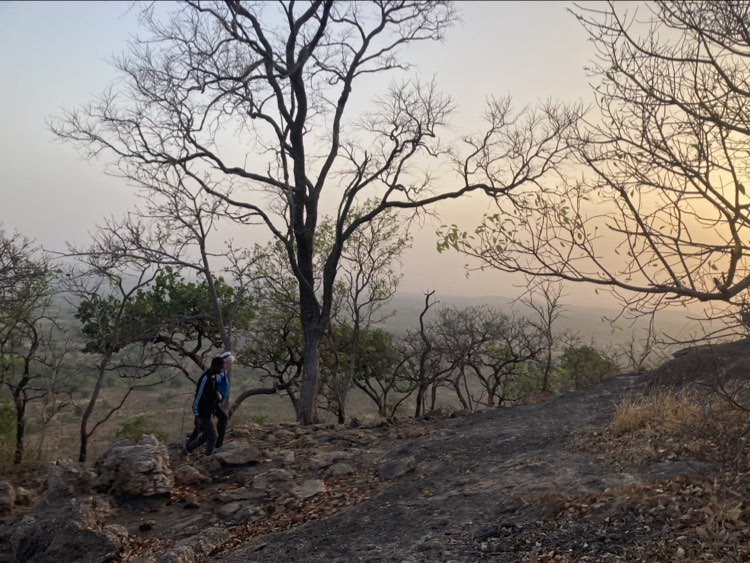
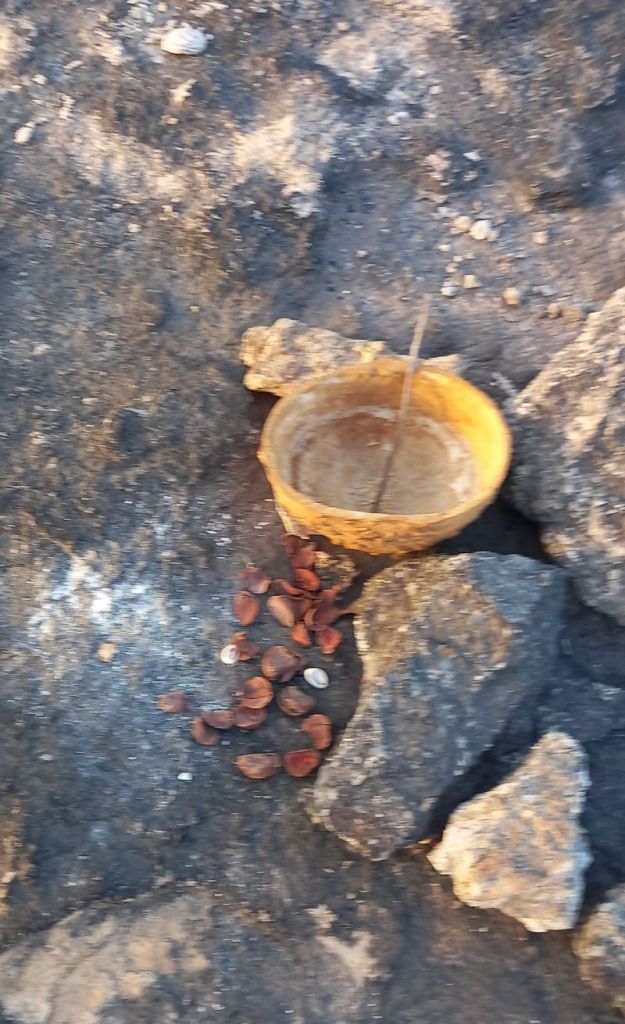
Where do you like to get away to for a personal retreat? I’ve appreciated group retreats, and centers that provide specific spaces for retreat that include labyrinths, gardens, or warm indoor rooms during winter. I loved those three hours set aside Saturday mornings for time in my “sacred grove” back in Côte d’Ivoire. Those are all legitimate ways to find time apart with protection from ordinary life.
There are retreat centers all over the United States, along with many scheduled retreat conferences. When one needs spiritual direction, these are often truly helpful.Though for most of us the opportunity to slip away privately is rare, having an extended retreat that is unscheduled by others can be truly refreshing. Making it happen takes determination. Whether we can carve out one or two days, or maybe a week or a month, it requires leaving behind the noise and demands that hold us in place in order to stop, be still, listen, and respond.
Going off on our own retreat may be what opens the door to time set apart with the Lord. While overseas I grabbeda few hours or a day by a river (near a small resort), or in a wilderness area like the rock above (always with others, for safety), or time beside the ocean when we were down south in the country. Each time, the impact of spiritual refreshment was palpable.
Next week I will be taking off for the Upper Peninsula of Michigan to the chalet-on-the-lake, the place that my parents built for their retirement home. They have been promoted to heaven. It is now a favorite spot for privacy, with little interference from the Internet or phones and community responsibilities. There are lots of ways to use time there; fixing up broken equipment and getting rid of clutter can be consuming. But one can also choose to walk in the woods, pick wildflowers or raspberries, or find a quiet nook to read and write. One can spend hours in contemplation, practicing silence and solitude—whatever appropriate spiritual discipline the Lord says to prioritize.
Usually I go there in mid-October with my husband, Glenn, to enjoy the peak of autumn colors. But this year he has activities tying him down in Detroit. My sister-in-law wants to get away too, but her husband is also unable to leave right now. So she and I have agreed to get away, just the two of us, respecting each other’s needs for space. There will be fellowship, of course. But we each need the renewal of retreat.
What will I focus on? Maybe if I share it here it will help me put these goals into practice:
setting aside time for solitude and silence, listening (pen in hand, because that is one way I listen best)
lectio divina and praying Scripture
enjoying reflection: walking in the forest around the lake, sitting by the water
self-examination: opening myself to the Spirit’s conviction and direction
journaling of a different kind: writing my memoir of the Lord’s fingerprints on my life, how he shaped me for ministry and for ongoing growth
community: journeying with my sister-in-law
rest!: freedom of the pressure of daily work--translation and exegesis--and deadlines
It seems almost too good to be true! But Chalet Shalom at Piatt Lake has never let me down. Dad and Mom left a legacy that is bearing fruit in their children. It will be a long drive to get there, about six hours, but even intentional travel is part of retreat:
“When we drive, walk, hike, bike, or in some other way pilgrimage to a setting in which our sole purpose is to draw near to God, we habituate our desire and intention to draw near to God in the process of getting there. Every step to the park, every mile to the retreat center, is a declaration to ourselves (to our bodies, our minds, our desires) that we want to love God more, hope in him alone, and deepen our trust in him. Going on retreat to cultivate communion with God is a way to crucify the flesh and its passions.”[1]
I don’t know yet whether Linnea’s Lines will be written next week or if that will wait; it depends on what the Lord will be doing in me. He himself took time off from crowds, teaching, and meeting the challenges of his antagonists by going to a private space to pray, even all night (Mat. 14.23; Luke 5:12; 9:28). To become increasingly like Jesus, we also need to give ourselves that place of parentheses, of rest from the hubbub and preparation for what is coming next. If he needed it, so do I! He calls me and I answer:
Come away, my beloved, and be like a gazelle or like a young stag on the spice-laden mountains. (Song of Solomon 8:14 NIV)
Yes, my soul, find rest in God; my hope comes from him. Truly he is my rock and my salvation; he is my fortress, I will not be shaken. (Ps. 62:5,6 NIV)
I know that this time apart will produce the fruit he intends. Here are some points of “God-given fruit” from retreat that Adele Calhoun lists:
·in the company of Jesus, able to quiet the noise inside and out
·making space in your hectic schedule for the Lover of your soul
·developing the ability to hear the still, small voice of God
·freedom from the need to be seen and to produce
·resting in God
·gaining perspective on God’s work and ways in your soul
·ability to be, not just do[2]From the ends of the earth I call to you, I call as my heart grows faint; lead me to the rock that is higher than I. (Ps. 61:2 NIV)
Hope you can find time, some day, to get away for a time of rest on the Rock!
Hang in there:
spin your web,
that intricate weaving
of who you are.
Wait there
in the interval
between up and down,
swaying in the wind,
hanging on by threads
that hold you in place.
Do what I made you
to do—
be what I made you
to be.
Rest there
in the caresses
of my breath
while I take care
of the world
spinning around you,
the hum of flying things,
the babble of masses.
Hang in your silent space
and wait,
ephemeral,
here today, gone tomorrow
but my design.
Mine.
I admit that it’s rare that a spider speaks to me, but this spider web mesmerized my eyes and spoke to my heart in a way I could not ignore. I was in my backyard in Côte d’Ivoire, enjoying the private quiet space reserved for me there on Saturday mornings, reflecting on the whirlwind activities of the past week and the exhaustion in my body and soul, trying to “be still and know” and finding it impossible. Then I looked up and saw the rising sunlight illuminate the ornate oval web, a laced work of art hanging quietly in space, held in place by long invisible strings attached to branches above us. Its job was to do what it was made for: wait, and be there for the critical moment when lunch would fly into its welcoming embrace.
I pulled out my pen, opened my notebook and began contemplating the intricacy of the web and the patience of the spider, quietly waiting. The words flowed out and touched my heart. I had been made for a purpose; my job was to do it, even if it was full of waiting and the challenge of trusting that I was being held by supporting threads I could not see.
My inner being relaxed, reassured of the Creator’s design and plan.
He was teaching me the spiritual discipline of reflection! I did not have a name for it then. But I knew that day after day he was using nature to impress truth on my heart. The birds were singing as they welcomed the new day; I was urged to praise the Risen Son. The smell of coffee as I raised my cup to my lips reminded me of his provision, delight coming out of earth and plants. Insects voraciously devouring a fallen mango could remind me to “taste and see that the Lord is good!” I might touch wet leaves and relish the memory of that rain we had been praying for, that had finally come last night.
The impact of the five senses as contributors to my spiritual growth was not something that I had noticed early on, even though it had been happening all my life. When I began to realize that the Lord was truly speaking through the world around me—whether I was at the beach or dealing with dangerous mudslides on a country road during a storm—the impact was even greater.
This underlines the essential element in reflection: “C.S. Lewis once said that our greatest dignity as creatures is not in initiative but in response. God speaks, we hear. He knocks, we open. He sows the seed, we receive it. Sowing those seeds is God’s attempt to restore Eden to the wilderness of the human heart. Receiving them is how we work with Him to do it.”[1]
We have to be receptive—we have to pay attention! God gave us our five senses for many reasons, and one of them is to be aware of the truth singing out to us from the world he made. “The reflective life is a way of living that heightens our spiritual senses to all that is sacred.”[2] An intentional pursuit of living reflectively involves developing other aspects of our spiritual formation, like practicing God’s presence. If we really believe he is with us and in us, and that his Spirit breathes wisdom and guidance to us, we need to be sensitive to that. Doing so will help us grow in our awareness of what he is teaching us, as well as in the process of transformation that he is accomplishing inside us as we keep company with him.
Contemplation is a key spiritual discipline in a reflective life. It “invites us to enter in to the moment with a heart alive to whatever might happen . . . Contemplatives are open to seeing the unseen world. They sift the days for symbols and scan the universe for meaning.”[3]
Ken Gire writes that as he learned to practice this, even paying attention to the arts, movies, books, and other people, they “all became my mentors, guiding me into a deeper relationship with the world around me. Which eventually led to the world inside me.”[4]
When that “world inside me” is also being fed by the truths of Scripture, the meaning of the symbols becomes clearer. Gire cites passages from the book of Proverbs that picture wisdom calling out in the noisy streets and the city square (Prov. 1:20-21) and at the crossroads and entrances to city buildings (8:1-5). I remember when the Lord called out to me those mornings when my quiet space in my “sacred grove” was being hammered by mechanics working nearby, or politicians broadcasting, or trucks revving up motors. Was my God still there, in the noise? Yes!
Wherever I am, in a quiet moment or in raucous hubbub, wisdom is there, God’s wisdom, “calling us to a different way of living.”[5]
Am I listening?
One of the other books that I believe the Spirit put in my path this year is This Sacred Moment: Becoming Holy Right Where You Are, by Albert Haase. It is rich in many dimensions, but this section leapt out at me:
“Over the years, every spiritual director I had challenged and encouraged me to develop a reflective lifestyle—an unhurried way of living that short-circuits spur-of-the-moment emotional outbursts or reaction. A reflective lifestyle incorporates meditative behaviors and contemplative habits that lead to informed and thoughtful responses. It also values time spent reviewing what’s going on in daily life and reflecting on what the five senses are experiencing, knowing such practices foster sensitivity to the variety of ways in which God calls us . . . It is about looking out the window and cultivating selfless openness to this sacred moment. The authentic fruit of such a lifestyle is the emptying of self for the enrichment of others.”[6]
What strikes me is that there are multiple pay-offs to living this reflective practice. Some of those mentioned are self-emptying, wise responses to words or circumstances, keeping company with God, listening to the Spirit’s prompts, and enjoyment of God’s creation.
All of this is aligned with our citizenship in the kingdom of God:
For the kingdom of God is not a matter of eating and drinking, but of righteousness, peace and joy in the Holy Spirit, (Rom. 14:17 NIV)
Life in God’s kingdom has different priorities than those of the world. It is not about “disputable matters” (Romans 14:1), daily habits and preferences that are not spiritually significant. But it is about doing what is right, promoting and experiencing peace, and being joyful in the Spirit! What does it mean to have joy in the Spirit? In addition to the grace we receive as he leads us, he also gives us that enjoyment of God’s creation and its deeper meaning. Even an exotic spider web can whisper a message in that sacred moment when the heart’s eyes and ears are open to observing and listening.
“Hang in there! . . . Do what I made you to do, be what I made you to be . . . Rest there in the caresses of my breath while I take care of the world . . . Hang in there!”
[1][1][1] Gire, Ken. The Reflective Life: Becoming More Spiritually Sensitive to the Everyday Moments of Life. (Chariot Victor Publishing: 1998), p. 49.
if He comes in darkness
a potent presence out of sight
I’ll learn new ways of knowing
grow sensors that can find him
learn trust like a baby
and find out
He’s light
in the dark
if He comes in mystery
with hints of holy secrets I can’t bear
I will learn to listen
study tomes of wisdom
ask him for discernment
and discover
growing is forever
if He comes in whispers
in the middle of ordinariness
I’ll follow every nudging
by the practice of His presence
find joy in obeying
receive
un-ordinary peace
When you see magnificent skyscapes, doesn’t it make you wonder what it means? What is beyond that face looking at me? What is ahead on this road: more beauty, or a thunderstorm?
Sometimes the pattern is highlighting the magnificence of the Creator. Sometimes it is a warning.
Discernment is having the knowledge necessary to tell the difference. When we’re talking about spiritual discernment, it has to be founded on knowing Jesus. That is a lifelong journey.
He shows himself to us when we truly seek him, and in order to follow the path he is laying out for us, we need to grow in that intimate relationship. As Peter said in the last words he wrote to those he was discipling:
Therefore, dear friends, since you have been forewarned, be on your guard so that you may not be carried away by the error of the lawless and fall from your secure position. 18But grow in the grace and knowledge of our Lord and Savior Jesus Christ. To him be glory both now and forever! Amen. (2 Pet. 3:17 NIV)
“But grow”! Knowing the Lord, accepting this gracious undeserved favor of walking life in close and secure companionship with the King, that is to be our pursuit! It is essential for growing in maturity.
The verses of poetry above are culled from a long poem contemplating many of the ways that he may choose to reveal himself and his wisdom to us.[1] The focus is on learning discernment, a gifting I have truly needed to develop. This verse lays it out for us:
But solid food is for the mature, for those who have their powers of discernment trained by constant practiceto distinguish good from evil. (Heb. 5:14 ESV)
Here is my first take-away: developing discernment takes constant practice! And secondly, it is about distinguishing right from wrong, good from evil. That is definitely essential for those of us “walking the Jesus Road,” as being a Christ-follower is called in the West African context where we worked for so long. We may come to a fork in the earthly road we see before us. Which way are we to choose? Many times the choice may be clear, such as when one turn clearly leads to the edge of a cliff and the other choice is safety. But it may not always be so obvious which is right and which is wrong. Both choices may look good from where we stand, or maybe mist is covering them and we find it hard to know what lies beyond.
How can we develop that sensitivity to the Lord’s direction that will give the answer we need? How will he come through? In some instances, his voice may be louder than we expect, impossible to ignore:
if He comes with thunder
a flash of light brighter than noon
my eyesight will be shattered
dis-illusioned by the brilliance
and within I’ll be struck
heartwise
and be healed
Will it be in mystery, or in whispers we can hear if we are paying attention? Our job is to practice his presence, heart-ears open to his promptings. Distinguishing his instructions from those that may come from other voices that want to take us on a detour or make us stumble, that is discernment. It is strengthened by knowing what he has already laid out for us in his Word. He shines light on what we need to know as we walk with him:
When we know what he has already told us, then we know what is good and what is not:
I have stored up your word in my heart, that I might not sin against you. (Ps. 119:11 ESV)
Clear light on the path is found in Romans 12, a chapter that means more to me every time I return to it. The essential first step is to be completely devoted to God and his priorities. We offer our bodies, ourselves, to him as a “living sacrifice.” I understand this as similar to the way the Levites were to consecrate themselves to Yahweh for ministry (cf. Numbers 8:8-10, 20-22) as an offering. We are to be priests in the kingdom of God:
But you are a chosen people, a royal priesthood, a holy nation, God’s special possession, that you may declare the praises of him who called you out of darkness into his wonderful light. (1 Pet. 2:9 NIV)
So, to live as children of light, consecrated as priests, we need to be able to do what God has laid out for us, not just what is viewed as good by the world we live in:
Do not conform to the pattern of this world, but be transformed by the renewing of your mind. Then you will be able to test and approve what God’s will is– his good, pleasing and perfect will. (Rom. 12:2 NIV)
That is discernment, this ability to “test and approve” what is good according to God’s standards. In this chapter Paul then uses sincere love as a key to evaluating what is good versus what is wrong, then living it out (vv. 9-21).
“Love must be sincere. Hate what is evil, cling to what is good. (Rom. 12:9 NIV)
If we are going to live this way, we need to weigh a value or action by whether or not it meets the standards of love. These standards include loving one’s neighbor and also one’s enemy, and respecting God as the one in charge (not myself!). This excellent explanation concludes with a command:
Do not be overcome by evil, but overcome evil with good. (Rom. 12:21 NIV)
If only I could always do that! It comes via the “renewing of my mind,” transformation in how I choose to do what is good now that I am a child of light, a priest in God’s kingdom.
8For you were once darkness, but now you are light in the Lord. Live as children of light 9 (for the fruit of the light consists in all goodness, righteousness and truth) 10and find out what pleases the Lord. (Eph. 5.8-10 NIV)
Here is an enlightening translation of verse 10:
10trying to learnwhat is pleasing to the Lord. (Eph. 5:8 NET)
We are not perfect in weighing good versus evil from the start—it is a learning curve! What is essential is committing ourselves to the journey, to “try to learn”—to let the Spirit do his work as our counselor as he renews our minds, and as we put into practice what he says.
A good place to start is to measure a prospective act against the fruit of the Spirit (Gal. 5.22-23), or the list of applications of love in Romans 12. If I do this act, am I honoring someone more than myself? Am I being patient when things are hard? Am I doing what I can to live in peace with others? Am I sharing with those in need? The list covers a lot of territory!!
I join with Paul in praying the following petition for myself and for any of you who are also on the Jesus Road:
And it is my prayer that your love may abound more and more, with knowledge and all discernment, 10 so that you may approve what is excellent, and so be pure and blameless for the day of Christ, 11 filled with the fruit of righteousness that comes through Jesus Christ, to the glory and praise of God. (Phil. 1:9 ESV)
thank you is
the flip side of fear
its antidote
unutterable
thanks bubbling over
wow! wow! wow!
grace welling
indwelling
dispelling
fear—it flees
in the face
of gratitude
You know that feeling: the joy that comes when something longed for, waited for, despaired of, suddenly shows up! You were afraid that it would never happen. You thought the worst was on its way. And then WOW!
It happened to me last week. There was not enough money in the account to pay the salaries of the Nyarafolo translation team (five men with families) after this month. Then WHOOSH! WHAT? The unbelievable happened. Two amazing totally unexpected donations came in, far above what we thought possible !
Deep gratitude definitely washed over me. I kept hearing, over and over, the Father reminding me: “Getting out the Word to the Nyarafolo is my project, one I started, one I am getting finished.” It was as if he was saying, “Why were you so afraid? Just be thankful, and keep pressing on!”
It had taken months to get that answer to our prayers. It was definitely a walk of faith, building our trust in the One In Charge.
This poem on gratitude was written when we had been recently evacuated from Côte d’Ivoire due to civil war, twenty years ago. The future was a big blank. We had no home to settle into, and kept wondering what our purpose was supposed to be. When the Lord showed us pieces of his plan (we were not going to be homeless!) and purpose for each of us (seminary for me, ministry for Glenn, high school for Bryn), fear dissolved. We could only thank our Provider and Guide.
It’s true that often we forget to actually express our thanks, whether it is to God or to a person. That was underlined for me about three decades ago, when I asked my Nyarafolo Christian friends to give me a name. I was tired of hearing so many of them resort to “Madame” when addressing me. Why couldn’t they call me “Linn?” They said that my name was just too difficult to use. Well then, I insisted, please give me a Nyarafolo name! They had already given one to Glenn, “Kajuʔulosori,” which meant basically: “Words just exit/he doesn’t hold grudges!” I was waiting for a good name like that.
They consulted briefly, came to consensus, and my friend Saly came over to me to tell me I was now “Penyuɔnɛkuɔ!” “So what does that mean?” I asked.
“Well, it’s short for a longer proverb that assumes that when you’ve helped someone, they are successful and get what they want, but they will forget to say thank you!” Saly said.
How was that a good name? I was startled. She saw my expression. “It’s so true,” she said. “That’s why it’s good.”
I began thinking about it. Situations in the Bible began to leap out in a new way, and I began to write “Penyuɔnɛkuɔ” next to them.
When I fed them, they were satisfied; when they were satisfied, they became proud; then they forgot me. (Hos. 13:6 NIV)
You deserted the Rock, who fathered you; you forgot the God who gave you birth. (Deut. 32:18 NIV)
Our ancestors in Egypt failed to appreciate your miraculous deeds, they failed to remember your many acts of loyal love, and they rebelled at the sea, by the Red Sea. (Ps. 106:7 NET)
Do I remember what the Lord has done for me, bringing me this far? Do I take note of all the times in the past he has provided for the Nyarafolo translation project? Do I remember the way the funds came pouring in after there was that horrible fire in the office that destroyed so many resources and the wiring? And now, am I remembering to pour out my thanks to God for this amazing provision? How about the days when the Internet connects me flawlessly to my co-translator Moïse so that we can continue to work on translating Isaiah? (This is actually happening!)
I want to be the King’s daughter who is paying attention, one who sees his fingerprints on what is happening. I want to be the one who runs to him with tearful amazement, fear gone, gratitude pouring out!
It’s true that often people forget to thank someone for their gracious act of help—in the grocery store, or the hospital, or in the kitchen, wherever. Parents usually try to train their kids to say “thank you.” Sometimes it sticks.
As children of the living God, we need to train ourselves to give heartfelt thanks to him. We do it before eating our meals, but it seems that often it becomes a ritual recitation, not true gratitude. Jesus thanked the Lord before meals, and we should as well—but we should mean what we say.
And if we are paying attention to all that he provides, we can send up “flash prayers” of gratitude, anytime, anywhere.
O Lord, my God, I will give you thanks with my whole heart! I will honor your name continually! (Ps. 86:12 NET)
He is training me in this—yes, it’s spiritual formation, this process of constantly maturing! A few nights ago I was driving home late at night in the dark. The freeway was being repaired, with lanes blocked and big orange cones everywhere. I nearly missed the exit I was supposed to take. So I slowed down, right-turn light flashing, ready to swerve in at the last minute, when a car suddenly whipped around me to the right and I almost hit it! I was so glad that what came out of my mouth was: “Thank you, Lord!” He was hemming me in, behind and before, and I noticed!
You hem me in behind and before, and you lay your hand upon me. (Ps. 139:5 NIV)
You have encircled me; You have placed Your hand on me. (Ps. 139:5 CSB)
I could have just been scared, or angry. But instead, the Spirit is changing my innate response to what it should be: gratitude. I am grateful.
As Chris McKnight says: “Christians are to thank God for creating and sustaining the world and for His ongoing redemption of it through Jesus. They are expected to pray to God privately (Matt 5:6) and thank Him for what He has done (Luke 17:12–19). The Psalms display individual prayers of thanks (Psa 69:30–36), and the New Testament includes individual thanks for fellow believers (Phlm 1:4). Thanklessness is regarded as a rejection of God, which leads to further sin and eventual judgment (Rom 1:21).
Ultimately, Christians are to do all things in the name of the Lord Jesus, giving thanks to God the Father through Him (Col 3:17). From this perspective, all of an individual’s life in Christ—whether in worship, at meals, or otherwise—becomes an opportunity to offer thanks.”[1]
When I help my grandson cope with a challenge, and he smiles and says “Thank you,” my heart is warmed and I feel our relationship glue getting yet stronger. Paying attention to what God is doing, acknowledging that it comes from him, strengthens my attachment to him as well:
“God is the giver and we are the thanks-givers. The circle is complete and it allows us to open yet a deeper part of our life where there is weakness and we acknowledge our dependence on God. God meets us at that point with another blessing and gift. His grace and help come into our lives. We recognize that he has met us and blessed us. We know that it is a gift of grace that he has brought into our lives, so we respond again with gratitude, praise, trust and faith. The circle is complete and the spiral of our life and experience with God continues to deepen and widen. Life begins to change, not because the circumstances are easier or less demanding, but because we begin to see them in a new light.”[2]
May we each be ready to open that deeper part of our life, realizing how dependent we are on God’s goodness—and noticing when he gifts us! We will indeed see things from a new perspective. Fear will be conquered by gratitude, and trust will be strengthened.
And let the peace of Christ rule in your hearts, to which indeed you were called in one body. And be thankful. (Col. 3:15 ESV)
[1] Chris McKnight, “Thanksgiving,” ed. John D. Barry et al., The Lexham Bible Dictionary (Bellingham, WA: Lexham Press, 2016).
Like your disciples
on that day between
your murder
and your return to life
I wait, longing to see
what you have promised.
You said that,
if I would just believe
even a little tiny bit
I could make a mountain move—
I would receive
from your loving hand
what I am begging for.
So I wait,
and scrape up hope,
asking you for mercy.
Help my unbelief!
Have you been there, pleading with the Lord, forced to wait to see what his answer will be? We who are his children often beg, wondering “if” . . .
His plan, his timing is not always what we hoped it would be.
But he tells us to pray without stopping! He told us that if we even have miniscule faith, tiny like a mustard seed, we would see our prayer answered (Mat. 17:20). It’s easy to throw in the towel and lose hope when we don’t see it happening immediately. But praying on behalf of others, intercessory prayer, is a training ground in trust, obedience, and knowing the Lord. There is lots to push us to keep on practicing it.
For one thing, we need to obey our Master and keep on praying. Jesus even told his disciples a parable about a woman constantly pestering a judge to give her justice, protection against an enemy. Jesus said that, like the widow, they should not give up:
7Will not God grant justice to His elect who cry out to Him day and night?Will He delayto help them? 8 I tell you that He will swiftly grant them justice. Nevertheless, when the Son of Man comes,will He find that faithon earth?” (Lk. 18:7-8 CSB)
And pray in the Spirit on all occasions with all kinds of prayers and requests. With this in mind, be alert and always keep on praying for all the Lord’s people. (Eph. 6:18 NIV)
Pray constantly. (1 Thess. 5:17 CSB)
So Jesus was clear that his followers should pray, continually. He even told his disciples that they would get what they ask for:
“Ask and it will be given to you; seek and you will find; knock and the door will be opened to you. 8 For everyone who asks receives; the one who seeks finds; and to the one who knocks, the door will be opened. (Matt. 7:7-8 NIV)
But there is also a warning: we might be asking what does not align with his priorities, and what he has told us are the purposes he has for us. If we ask for something for selfish reasons, we cannot expect to get what we ask for. Would I give my child whatever she wants, even if I know it will only be unhealthy for her, maybe even something that could encourage her to do something wrong?
When you ask, you do not receive, because you ask with wrong motives, that you may spend what you get on your pleasures. (Jas. 4:3 NIV)
It becomes clear that we, God’s children, can come to him freely, but we need to get more and more in tune with his teaching. We need to learn how to pray correctly by living in him, letting his Word live in us increasingly, and then asking him to act in line with that. As he said:
If you abide in me, and my words abide in you, ask whatever you wish, and it will be done for you. (Jn. 15:7 ESV)
That is the big IF we need to take into account!
In Celebration of Discipline, Richard Foster advises us to take an important first step before launching into our intercessory prayer: be still, listen, see what the Lord is saying about the person or situation. Then use that as the format for our prayer.[1]
This prepares us so that we can come like children to their Father, as Jesus said to do, trusting his good heart. His model prayer begins, “Our Father in heaven”. Yes, he is high over the earth, but lovingly connected with his dear ones. Imagine, or “see” with your heart, the good outcome you desire, and pray it to him.[2]
Here is a suggestion: collect texts that lead you to pray the way that the Lord is teaching you. I have begun to do that myself. For example, I am praying for the Nyarafolo people, who are still in the category “least reached.” Joined by many others, prayer has been going on for years. And more and more are coming to him. The following verses give good leads—then we can add data that we know, events that are going on. It is in line with his heart to ask for more to believe, for more people over to there to share the Good News, for his purposes to be fulfilled:
For the Son of Man came to seek and to save the lost.” (Lk. 19:10 NIV)
And the gospel must first be preached to all nations. (Mk. 13:10 NIV)
All the nations you have made will come and worship before you, Lord; they will bring glory to your name. (Ps. 86:9 NIV)
For God so loved the world that he gave his one and only Son, that whoever believes in him shall not perish but have eternal life. (Jn. 3:16 NIV)
I write to you, dear children, because you know the Father. I write to you, fathers, because you know him who is from the beginning. I write to you, young men, because you are strong, and the word of God lives in you, and you have overcome the evil one. (1 Jn. 2:14 NIV)
That last one gives ways to pray for the believers who are already there, but also that others might “know him who is from the beginning.” And may the “word of God” come to them and live in them!
When I pray for someone wandering, I have found Jesus’ parable of the lost sheep to be a wonderful structure for my prayer (Luke 15:4-6). He loves that lost sheep, who belongs to his flock but has allowed other things to lead them astray. I know he is that Good Shepherd who will pursue them.
Another practice that can fill our hearts with compassion as we pay attention to those around us is what Frank Laubach calls “flash prayers,” praying for anyone we see. We can do this at family get-togethers, when with friends, or on a prayer walk.[3] This can truly change how we interact with those people.
If the Lord lays someone on our heart, prompting a genuine yearning for his intervention in their lives, that is a prompt we should pay attention to. Foster says: “If we genuinely love people, we desire for them far more than it is within our power to give, and that will cause us to pray.” This “is one of the clearest indications from the Lord that this is a prayer project for you.”[4]
We cannot command our Father! We come with hearts submitted to him as King of the Universe, Lord of our lives, and petition him. He hears us. But he also lets us come to him with pleading for his understanding:
Listen to my prayer, O God. Pay attention to my plea. (Ps. 54:2 NLT)
Then, trusting him and his goodness, we wait.
[1] Foster, Richard J. Celebration of Discipline: The Path to Spiritual Growth. (San Francisco: Harper and Row, Publishers), p. 35
Father, our hopes are drying up
just like the earth,turned to dust;
just like the leaves,shriveled to paper.
No sign of change; no rain.
How long must your people
wither, shiver in thirsty air
that claims all moisture as its own?
Tears are gone with the wind.
Our hearts ache and find no solace.
How long must our eyes burn,
longing, searching the horizon
for some glimpse of hope?
Slap the violent out of their arrogance!
Pull their stolen chairs out from under
their fat bums, grown gross
from slurping up the profits of the poor!
Nail them to the crosses they’ve erected
for the innocent, judging them guilty
for their names or point of view!
How long, dear King, our Father?
We know you rule the universe.
Let us see your justice—
we beg this of you! Hear our prayer:
this petition signed in anxious trust . . .
all our hope is in you!
I wrote this lament in 2010, in Côte d’Ivoire, where we were living in the northern region still held by rebels who had gained that territory in 2002. They were without compassion, cruel. But so was the government that still ruled the south! There were too many northerners trying to find new hope by going south who were then killed by police or soldiers as “suspect,” since they had a “northern” last name. It was hard to know how to pray. How could justice be done in the middle of such a mess?
Psalm 13 gave me structure for my personal lament. And Psalm 75 gave me hope; it underlines God’s sovereignty and his judgment of the arrogant and those oppressing the poor.
Praying the Word has increasingly become a rich foundation for my prayers. The practice comes in different forms, depending on the context and purpose. Each time it gives guidance in praying according to the Lord’s direction.
One warning: when choosing a Scripture text on which to base such a prayer, you need be careful to not take it out of context in such a way that its message is falsified. Once when I was a guest at a church I had never visited before, the pastor urged anyone in the congregation who had a need to speak their words and whatever they said would happen, that need would be met, that wish fulfilled. The text they were to base their prayer on was this:
So tell them, ‘As surely as I live, declares the LORD, I will do to you the very thing I heard you say: (Num. 14:28 NIV)
People went forward, claiming this as their promise. The pastor had not given them the context, or the following verse:
In this wilderness your bodies will fall– every one of you twenty years old or more who was counted in the census and who has grumbled against me. (Num. 14:29 NIV)
The “promise” was that their words of refusal to enter the promised land would be exactly what they would get in return: no entry, just wandering and death! It was a curse, not a formula to follow to manipulate God!
One way to practice praying Scripture on a solid basis is to benefit from the careful work of those who have done thorough research to give useful examples. Kenneth Boa’s books, Face to Face: Praying the Scriptures for Intimate Worship (two volumes), have guided me for years. I use them as I begin my daily quiet time. Boa explains that he based the daily collections of Scripture texts on the eight forms of prayer found in “The Lord’s Prayer”: adoration, confession, renewal, petition, intercession, affirmation, thanksgiving, and closing (from Matthew 6:9-13).[1] He has personalized verses that fit in each of those categories. Every day has a new collection, and I find that they help me not to leave out adoration, or confession, for example, from my prayers. Great reminders!
Adele Calhoun, as usual, puts the purpose of the practice in meaningful terms: “Praying Scripture is a way of entering deeply into the text with a heart alert to a unique and personal word from God. Words and verses that catch our attention become invitations to be with God in prayer. When our prayers seem to be more about maintaining control and offering God our agenda for his stamp of approval, praying Scripture can return us to a simpler state of openness and attentiveness to God.”[2]
It is way too easy to make our prayers only petitions or intercession. I have been learning to broaden the scope, but also to listen carefully to texts that the Lord wants me to use with truly personal application. While doing lectio divina, the text that captures my heart as I concentrate on a Scripture section becomes a focus of prayer as well. This past week one highlighted for me was Romans 7:4:
So, my brothers and sisters, you also died to the law through the body of Christ, that you might belong to another, to him who was raised from the dead, in order that we might bear fruit for God. (Rom. 7:4 NIV)
I underlined the words that became increasingly meaningful to me as I meditated on them, then prayed them back to my Lord, Messiah, personalizing them like this: “You, the resurrected one, the living Christ, you wanted me to belong to you! And you have this purpose for me, now that I am yours: you want me to bear fruit for you, you who are God. I want to do that. I want to do what you want me to. What are you putting before me today? How can I bear fruit today? How about in the future, the immediate or long-term?”
This has put me in a place where I am paying much more attention to the promptings that come my way. I’ve already seen him set up a connection for encouraging a young woman in her growth, one I did not expect. He knew it was coming! When it opened up, I knew immediately it came from him, that it was fruit he wanted me to bear.
Praying the Scriptures is also a practice in the prayer group that Glenn and I attend at our home church, Highland Park Baptist. At “Oasis” on Wednesday evenings, church leaders present a passage and ask for discussion, then open it up for prayer based on the verse or verses just covered. Right now we are slowly going through the book of James. At the end of the session, we divide into small intimate groups to apply the principles in more personal prayer. It is rich. Instead of dealing with long carefully crafted petitions that take over a “prayer meeting,” we focus on God’s Word to us in that moment.
While researching this practice I found a great resource: how to do Scripture-based prayer for a people group that does not yet have the whole Word in their language. It is on the Wycliffe Bible Translators’ site. Since Bible translation is the ministry the Lord led me into, for the least-reached Nyarafolo people in northern Côte d’Ivoire, I deeply appreciate their suggestions for how to pray for a people that does not yet have all the Scriptures, even if you do not have immediate updates and don’t know that much about what is happening. These are the basic steps:
“So when words fail you, open up the Bible and allow God’s words to be your prayer. Here are a few tips that can help get you started:
Find a quiet place to connect with God.
Begin by praying a Scripture that prepares your heart for connecting intimately with God. (Suggestions: Hebrews 4:16, Psalm 119:118)
Use a verse or passage to shape your prayer. (Example: “Lord, the whole earth is yours, and everything in it! The world and all its people belong to you—including the __ people. May they understand the depth of your love for them today” –based on Psalm 14:1)
Allow imagery from Scripture to influence your prayer. (Suggestion: Revelation 7:9-10)
Turn a verse into a first- or third-person prayer.
Pick a verse and declare it as truth for a people group or nation.
Ask the Holy Spirit to help you pray. (He helps us in our weakness, and pleads for believers in harmony with God’s will – cf. Romans 8:26-27)[3]
May we all make progress in praying as our Lord wishes, as we pray his own Word back to him!
[1] Boa, Kenneth. Face to Face: Praying the Scriptures for Intimate Worship. (Zondervan Publishing House: Grand Rapids, MI, 1997), pp. vi-vii.
[2] Calhoun, Adele Ahlberg. Spiritual Disciplines Handbook: Practices that Transform Us. (Downers Grove, Illinois: IVP Books, 2005), p. 246
We are like Joshua, like his crowd of followers,
circling, circling the walled city in silence,
hoping, crying out from our souls
only to You, Master of the Universe,
to break through those daunting walls.
People shout from inside, defaming you.
They do not know you. They do not feel
your loving arms around them.
All they have are huge thick walls.
So they assume they are just fine.
We have to trust, circling in silence,
that you will do what you have promised:
crush those walls and break on through
in your own timing. It will be a miracle
and we will cry out shouts of praise!
So we wait and keep on walking,
walking with You, Your hand holding ours,
the path before us clear, unchanged---
circling, waiting, heart-eyes fixed on You.
And walls will crumble down.
A few weeks ago I got a call from a friend at my church, Margaret Hadley, asking me to join her on a prayer walk. Prayer walking is her passion – her book, A Prayer Walk through Washington D.C., came out in 2020. Now she is working on a marathon-length walk here in Michigan. Would I join her in the initial segment, a walk up Woodward in Detroit?
I live in Detroit and have come to love it. I am also a walker, and combining prayer with motion is delightful to me. So the two of us walked seven miles together from the Detroit River Walk, where Woodward Avenue ends, up to 7 Mile Road. Margaret was leading the event and had brought prayer prompts, the first verses of several psalms. They helped, but mostly we talked to the Lord about what we saw on our journey out loud, eyes wide open so that other pedestrians would see us as just engaged in conversation. We passed medical buildings, universities, restaurants, bars, churches of all kinds, beggars, families, and eventually neighborhoods. There was so much to lift up to the Lord of the Universe as we contemplated the needs of this city. At the end of the walk my feet were sore, but my heart was happy. Yes, there are many needs, but there is also hope. And it is our Lord who can break through all walls and bring change.
It brought back memories of another time years ago when my friend Cecilia Fueslein drove me to key sites in the city (the weather was cold) and we prayed together for its “peace.” I had recently become a resident of Detroit; she had a longer history here. We both really wanted to see change, and an evangelistic event was on the horizon. The Word says:
Also, seek the peace and prosperity of the city to which I have carried you into exile. Pray to the LORD for it, because if it prospers, you too will prosper.” (Jer. 29:7 NIV)
Peace and prosperity are attempts to try to express the word “shalom” in the Hebrew. It includes concern for the welfare of the city, its health.
Another time, back in Ferkessédougou, I had joined some missionary coworkers in walking around the Baptist Hospital, praying together for God to do what seemed to be miracles. It was going through extremely hard times, and our hearts were deeply burdened. Praying together for its welfare, and against the Enemy attacks it was experiencing, we were united in asking for breakthrough. And recently we have seen that beginning to happen!
It all reminds me of the way Joshua and his people walked around Jericho (see Joshua 5 and 6).
By faith the walls of Jericho fell, after the army had marched around them for seven days. (Heb. 11:30 NIV)
They were told to be silent, and only to shout on the seventh day after the seventh time the city had been circled that day. But the fact that the ark of the covenant was with them, seven priests carrying trumpets that also sounded at that critical moment, showed that they were counting on Yahweh’s presence and action. What would I have been crying out in my heart if I were among that crowd of people following the army, circling a city that hated me and my Master? How would I have handled my fear? I’m sure I would have been desperately calling out to him “in silence” with my inner voice. The people had not seen a city of enemies experience that kind of spiritual warfare. It was so scary, but they obeyed and exposed themselves to anyone guarding the city, on its walls, to walk all those days!
Prayer walking is truly a form of spiritual formation, and more and more Christian groups are practicing it together on university campuses, in cities and in neighborhoods. Our church uses the warm summer weather to take prayer walks in the community surrounding it. When someone asks a question that opens up the opportunity to talk, you are encouraged to ask if they have something they would like to ask prayer for. But mostly it is just about walking two by two, praying out loud as we pass different venues and people, asking the Lord to do his work in that community.
Often my morning walks in my neighborhood involve meditation, or prayer for dear ones near and far, but there are also many times when the Lord prompts me to pray for people I know as I pass by: a woman whose son was killed, an immigrant family from Africa, a woman involved in witchcraft, a friend who does not know Jesus yet. He continues to prompt me to pray for spiritual movement toward true knowledge of the Jesus Way, to actually know him. It is part of my current learning curve as the Lord pushes me to pay attention to the world around me and to walk with him in it, not just alone with my preoccupations and my intent to exercise!
One huge difference that this practice makes in my walk is remembering that he is right there with me—practicing his presence. When I walk with a partner, the same thing happens: we are not just two or three humans covering the distance together, but we are talking with the One who is the focus of our conversation. He wants us to pray, everywhere, constantly:
And pray in the Spirit on all occasions with all kinds of prayers and requests. (Eph. 6:18a NIV)
And wherever we go, he is with us:
Yet I am always with you; you hold me by my right hand. (Ps. 73:23 NIV)
The right hand is symbolic for action, so this is not only about the comfort, guidance and protection we
need. It is also about doing what he wants us to do. Like praying “with all kinds of prayers”.
I appreciate this simple three-point outline that applies to this practice:
Prayer-walking lets our context shape the prayers we pray.
Prayer-walking reminds me of the vast opportunities around me and the finiteness of my resources.
Prayer-walking enables you to engage real kingdom work in your vicinity, in a location where there may not be many (or any) other Christians.[1]
We can take prompts from what we see, what we hear, and from any of our senses. The ancient broken sidewalks in Detroit remind me that this city is broken and needs healing. I pass an old man, hunched over and limping; he needs prayer. I pass the home of a friend who is a missionary now on the field; even that is reminder to pray for her. I see kids’ toys out on the sidewalk and pray for their welfare, and for spiritual blessing on them. A police car rolls slowly by and I pray for them as they protect the people, for wisdom and integrity, and salvation! Leaves fall and I am reminded of passing seasons and the brevity of life. So I ask God to work in me and through me in the days I have left.
When God lays a word from Scripture on our hearts, we can let it structure how we intercede for people and for our interactions. One pertinent example is the commandment to love our neighbors. So as we walk and pray, we can ask him how we can show that love in words and actions.
Where we know there is evil at work, we pray against it.
Knowing that a community has deep spiritual needs, we pray for breakthrough, for openness to the Good News. It matters.
When we think about lurking danger, we can remember that we are protected by the One with whom we are walking:
You hem me in behind and before, and you lay your hand upon me. (Ps. 139:5 NIV)
As Adele Calhoun says in her excellent book on spiritual disciplines, what I must desire when practicing prayer walking is “to align myself, while walking in particular places, with Christ and his intercession for the kingdom to come.” So it includes “deliberately walking through places for the purpose of intentional and listening prayer . . .seeing places through Jesus’ eyes.” [2]
Yes, I need to grow in my ability to see places and people through Jesus’ eyes, talking with him about them as we walk together. And where there are walls, he is the one who can make them crumble down!
So I walked up to him
stretched out my arms
and laid it gently
in his lap, where
it glistened like an emerald
in the throne’s radiant light.
And, though my fingers lingered
to caress it as they left,
I took my hands off
resolutely
and brought my eyes to his.
They locked, and I could go,
knowing that he understood,
and cherished my dream too,
and in his care
it would be safe.
Even if it’s hidden
and my aching hands are empty.
“Hands off” is not easy to accept. But how else can one “let go” and “let God” work? But there are times when it becomes obvious that there is no way to control a situation. Then the only solution becomes clear:
Cast your cares on the LORD and he will sustain you; he will never let the righteous be shaken. (Ps. 55:22 NIV)
Cast all your anxiety on him because he cares for you. (1 Pet. 5:7 NIV)
Throw concerns onto him! Now that sounds disrespectful, walking up to the throne of the King of the Universe to give him something I find too heavy a load to carry, or something hurting me. But he loves me and actually wants me to do that!
In fact, if I don’t, I am trying fruitlessly to do what only God can do. Holding on to it, I become hopeless. Letting go, I come to the One who can do way beyond what I dream.
Guide me in your truth and teach me, for you are God my Savior, and my hope is in you all day long. (Ps. 25:5 NIV)
Now to him who is able to do immeasurably more than all we ask or imagine, according to his power that is at work within us, to him be glory in the church and in Christ Jesus throughout all generations, for ever and ever! Amen (Eph. 3:20-21 NIV)
When in a situation that seems hopeless, there is only one Person to turn to, and he can work powerfully within us to give us peace and hope. V. Raymond Edman calls this the “discipline of desolation.” That sounds like the opposite of hope, doesn’t it? “Thus it is with the desolate heart: utterly withered, but God; and thereby life, with its emptiness and futility becomes filled with eternal realities. Companions and comforts may be consumed like smoke, but the Savior remains, the Compassionate Christ, and in him we have more than enough.”[1]
That feeling of desolation can lead us to let go, to relinquish our hold on that situation and turn to the one place where we can find true peace. Thomas Merton, in his prayer for this kind of relinquishment, asks for the ability to seek God perfectly, “to have a will that is always ready to fold back within itself and draw all the powers of the soul down from its deepest center to rest in silent expectancy for the coming of God, posed in tranquil and effortless concentration up the point of my dependence on Him; to gather all that I am, and have all that I can possibly suffer or do or be, and abandon them all to God in the resignation of a perfect love and blind faith and pure trust in God, to do His will. And then to wait in peace . . .”[2]
Good words: desolation that leads to relinquishment, and resignation. Peace.
I wrote that poem “Letting Go” about 25 years ago, and I am still waiting for the Lord to finish what he is doing in that situation. But over and over he has reminded me to trust him, to leave my desperate concern with him. Realizing over time that I’ve been grabbing it back, I lay it down again on his lap, and that is when I can continue my journey, waiting in peace.
Practicing “relinquishment” is actually a life-saver. It brings peace, while “holding on” to what cannot be controlled is constant hurt and frustration, hopelessness.
As a missionary, I had to say many goodbyes. I considered those some of the hardest requirements of my calling. God did tell us to honor our parents, right? But he also told us not to hang onto anything as more important than what our Lord is calling us to do. I was only about four when I realized that my own mother had needed to choose to follow God’s leading rather than her own mother’s preference. Our family had recently arrived in Congo when she got a telegram informing her that her mother had passed away. And her mother had not wanted her to be in ministry, far away. Mom’s tears, and her perseverance, were a model for me. She loved her mom, and had told her so, but she loved God most of all. And she knew that now that her mom was with the Lord, she would understand. Still, the goodbyes were hard, the one when leaving and the one when that telegram arrived.
That is why Jesus said those hard words: “If you want to be my disciple, you must hate everyone else by comparison — your father and mother, wife and children, brothers and sisters — yes, even your own life. Otherwise, you cannot be my disciple. (Lk. 14:26 NLT)
Hard words. But that is what living out “Lordship” means. He must be in control, when we yield ourselves to him as Master, the one in charge. Not me, but God. And when I know that he is the Sovereign King, and truly loves me, and promises to be my Shepherd and care for me, then I can rest in peace. And wait.
I remember a day when I was in seminary, studying Hebrew, when the class was dealing with how to understand this verse:
But I have calmed and quieted myself, I am like a weaned child with its mother; like a weaned child I am content. (Ps. 131:2 NIV)
The men in the class were confused about why the psalmist would liken himself to a weaned child. I realized that I was the only one there who had breastfed babies, so I raised my hand and shared the truth that makes it meaningful. Before being weaned, when the mother holds the baby to comfort them, they will root around for that source of milk. It is the weaned child who will just nestle against the mother’s chest for comfort; that is enough.
I have calmed and quieted myself, like a weaned child who no longer cries for its mother’s milk. Yes, like a weaned child is my soul within me. (Ps. 131:2 NLT)
When I have calmed myself and left my cares on God’s lap, I am content. He will take care of me and of my concern. Letting go, relinquishment, is trust. And that is our calling!
The LORD is my strength and shield. I trust him with all my heart. He helps me, and my heart is filled with joy. I burst out in songs of thanksgiving. (Ps. 28:7 NLT)
[1] Edman, V. Raymond. The Disciplines of Life. (Wheaton, Illinois: Scripture Press Foundation, 1948), 118.
[2] Merton, Thomas. New Seeds of Contemplation. (Abbey of Gethsemani, Inc.: New Directions, 1961), 46