The Spotlight Shifted!

They were shoved to the margins,
viewed as insignificant,
poor people scattered
in little bush villages,
living off infertile land.

But some had been waiting
to hear the Good News,
and when it arrived
their hearts opened wide,
fertile, welcoming seed.

“Now how can we sing
praise to our new King?”
Other peoples had songs,
but this language had tones
that required their own fit.

Then it began, launched
one Christmas night,
hands clapping along.
Enthusiasts gathered
to create some more.

Still shoved to the shadows,
spotlight on the others,
they pressed on for years
with just one balafon.
But it died. What to do?

No funds for repair. But
they found new direction,
and turned to tradition:
a unique pair of drums
used to energize work.

And it worked! Their new music
was tuned to the beat
that incited all feet
to delight in the heat,
arms threshing the air.

Praise lifted, encouragement
flowed like a current!
It now shouted out:
“Let’s work for the Lord!”
Now, spotlight on them!!

Ever since we attended the music festival Sunday afternoon my heart has been contemplating this Scripture:

7 He raises the poor from the dust and lifts the needy from the garbage pile  8 in order to seat them with nobles– with the nobles of His people. (Ps. 113:7-8 CSB)

That is what our God has done for the Nyarafolo! He has lifted them up and placed them in a high position of respect that no one would have predicted!

 You know what happened this past Sunday if you saw my Facebook post about the concert, and if you took a few minutes to sample the music shared on my YouTube channel: https://youtu.be/vlZZy-mMYQM?si=2ZvcntE3HpdC5QF9

Here is a summary. A group associated with the national Ministry of Culture invited chorales from churches in various language groups to gather together, highlighting those that are using traditional instruments rather than Western ones. We were excited that the Nyarafolo Chorale was representing the area where we work, Ferkessédougou, and that for a second time they had been chosen to sing at the concert in the large town west of here, Korhogo. When we were still out here full-time, I had participated in that chorale. Now I was an observer there to support them and enjoy the many varieties of other ethnic music.

The billboard at the gate advertised the title: “Afrik Arts: Concert Balafon et autres instruments!” The balafon is one of the most well-known West African instruments, originating from northern Mandinke ethnic groups and borrowed by many other peoples. It was often used in traditional occult ceremonies. We all remember when there was a three-year-discussion in our area on whether such an instrument could be used by Christians in our Baptist churches—a lot like the long process of debating whether guitar music was acceptable in American churches. The verdict was that instruments could be redeemed for the glory of God. The balafon is loved by many Christians here, widely used.

There were several groups that performed first in the hot afternoon sun as the concert began, using balafons, and the crowd was slowly gathering (this is not a time-oriented culture), listening quietly. Then the Master of Ceremonies announced that the Nyarafolo from Ferke were next and asked the crowd to shout their name out loud after him, twice: “Nyarafolo! Nyarafolo!”

They came on stage, about twenty singers accompanied by the unique set of drums (the “pire” (pronounced “pray,” a tenor and a bass) that had captured the attention of the Afrik Arts coordinators. The chorale lined up, their paired drums next to them along with a shaker (a gourd laced with shells or beads). The singing began, the song composer leading out, her verses punctuated by a repeated response chorus from the chorale as they danced in place, shuffling feet and swishing arms back and forth as though working in a field.

Suddenly people began popping out of their chairs, swaying, dancing, enthralled! As my husband Glenn said, it was as though they had been given some kind of energy shot. After the Nyarafolos had sung two songs, other groups took their turns. Nowthe crowd remained actively involved.

The whole concert was being recorded by a drone camera swooping over them; another video camera held by a man was following the groups on stage. The performances will be viewed by many more people too!

I couldn’t help but be amazed. For years the Nyarafolo had been marginalized as insignificant poor farmers with little education or standing in the community, even by Christians from other ethnic groups. We had tried unsuccessfully for years to have some services in Nyarafolo begin in our association of town churches that are multi-ethnic, but were always turned down. Things started changing as their music gained traction in the community, and then when their printed Scriptures arrived (the New Testament, plus Pentateuch and Psalms) they had even more respect. Now there are two Nyarafolo pastors in the four Baptist churches in Ferke, and in one of the other two churches the Nyarafolos have been accorded their separate service as well. It’s a revolution!

Yes! This is what our loving God does!

7 He raises the poor from the dust and lifts the needy from the garbage pile  8 in order to seat them with nobles– with the nobles of His people. (Ps. 113:7-8 CSB)

My assessment was confirmed when a pastor here in Ferke from a different language group, one who had cooperated in organizing the concert, came into the translation office where I was working on Monday.

Two members of the team there are leaders in the group that has formed the Nyarafolo Chorale, one as a key musician  and the other as an organizer. The pastor wanted to confer with them about some plans, but he first stood among us all and said, “Just think about what has happened! The Nyarafolo, who were viewed as insignificant, are now nationally famous!”

It took years for them to be seen as worth paying attention to. But God had a different plan, one that included sending us (!!) to them and calling more and more Nyarafolos into his Family. One of his key instruments is Moïse, who began working with me in translation 24 years ago and also composed that first Christian song so that the small group of Nyarafolo believers in Ferke would have one to contribute at the churches’ combined Christmas celebration. He then invited them to continue meeting Sunday afternoons, one of their main goals being to be able to pray and worship together in their heart language. Another one was to keep making their own songs.

It took off and grew much larger. Glenn had a large gazebo built behind the house where we lived so that they would have a good place to meet. And they are still doing it, creating more and more music in their traditional style, learning to read their language and getting solid teaching in it, building strong community as they work together. Now their influence is spreading, mainly through their music. May it incite many others to live out Psalm 150 the way that these believers have learned to do:

Praise Him, Praise Yah!

    1      Praise Yah![1]

Praise God in His sanctuary;

Praise Him in His mighty expanse.

    2            Praise Him for His mighty deeds;

Praise Him according to the abundance of His greatness.

    3      Praise Him with trumpet blast;

Praise Him with harp and lyre.

    4            Praise Him with tambourine and dancing;

Praise Him with stringed instruments and pipe.

    5            Praise Him with resounding cymbals;

Praise Him with clashing cymbals.

    6            Let everything that has breath praise Yah.

Praise Yah! [2]


[1] “Praise Yah” is a translation of the Hebrew word usually written in English translations as “Alleluia”. “Yah” is a short form for Yahweh.

[2] Legacy Standard Bible (Three Sixteen Publishing, 2022), Ps 150:1–6. The LSB is a joint-venture product of The Lockman Foundation, Three Sixteen Publishing, and the John MacArthur Charitable Trust. The translation committee consists of a group of biblically qualified, faithful men from the Master’s University and Seminary, all of whom are scholars and preachers.

I Belong to Yahweh!

I belong to Yahweh!
I am his, and he is mine.
He lives in me--astonishing,
this truth I can’t absorb!
I live in him, in whom I have
my being, my true home,
my source of life and strength,
all my giftings and my soul,
the “who” I am, because of him.


“I AM,” he said to Moses
and he says it now to me:
the Alpha and Omega,
the Truth from A to Z,
the One beginning and the end
but there’s no starting place,
no finish line that ties up time;
HE IS eternally. And
I am his, and he is mine!

Yes, I belong to Yahweh. And for years I didn’t know I could call him by his name!

Rich treasures of truth have been poured out on me through the work God gave me to do: Bible translation. I would never have guessed what a learning curve it would become, not only in terms of the fascinatingly complex Nyarafolo language I was sent to work in, but also through digging into the original language texts. A key principle of accurate translation is knowing what the message meant to those who first wrote and heard it. Then you try to capture that in the target language.

I have lots of stories I could share, but recently an essential key term came up for discussion again. Right now I am over here in Nyarafololand for a few weeks. Today we  gathered together a group of Nyarafolo pastors and some lay people who help us edit translation drafts in order to review our rendering of God’s personal name. In Hebrew it is YHWH, often called the tetragrammaton. In the Pentateuch and Psalms, which have already been published along with the New Testament in Nyarafolo, we have used a transliteration that is different from the ones  in other languages around here, but reflects the meaning of YHWH, which is based on the Hebrew verb “to be.” In Nyarafolo we have used Yewe, because ye is the verb “to be” and the suffix we makes it a noun: the being one/the one who is! Two related languages use Yawe, which is also a possibility. One of those always accompanies it with their word for God in order to identify it clearly, since a mispronunciation could confuse it with their word for “mother.” That could happen in Nyarafolo too.

That special rendering, Yewe, had been suggested by our former SIL partner here, David DeGraaf, who helped us get off to a good start in translation back in the ‘90s. Then he and his wife Karen were needed in other areas, and the young Nyarafolo man who had worked with him translating the Gospel of Mark went off to get further training. Moise and I leapt in to keep things going. Our first challenge? The Pentateuch, which is Genesis through Deuteronomy.

We had realized that those books were necessary background to understanding the Good News about Jesus, and much other teaching. And right away, in Genesis, we had to decide how to translate YHWH. I’ll make a long story short and explain why I am glad we chose to use Yewe rather than a substitute word like what we are used to reading in almost all English (and French) translations:  LORD (Kàfɔli in Nyarafolo).

I had grown up knowing the Lord, praying to him, singing about his name in songs like this one: Glory to his name, Glory to his name; There to my heart was the blood applied; Glory to his name!  (“Down at the Cross”).  I didn’t think much about what his name actually is; I was always told that his “name” just stood for his character. But then one summer while in college I went to the InterVarsity training camp in Michigan’s Upper Peninsula, Cedar Campus, and learned something new. The Bible teacher that year was using The New Jerusalem Bible, and I was astonished as I heard “Yahweh” and discovered that it was the way God had identified himself to people all through the Old Testament. When my parents asked me what I wanted to get for Christmas that year, I told them I wanted a copy of that Bible. I was off on a journey of discovery.

The more I studied the Word, both in doing translation and in seminary, the more I realized what a privilege it is to know that God wanted human beings to know his name—not just however they said “God” in their language, the one above all the world and transcendent, but as the one who actually wants them to know him, and to call him by his personal name. And his name has deep meaning that tells us he is eternal:

‘I am the Alpha and the Omega,’ says the Lord God, who is, who was, and who is to come, the Almighty. (Rev. 1:8 NJB)

When he revealed himself to Moses, and Moses wanted to know who this was who was sending him back to Egypt to rescue the enslaved Israelites, he told him:

God said to Moses, “I AM WHO I AM.”And he said, “Say this to the people of Israel: ‘I AM has sent me to you.'” (Exod. 3:14 ESV)

God said to Moses, ‘I am he who is.’ And he said, ‘This is what you are to say to the Israelites, “I am has sent me to you.” ‘ (Exod. 3:14 NJB)

Putting I AM in capitals does make it stand out as his name! 

When we translated that part of Exodus into Nyarafolo, we found that the phrase “I am he who is”  ends with the words YE WE. It seemed like a miracle, something put in place by God himself to make himself known to the Nyarafolos by his name:  Yewe.  It is a language-friendly transliteration of YHWH, reflecting its meaning!

But now, comparing their translation to the French ones all around who use SEIGNEUR, “LORD,” and a similar rendering in an unrelated language that is a trade language, some workers in translation and the churches were wondering whether we should not just do like those others, and use the Nyarafolo word that means leader/chief/master (Kàfɔli). We dug into the consequences, and the use of YHWH in texts. And decided to stick with our rendering–I am delighted!

We had a very interesting discussion today. I had found an article published in The Journal of Translation in 2005, by Nico Daams, that provided an excellent outline for looking at YHWH in various constructions. It guided my choice of lining up verses in Nyarafolo that show how using God’s personal name actually has much more meaning that covering it up with “Lord.”  I’m going to try not to get too lost in scholarly ramblings here. I just want to share this one example that struck me in a whole new way this week as I prepared for the discussion:

God said to Moses, “I AM WHO I AM.1 This is what you are to say to the Israelites: ‘I AM has sent me to you.'” 15 God also said to Moses, “Say to the Israelites, ‘The LORD, the God of your fathers– the God of Abraham, the God of Isaac and the God of Jacob– has sent me to you.’ “This is my name forever, the name you shall call me from generation to generation. (Exod. 3:14 NIV)

God said that this is the name that he should be called always! And yet what name do we almost always use in English in this verse ? The LORD. It has been substituted throughout wherever YHWH is actually written. But it actually refers to his position as sovereign. It is not his personal name. Because of the way his name has been hidden, few of us even know what that really is.

There is a long history behind that. To summarize: After the books of the Old Testament had been written and not long before the coming of Jesus, the Jewish leaders decided that it was risky to keep pronouncing YHWH when they read it (most likely something like “Yahweh”), since they might take it “in vain” and disobey the commandment forbidding that:

“You shall not take the name of the LORD your God in vain, for the LORD will not leave him unpunished who takes His name in vain. (Exod. 20:7 NAS)

So they said out loud their word for “Lord”, adonay, instead, whenever they saw YHWH. And starting in about the 6th century AD they began adding vowels to their written language—previously just consonants—so that the untrained could more easily read the Hebrew. They put the vowels for adonay into YHWH. And centuries later, Masoretes (monks trained in Latin) misread that and transliterated it as Jehovah using those vowels that actually represented adonay, with different consonants since they didn’t have the y or the w in their language. 

And many people, not knowing this mistake, are still using Jehovah in songs etc., even though it has been taken out of nearly all English translations. Instead, there we have LORD. It hides his personal name. And people want to know his name, so that version—”Jehovah”–has stuck around.

A personal name is important. When I first came to Nyarafololand, my friends in town kept calling me “Madame.” I finally told them that it made me feel like I didn’t really belong, like an outlier of some kind. They said that “Linn” was strange to them. So I asked them to give me a name in their language, and they did. Even now, forty years later, when I tell new people I meet over here that my name is Penyuɔnɛkuɔ, they laugh with delight and begin building a friendship with me. Knowing my name, and me knowing their name, brings a new measure of closeness.

When God told his chosen people his name, it identified him for them that way: as a unique, personal God whose name also revealed that he truly exists, always has and always will, and who wants them to belong to him.

And now, those of us who have come to him are his chosen people too:

But you are a chosen people, a royal priesthood, a holy nation, God’s special possession, that you may declare the praises of him who called you out of darkness into his wonderful light. (1 Pet. 2:9 NIV)

And we are to sing his praises, even the praise of his amazing name. Compare these translations. I find it much more inspiring to praise Yahweh, the I AM who loves me and will hold me forever, than just a word that means “Master”:

Praise the LORD, for the LORD is good; sing to his name, for it is pleasant! (Ps. 135:3 ESV)

Praise Yahweh, for Yahweh is good, make music for his name — it brings joy- (Ps. 135:3 NJB)

Praise Yahweh, for Yahweh is good; sing praise to His name, for it is delightful. (Ps. 135:3 CSB)

He is way above me, but he has brought me into his family and wants me to “be one” with him (cf. John 17). I am so delighted to know him, and to share with others the joy of belonging to him. I will indeed learn more and more about how to praise Yahweh, my God!

I Am That Heifer!

You’ve made me your heifer, pulling the plow,
you’ve shaped me and trained me, showing me how
to lean to the left when your strong hand presses,
to walk straight ahead, cleaning up messes
and tearing out weeds, preparing the way
for planting the seed in that soil on the day
when all is in readiness, soft dirt tilled,
and we press in the seeds till the rows are all filled.

You bring out the seed: it’s sorted, it’s good;
it’s all about health and the way that we should
be loving our neighbor, helping the torn,
the poor, the lost, the hungry, the worn,
carefully living, meticulously,
the love of the Father for you and for me
and for all the husbandless, all those alone,
for all of the fatherless needing a home.

You must give the seed; my own is diseased.
Show me how to plant it, then as I wait, please –
you must send the rain that will make the shoots thrive,
the rain of what’s right and of hope that’s alive.
The roots will go deep, the stems will grow tall,
the leaves will shout green and the blossoms will fall
to make way for grain that is bred up above:
a life-giving harvest of unfailing love.

That line of kids sitting on the long exposed root of an old tree in the village of Tiepogovogo keeps coming to my mind these days. Why? Because that was Sunday School back in the early days, when the group of believers there was beginning to grow. I saw the kids hanging out and wondered how they could be reached. My fluency in Nyarafolo was nowhere good enough to teach them. But I knew a young woman, Mariame, who might come with me to the village and do it. It worked! She had a gift for teaching! I would help her plan the lesson, but she taught them. The adults were meeting in a temporary thatched shelter. We just used the shade of that huge tree nearby for Sunday School; the root served as a bench. The kids were enthralled.

And now, a little boy who came to Sunday School a couple of years before those in the row in the photo is the Sunday School teacher at Tiepogovogo. In addition he works in the Nyarafolo Translation Team, translating a Sunday School curriculum into the language as well as working in many other ways.  

I did not know back then what fertile soil was in his heart, and in others there, or what fruit would come from that simple beginning. But we were sowing seed where the Lord had told us to, and he was making it grow.

When I wrote that poem likening myself to the heifer it was twelve years ago; we had finished three decades of ministry and were pressing forward. There were, however, many ongoing challenges. I was increasingly realizing how imperative it is to keep letting the Master direct me constantly. Only he knew which soil was fertile, where to go, what to do, and how to plant the seed of the Good News (think about his parable of the Sower in Matthew 13).

The following verses had spoken to me in a new way:

Ephraim is a trained heifer that loves to thresh; so I will put a yoke on her fair neck. I will drive Ephraim, Judah must plow, and Jacob must break up the ground. 12 Sow righteousness for yourselves, reap the fruit of unfailing love, and break up your unplowed ground; for it is time to seek the LORD, until he comes and showers his righteousness on you. (Hos. 10:11 NIV)

My spiritual gifting is not evangelism, but I was seeing ways that the Lord was using me as part of a team to make his Good News clear to people who were from a culture traditionally resistant to the Good News, the Nyarafolo.  It was like “unplowed ground” that had become hardened, no one cultivating it. That meant hard work, most of all the kind of work that softens the soil so that it can accept seed and even produce a crop.

Preparation of the soil is actually necessary. So how could that be done?  These verses pointed out some essentials: living out God’s commands for right living that demonstrate “unfailing love.” That covers just about everything! For me, it included showing those kids that they were important and deserved to hear the Word too. God had put it on my heart. It is necessary for the worker to be led by the Spirit—the “yoke” that guides the heifer, God’s hand pressing his servant to move in certain directions.

Derek Kidner’s comments on these verses clarifies the background and their application:

“The point about the heifer in the opening verse (11) is that threshing was a comparatively light task, made pleasant by the fact that the creature was unmuzzled and free to eat (Dt. 25:4) as it pulled the threshing-sledge over the gathered corn. This owner’s pride in his beast, and his consideration for it (cf. Pr. 12:10), together with the creature’s obedience and contentment, provides one of the many affectionate touches in these troubled chapters . . . But the idyllic scene had to change. Perhaps we are meant to see that in any case there must be a transition to hard and testing work, in any worth-while enterprise and for any growth to maturity:   ‘Although he was a Son, he learned obedience through what he suffered’. ‘For the Lord disciplines him whom he loves’ (Heb. 5:8; 12:6).’ . . . Yet the picture is not one of unrelieved or pointless gloom. The yoke, after all, is there to serve the best of ends, the harvest, through the best of means, the plough and harrow. So verse 12a is as positive as it is practical, and 12b as generous as it is urgent.”[1]

What we are supposed to do is to keep at what he is telling us to do, all the time. We are not in charge; a true servant is like the yoked heifer. Only the Master knows what is to come next in the planting project:

As you do not know the path of the wind, or how the body is formed1 in a mother’s womb, so you cannot understand the work of God, the Maker of all things. 6 Sow your seed in the morning, and at evening let your hands not be idle, for you do not know which will succeed, whether this or that, or whether whether both will do equally well.  (Eccl. 11:5,6 NIV)

There is another truth about being in the yoke that is chosen for us: it is actually directed by the kindest Master there is, who cares about how much we can bear. Jesus himself said:

Take my yoke upon you and learn from me, for I am gentle and humble in heart, and you will find rest for your souls. 30 For my yoke is easy and my burden is light.” (Matt. 11:29 NIV)

May we be part of the workforce that is being guided by Jesus, bringing in a life-giving harvest of unfailing love!


[1] Derek Kidner, The Message of Hosea: Love to the Loveless, ed. J. Alec Motyer and Derek Tidball, The Bible Speaks Today (England: Inter-Varsity Press, 1976), 97.

It’s a Continual Sacrifice!

slow motion eastward
the world whirls
turning constantly
towards its sun
then welcoming
the dark embrace of night

and swirling all around
smokey mist rises
incense in all colors
contrasting textures
braiding together
with purpose in flight

first day of the week
it intensifies
as praises are sung
and the worship expressed
in the Family of God
covers the rotating earth

one longitude
gives way to another
but in each space
there are hearts in prayer
or two or three
or a crowd together

a fourth dimension
of reverence and joy
mixed with pain
and shades of yearning
a constant sacrifice
reaching toward Love

the incense keeps rising
from every nation
and in each language
that knows the Truth
the aroma twirls
into magnets of light

Where were you last Sunday? Was your heart overflowing with praise? If so, I picture incense rising up to heaven, a part of the worldwide flow that intensifies the first day of the week as believers gather together. What a chorus that must be!

Last Sunday we were back in the Tiepogovogo church that began about 40 years ago when a few young men asked us to begin teaching them about Jesus. At first we met at night around a fire in a courtyard. When more people joined the group, they built an open thatch shelter where we could gather Sunday mornings. After that a tiny church was built, a cement building the size of a living room, then finally the current church where believers from multiple villages come to worship together.

Over the years we learned a lot from these Nyarafolo believers. One of the dynamics that I miss when we are in our other home country, the U.S., is group worship through dance. I had not realized just how much I am missing it until this past Sunday when I joined Minata in the circle dance—she is my longtime friend who was playing the metal scraper for percussion and leading out into the space in front of the pulpit. Other women joined us, each of us listening to the song and trying to respond verbally with the chorus after each of the singer’s calls (like verses). At first I was just glad that the steps were coming back to me naturally. Then I lifted my heart to the Father above and thanked him that I could be with these dear sisters leading in the dance. I began to worship, not just following the song’s lyrics but praising the Father for his creativity and love for all peoples. And suddenly I was choked up, trying not to let my tears began to fall. The joy was overflowing!

It isn’t every time I am at a church meeting that I experience that, although sometimes it happens. Every time I am truly worshiping the Lord with others in his Family, I know that it pleases him deeply. He has recently been prompting me to pay increasing attention to him when singing, in the congregation or the choir—wherever I am. It is so easy to focus on the quality of the music, or even to just sing the words without really processing them and lifting them up to him as a “sacrifice:”

Through Jesus, therefore, let us continually offer to God a sacrifice of praise– the fruit of lips that openly profess his name. (Heb. 13:15 NIV)

At Tiepogovogo this week, the songs they were singing were new to me. That is fantastic! It means the singers are still creating songs in their style and teaching each other through them, or inciting worship. The call/response style means they don’t need hymnbooks or words on a screen; once you listen to the chorus, you know what to say when the singer pauses, what to repeat in song with the congregation. I watched the children joining the movements, enthralled by the dance. May they be absorbing the words as well as yearning to be part of the balaphone band or the ring of worshiping dancers!

And I’m sure that the Lord was deeply pleased by the joy rising here as well as in the next town, the neighboring countries on this continent, then as the world kept turning and others gathered to the west, all the different languages and musical styles that were rising high and into his heart. He loves variety (just look at the amazing assortment of plants and their flowers, trees and their leaves and fruit, birds, animals, and ethnic groups around the world). He loves the richness of world music!

Followers of Jesus no longer offer actual incense offerings, but their prayers, the words of their heart, and their body movements can have that same fragrance as they lift them up to their beloved God. The Word does liken our heart’s worship to an offering:

May you accept my prayer like incense, my uplifted hands like the evening offering! (Ps. 141:2 NET)

The culture we’ve been raised in, or where we’ve been worshiping, can affect what we are comfortable doing. I realize not everyone is inspired by the dance the way that I am (my husband is different from me in that regard). But the Word commands us to sing our worship, so let’s do it with sincerity and joy in the way that speaks to us in our culture, in whatever mode we find brings us together! He is calling all nations to participate, and someday they will, we all will:

For from the east to the west my name will be great among the nations. Incense and pure offerings will be offered in my name everywhere, for my name will be great among the nations,”  says the LORD who rules over all. (Mal. 1:11 NET)

Let all the people of the earth acknowledge the LORD and turn to him!  Let all the nations  worship you! (Ps. 22:27 NET)

All the nations, whom you created, will come and worship you,  O Lord. They will honor your name. (Ps. 86:9 NET)

Let them praise his name with dancing! Let them sing praises to him to the accompaniment of the tambourine and harp! (Ps. 149:3 NET)

Praise him with the tambourine and with dancing! Praise him with stringed instruments and the flute! (Ps. 150:4 NET)

Wherever we are, let’s contemplate how to put his command into practice next time we gather with others to worship him!

Worship  the LORD with joy! Enter his presence with joyful singing! (Ps. 100:2 NET)

I Am One Piece of It All

I am not the center of your plans,
and yet you give me significance
as one special piece
of the enormous puzzle
that is your kingdom:
a breathing, sentient reality
that is growing into
your New Creation,
a wonder of wonders
that no evil can destroy.

So I just keep on saying it,
telling you that (paltry as it is)
I give you my love.
I add my tiny contribution
to the universal brew,
as if it were a fragment
of one of the herbs
adding its own flavor
to the libation
of worldwide love
poured out to you!


Here we are again, feet on African soil! These first three days have been spent in Abidjan, a huge growing city with a population estimated to be 5,867,000[1]. Glenn has been busy with business; I’ve had time to read and meditate, preparing for our major goal: work with our Nyarafolo coworkers up north in Ferkessédougou and the surrounding villages. That is like a whole other world, much smaller and more “traditional.” The people group we worked among for over 40 years, the Nyarafolo, are still “least-reached," with just a minority of Jesus-followers who truly know him (not just claiming a religious affiliation with some form of Christianity).

It is amazing to see what God has been able to accomplish during our 40+ years among them. When we came, there was just one village church and no Nyarafolo services in Ferke town. Now there are several church groups in varying degrees of development. Glenn preached a lot, and mentored pastors, while also serving the Baptist Hospital in many ways. I helped analyze the language linguistically, and along with coworkers (one SIL couple, Dave and Karen DeGraaf, and Nyarafolos we trained) put it in writing. Now they have the printed version of the New Testament, Pentateuch and Psalms in their language—and we are working to finish the rest of the Old Testament. In addition there is literature in Nyarafolo, and primers for teaching new readers.

We are going back to Ferke for just a few weeks. What can really be accomplished? Glenn has key challenges to address for the widows’ co-op chicken farm project that he has been establishing. I will just keep on doing my work, exegeting chapters in Isaiah, but face-to-face when we translate, doing all that I can to encourage the team.

It often seems so small, each little step taken. We each play our part, but none of these things could be done if it depended solely on us. There are all the national coworkers involved, and also all our supporters who pray, and those who make it financially possible for us to be here, pay salaries, and help the needy. Contemplating this helps me to put it all in perspective.

The Lord has a purpose for each of us in his Family. He shows the way forward when we pay attention to his guidance. And our response should be to willingly do it, not merely out of duty, but because he has poured his love into our hearts through his Spirit. That love gives us peace and joy in him and all that he has promised us, as well as endurance when things get tough:

1 Therefore, since we have been declared righteous by faith, we have  peace with God through our Lord Jesus Christ, 2 through whom we have also obtained access by faith into this grace in which we stand, and we rejoice  in the hope of God’s glory. 3 Not  only this, but we also rejoice in sufferings, knowing that suffering produces endurance, 4 and endurance, character, and character, hope. 5And hope does not disappoint, because the love of God 5 has been poured out  in our hearts through the Holy Spirit who was given to us. (Rom. 5:1-5 NET)

This love is what we give to him in return. It is gratitude, but it is also deep appreciation for him as we grow in our personal relationship with him, getting to know him and love him. It is his self-giving love that moves us forward:

14 For Christ’s love compels us, because we are convinced that one died for all, and therefore all died. 15 And he died for all, that those who live should no longer live for themselves but for him who died for them and was raised again. (2 Cor. 5:13 NIV)

These truths are not new for most of us, but recognizing their impact on us can get shoved away under the flurry of activities. We live for Christ because of his sacrificial love for everyone. Now, living for him, our love should be like that too! We are where he places us so that we can live out that love. It does take practice, which leads to daily growth:

But practicing the truth in love, we will in all things grow up into Christ, who is the head. From him the whole body grows, fitted and held together through every supporting ligament.  As each one does its part, the body grows in love. (Eph. 4:15,16 NET)

This is what he expects from me, from all of us who are in his “body.” We each have a part to play. I like the example of how hard it is for one finger to pick up something if the thumb is not available. We need each other, and are to work together in love. As we do so, the “body grows in love.”

This is what I will be practicing here: doing my little bit of the huge work that God is doing around the world. It is what you are to do as well, wherever you are and whatever he has put before you. Then the worldwide “body” will increasingly demonstrate love in its ways of working together, and outsiders will be attracted to the loving company of God’s people—especially when we show that same kind of love to them as well!


[1] Macrotrends

https://www.macrotrends.net › cities › population

Eyes Fixed on Him

Lord, teach me how
to stay on alert,
watching out for the traps
insidiously camouflaged,
waiting for me
to take one false step
and cave in to fear,
or greed, or false symbols
of who I am. Show me
where my adversary has poisoned
the thorns beneath the roses;
help me to recognize evil
and avoid it completely,
holding only to what is good
and promotes love.

At the same time
I need to keep my eyes
fixed on you——your goodness
and the light of your truth.
Then I will notice
when you murmur a warning,
when you point out the danger
and highlight the poison.
Eyes on you,
I’ll walk in safety
on the narrow path.

We are in the New Year. Yes, 2024 is here! It seems in some ways like we are “back to the future,” with all sorts of AI contraptions oozing into world systems (even though cars are not yet airborne!). And there is chaos all around. The future is precipitous and it is hard to not be apprehensive.

But our Lord has promised to be with us always, even when we feel too weak to handle a challenge. This past week as I presented my concerns to him and asked him to give me his response to them, to carry me through 2024, daily this verse is highlighted:

But he said to me, “My grace is sufficient for you, for my power is made perfect in weakness.” Therefore I will boast all the more gladly about my weaknesses, so that Christ’s power may rest on me. (2 Cor. 12:9 NIV)

Boast about my weaknesses? Really? Well, I can only boast about them if they become a channel for his power to flow through! I looked up the various meanings of the Greek word used in this text and found some interesting and applicable ones:

[Fri] ἀσθένεια, ας, as a state of incapacity weakness, impotence; literally, as bodily ailment sickness, disease, infirmity (LU 5.15); as physical inability weakness (HE 11.34), opposite δύναμις (might, strength); figuratively, as a quality of character weakness, lack of insight (RO 6.19); timidity, feeling of inadequacy(1C 2.3)[1]

In 2 Corinthians 12:9, the definition that applies is the last one, “opposite δύναμίς,” which is the word used in this verse for “power.” Timidity and feelings of inadequacy—those truly are weaknesses I deal with. For instance, I look ahead to the upcoming trip back to Côte d’Ivoire. I have been writing Nyarafolo frequently, working on translating Isaiah with Moise long-distance. But I have not been speaking it much. Will I be able to converse naturally as expected? And when questions arise in the translation team, will conflict put me in a vulnerable position? I do wrestle with feelings of inadequacy and timidity. My perfectionism tends to rise and mock my “weaknesses,” especially when I don’t meet the expectations of others. Here is the reminder I need: meet my Lord’s expectations!

Another question keeps coming up: what should my priorities be this year? There are so many possibilities. Which ones are in his program for me?

Every time I’ve brought up the topic of preparing for 2024 with friends, the main fear that is voiced is that of political chaos here in the States. I feel that too. In addition, for those with eyes on the world scene, wars and other crises are heartbreaking. Our only hope, incapable as we are to be world-changers, is to look up. And then do whatever he tells us we should do.

Here is the key: taking eyes off myself (or yourself) and fixing them on him. That way his power can be channeled through each personal weakness to accomplish his purpose.

And that is what I want, deep down. So I’ve asked him to make this happen, to remind me daily to practice this. Maybe you need these reminders too. Let’s look at some other verses that underline the way he will come through every time as we keep our eyes—the eyes of our heart—fixed on him.

I keep my eyes always on the LORD. With him at my right hand, I will not be shaken. (Ps. 16:8 NIV)

My eyes are ever on the LORD, for only he will release my feet from the snare. (Ps. 25:15 NIV)

The LORD is my strength and my shield; my heart trusts in him, and he helps me. My heart leaps for joy, and with my song I praise him. (Ps. 28:7 NIV)

Trust in the LORD with all your heart and lean not on your own understanding; in all your ways submit to him, and he will make your paths straight. (Prov. 3:5,6 NIV)

He alone knows what lies ahead, whatever challenge it may be, whatever wonderful opportunity. Trusting him, focusing on him and listening to him, we can walk this 2024 path in peace!


[1] Friberg, Analytical Greek Lexicon

The Red of Love

Love—deep red love— 
came struggling through
the pressure of the birth canal
and landed safe in loving hands
that washed away the blood
and held him close.
They did not know, not yet,
that Love’s own blood
would someday spurt
from lashes to his back,
from nails plunged straight
through his own hands,
and through his feet—
blood of Life and supreme Love
that would bring hope to anyone
who trusted in his words
and in the power of his shed blood
to wash away the curse of sin.
It sealed a covenant of peace
between the Lord and his dear ones,
a document of liberation
signed in crimson blood,
the red of Love.

God’s love, shown in becoming human and living among us so that we could belong to him, that love is what Christmas is truly about. This year, with Christmas Day landing on the Monday just after Sunday, the Fourth Week of Advent lasted just one day! That week focuses on love, and it deserves reflection.

So this week, with all the holiday hubbub taking over our lives, I just send out this poem written eight years ago that is speaking to my heart now. May Jesus’ self-sacrifice, the blood of birth and death, be a continuing theme of our hope, peace and joy! He conquered death for us. The new covenant he put in place is one of peace and life, sealed by his love!

“Thank you, Jesus, for all you’ve done–thank you, Lord!”

His Joy is My Strength!

When my happiness fades away,
disappointment moves in to stay.
But his joy makes me strong!
It lifts me like a song!
It’s not laughter-dependent,
doesn’t need a comic moment—
not transient like a smile
that might last for a short mile
then gradually melt down,
maybe change into a frown
at the pain and deep distress
in my world’s sloppy mess.

My Master’s joy is potent,
rooted in truth and future portent,
fed by awareness of his goodness,
his grace and perfect purpose.
His plan cannot be strangled by
the storm that’s brewing in the sky,
the past or present frenzy.
He sees beyond what I can see.
Drinking it in, infused by him,
my worry fades to dim.

I can run a marathon
fueled by joy that doesn’t end,
does not grow sour, evaporate
or ever sadly dissipate.
Instead, its fragrance draws in
others, pointing back to him.
It strengthens my heartbeat,
energizes my weary feet—
teaches listening and wise words.
This is what my ears have heard:
Live within his joy and know
that he will never let you go!

Here we are in the Third Week of Advent, celebrating joy. In this season we are constantly reminded that joy has come to the world because the Lord has come! We sing “Joy to the World,” and remember what the angel told the shepherds that night long ago, just before a whole choir of angels burst into song:

“Do not be afraid. I bring you good news that will cause great joy for all the people. 11 Today in the town of David a Savior has been born to you; he is the Messiah, the Lord . . .” (Lk. 2:10-11 NIV)

When we truly focus our thoughts on that truth, those of us who know the Messiah can feel our inner being react with joy—maybe “leap with joy” like the baby in Elizabeth’s womb did when the Holy Spirit told her that the baby in Mary’s womb was the Lord himself (Luke 1:44). Joy is often a spontaneous reaction, one that occurs when we listen to good news or contemplate it. The LORD, Yahweh, even acknowledges that physical response is appropriate when his promises are fulfilled:

13 The LORD says, “At that time young women will dance and be glad. Young men and old men will rejoice.  I will turn their grief into gladness. I will give them comfort and joy in place of their sorrow. 14 I will provide the priests with abundant provisions.  My people will be filled to the full with the good things I provide.” (Jer. 31:13-14 NET)

Sing joyfully to the LORD, you righteous; it is fitting for the upright to praise him. (Ps. 33:1 NIV)

Shout for joy to the LORD, all the earth, burst into jubilant song with music! (Ps. 98:4 NIV)

Joy then becomes part of worship, an outburst of praise to God.

But how about the rest of the time, when things are hard? How can this other Scriptural saying be a reality in our lives?

the joy of the LORD is your strength.” (Neh. 8:10 NIV)

As a young girl I used to sing that song as a chorus, full of rhythmic joy. But later I began to wonder how it actually works out. How could I get strong, feeling joy from my God, when I was sad, disappointed, angry or suffering?

Looking at the context of the saying helps me to apply it. The exiles had just returned from captivity and were finally listening to God’s Word (the Law of Moses) as it was read aloud to them for hours, all morning. Those instructing them explained it so that they could understand. They were weary after the years of captivity, the long road to return. the work of rebuilding. And they were not sitting on chairs all that time while they listened outdoors! They even began crying as they began to understand how much they had not known, how little they had obeyed their God.

But Nehemiah told them to stop crying. Instead, they were to celebrate on this day that was set apart for Yahweh, a time for worship and rejoicing. “Do not grieve,” he said, “for the joy of the LORD is your strength” . . .And the people went away to “celebrate with great joy, because they now understood the words that had been made known to them.” (Neh. 8:10,12b”

So that word came to them in a time of great conviction and grief. Yet if they understood it correctly, from the perspective of knowing that God Yahweh was truly in charge and good, constantly seeking his people, then they could have joy!

This is what I have been learning to apply over the years. Our choice of focus matters. I appreciate this way of describing the process:

“Happiness is an emotion that can disappear as quickly as it rises to the surface. Joy, however, is a choice. We have a choice. God gives us a joy that is unconquerable. We can choose to live in an attitude of resentment, anger and fear or we can choose to pursue the joy of Christ.”[1]

Making that choice to pursue joy means to trust in what we cannot see. This requires faith that affirms our hope (the emphases of the two previous weeks of Advent):

The hope of the righteous is joy, but the expectation of the wicked will remain unfulfilled. (Prov. 10:28 NET)

Focusing on who God is, that he is characterized by love and light, leads to joy in worship:

There I will go to the altar of God, to God — the source of all my joy. I will praise you with my harp, O God, my God! (Ps. 43:4 NLT)

Delving into his Word gives joy like what those exiles experienced as they listened to it. God’s words did that for the prophet Jeremiah even while he going through long years of suffering and of taking words of doom to his people. For him, there was also always also the promise that at the right time, God would bring deliverance:

As your words came to me I drank them in, and they filled my heart with joy and happiness because I belong to you. (Jer. 15:16 NET)

Ah, there it is, the truth makes the whole difference: “because I belong to you.” And he was constantly reminded of that by drinking in God’s words. We have his Word at our fingertips; we need to drink it in daily too. Our relationship to Jesus will grow as we keep on relishing the truths left to nourish us. In his last words to his disciples before he would be taken away to be crucified, Jesus said:

“I have told you these things so that my joy may be in you, and your joy may be complete”. (Jn. 15:11 NET)

What had he just told his disciples? it was a discourse about how essential it was that they stay attached to the vine (to him), remaining In his love—drinking it in! If they obeyed his words, they could remain in his love (Jn 15:10). Then their joy would be complete, his love filling them!

The application for us is to not only enjoy current sporadic moments of delight when we focus on the good news that Jesus Messiah came to earth and opened the way for us to belong to him, to God, but also to pursue that union with him so that we can have ongoing joy. That is different. It is joy that can take us through hard times. It is joy that comes from practicing his Presence, knowing that he is with us as he promised. It is joy like a pregnant woman feels even while in the agonizing pains of childbirth—it is based on solid trust and hope  (at last it is happening!). As Peter wrote to believers who had never walked with Jesus physically the way that he had:

You  have not seen him, but you love him. You do not see him now but you believe in him, and so you rejoice with an indescribable and glorious joy,  (1 Pet. 1:8 NET)

May it be so! May we rejoice at the good news that Messiah came, and experience joy that flows from him into us because we are dedicated to him—attached to him, walking with him!


[1] https://www.lifeway.com/en/articles/devotions-christmas-advent-week-three-joy

Where is Peace?

The angels sang of peace.
And yet I struggle
to remember
what seems
so elementary:
peace has its source
in you, the Prince of Peace.

Peace seems to be
the theme song of
a mocking bird,
just borrowed
and played back,
called out in bland
irrelevance, mere words.

Where is goodwill
when wars devour
the planet? Even
in your Body
the cruel manipulation
of the truth scores wounds;
ill will is out to banish peace.

There is no peace.
At least not in the
daily scratch
and dig of
selfish, cancered
brokenness. Bells and tinsel
are a mockery if this is all there is.

If not for you, our hope
would lie abandoned
in the darkness.
But your Light
still shines,
and in that Light we see beyond the now
to the not yet, made perfect with your peace.

Peace is my hope, my
confidence beyond
myself in you,
that you
will stand
and call us each by name
to lead us like a flock to peace,

to living undisturbed
by tranquil streams
where canine teeth
no longer tear
at hearts
but we are safe and
loved, your Kingdom come.

So now I take this truth
to be my own, my
present living out
of future grace.
Your Kingdom
is alive inside my heart.
Your will be done, dear Prince of Peace.

This is what faith is: “my present living out of future grace.”

I find it interesting that many view “faith” as the focus of the Second Week of Advent, remembering the prophecies that were fulfilled at Christ’s birth and meditating on the promises of the Second Coming, while others contemplate “peace” during the Second Week. Which to follow?

I find a gentle weaving of the two in Scripture. One precious prophecy underlined that the coming Messiah would be called “Prince of Peace.” This is one of the most quoted verses during this time of Advent, of preparation for celebration:

For to us a child is born, to us a son is given, and the government will be on his shoulders. And he will be called Wonderful Counselor, Mighty God, Everlasting Father, Prince of Peace. (Isa. 9:6 NIV)

The child who would be born (a human!) would also be Mighty God! And his ministry would be a government ruled by peace! When we hear “prince” we automatically think of one who is the son of the king, but the Hebrew word used here refers to an official, leading person, chief, a ruler.[1] Yes, this “child” would become the one governing the world, and his rule would be characterized by peace.

So when we look at the desperate state of affairs around the world, we need to have faith that there will come a time when peace will be reality. The Messiah has come, and he brings true peace even now to those who are citizens of his Kingdom, peace in our hearts. My heart cries out in the poem, “If not for you, our hope would lie abandoned in the darkness.” Those who are not in the Kingdom have no confident assurance of peace, not now, not in the future. Those of us who have the Prince of Peace as Master of our lives have shalom, a word in Hebrew with such depth of meaning that in English we need to translate it differently according to each context. It includes wholeness, being intact; salvation; health; well-being; peace.[2]

So those of us who have this Prince of Peace living in us, shepherding us, are walking in confident assurance (faith!) that he is in charge of our well-being (peace!) and that when his Kingdom is ushered into its complete reign, at last there will complete peace everywhere.

That is definitely worth contemplating as we prepare for the day when we celebrate Messiah’s birth on earth. As the angels sang:

“Glory to God in the highest heaven, and on earth peace to those on whom his favor rests.” (Luke 2:14 NIV)

And looking forward in faith to the future, we know that the Wonderful Counselor, Mighty God, Everlasting Father, Prince of Peace will usher in complete wholeness, forever:

Of the greatness of his government and peace there will be no end. He will reign on David’s throne and over his kingdom, establishing and upholding it with justice and righteousness from that time on and forever. The zeal of the LORD Almighty will accomplish this. (Isa. 9:7 NIV)

That Kingdom characterized by complete “justice and righteousness” is what we look forward to with fervent anticipation!


[1] Holladay lexicon.

[2] Ibid.

Breathe in hope!

Breathe in the wet earth
Breathe in my mercy
Breathe in wafts of breeze
Breathe in my Spirit

Breathe in red poinsettias
Breathe in my artistry
Breathe in owls cooing
Breathe my approbation

Breathe in candles glimmering
Breathe in gifts of hope
Breathe in massive fir trees
Breathe my complex weaving

Breathe in shafts of sunrise
Breathe in Light and Truth
Breathe in ringing church bells
Breathe my love for you

Just breathe . . . and hope expectantly!


I love Christmas preps and the celebrations. I love the music that triggers memories and incites joy. But in the damp gray of early December in Detroit, in a season full of to-do lists, gift lists, shopping, cooking, special events and gatherings, I need to pause.

I need to stop in order to pay attention to what is hinted underneath the noise, and breathe in essential truths hidden in the season. I say “hidden” because they are the new normal in our culture, fun stuff that masquerades as the essence of Christmas: lighted evergreens, jolly Santa Claus, snow and sleigh rides, reindeer statues on the lawn, jingle bells, wreaths. I am not against these—you should see my house and see my delight at the reindeer and wreaths as I walk the neighborhood. The danger is that they so often become the focus.

You know the truth that incited this entire holiday:  Jesus, the Son of God, came to earth in human form to save us! Focusing on that miracle, that spectacular display of love, changes Christmas from mere festivities to deep-felt awe and wonder.

Have you added to your personal sacred rhythms the practice of Advent, a guided celebration of the four weeks before Christmas? We first learned how to observe it in an intimate family context while visiting missionary friends, Bob and Joyce Carlson, who lived in a village in Mali north of our Côte d’Ivoire home. It was early December, the windy dry harmattan season out in the countryside. In the simplicity of candle-lighting and singing inside a mud hut, we found our hearts prepared in a new way for Christmas joy and took the practice home with us.

This first week of Advent is a time to pause and reflect on the hope that we have because the Messiah came, and will come again.

The people walking in darkness have seen a great light; on those living in the land of deep darkness a light has dawned. . . For to us a child is born, to us a son is given, and the government will be on his shoulders. And he will be called Wonderful Counselor, Mighty God, Everlasting Father, Prince of Peace. 7 Of the greatness of his government and peace there will be no end. He will reign on David’s throne and over his kingdom, establishing and upholding it with justice and righteousness from that time on and forever. The zeal of the LORD Almighty will accomplish this. (Isa. 9:2,6-7 NIV)

It happened! Pause. Take time to think about the fact that what Isaiah prophesied, that this momentous event of the birth of our forever King would happen, did happen. Messianic Rabbi Jonathan Bernis underlines the miracle of how Jesus fulfilled a huge number of prophecies concerning his coming this way:

“There are hundreds of Messianic prophecies in the Hebrew Scriptures that foretell specific information about God’s promised Messiah. Mathematician Peter Stoner looked at the statistical probability of one man fulfilling even a handful of them. In his book, Science Speaks, Stoner revealed that the chance any one man might fulfill just eight of those Messianic prophecies in the Old Covenant is one in one hundred quadrillion – one in 10 to the 17th power, or one in 100,000,000,000,000,000.”[1]

Yet against all probability, Jesus the Messiah was born and lived and died and rose again, fulfilling what had been predicted!

There were prophecies about his birth, and others, even in those Isaiah verses cited above, that also exult in the hope (the confident assurance!) that he is coming again and will be our perfect King forever! The world around us is rife with war, hate crimes, controversies, calamities. But we know that the story is not over yet. The King is coming!

So how can we thoughtfully incorporate this Advent season into the sacred rhythms that keep us growing spiritually? It is helpful when we attend church communities that highlight our joyful remembrance of Jesus’ birth and our precious hope of his return. It can be done in our homes, too.

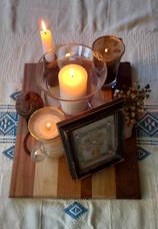
We still had children with us when we began lighting Advent candles on our dinner table years ago. Keeping it simple, we sang “O Come O Come Emmanuel” every night at supper as we lit that week’s candle, reminding ourselves of what the season is really about. “Advent” means “the coming,” and Messiah came! On Christmas Day, we sang “Joy to the World!” We had learned about using an Advent wreath from our friends, something that holds four candles in a circle, one for each week. Ours consisted of four cup-size clay pots bought in the local market to use as candle holders, set on a clay tray (find it in the photo above). We had a fifth candle in the center, for celebrating Christ’s birth. We were taking time to remember. To breathe in truth, and be grateful. And often we had guests from our community. The candles brought a great opportunity for sharing what they represented.

Here in Detroit we can dig deeper into the tradition, buy colored candles and an Advent wreath, and read Advent devotionals. They follow the themes of the four weeks leading to Christmas. We can even add in hymns chosen for each phase:

  • The first candle symbolizes hope and is called the “Prophet’s Candle.” The prophets of the Old Testament, especially Isaiah, waited in hope for the Messiah’s arrival.
  • The second candle represents faith and is called “Bethlehem’s Candle.” Micah had foretold that the Messiah would be born in Bethlehem, which is also the birthplace of King David.
  • The third candle symbolizes joy and is called the “Shepherd’s Candle.” To the shepherd’s great joy, the angels announced that Jesus came for humble, unimportant people like them, too. In liturgy, the color rose signifies joy.
  • The fourth candle represents peace and is called the “Angel’s Candle.” The angels announced that Jesus came to bring peace–He came to bring people close to God and to each other again.

The (optional) fifth candle represents light and purity and is called “Christ’s candle.” It is placed in the middle and is lit on Christmas Day.[2]

Hymns that fit the themes:

Week 1: Hope – Come, Thou Long Expected Jesus (Charles Wesley)

Week 2: Preparation (faith) – O Come, O come Emmanuel (John Mason Neale)

Week 3: Joy – Joy to the World (Isaac Watts)

Week 4: LoveHark the Herald Angels Sing (Charles  Wesley)[3]

Then on Christmas Day, choose one or more that say it all to you!

There are many prophecies that can be read to accompany each theme.

We are currently in the first week, reminding ourselves of the long wait that Israel experienced as they waited for their Messiah to show up, and our own long wait as we long for his second coming. On Sunday, the verses in Isaiah 9:2,6-7 (see above) are usually read, and can be repeated at each lighting of the candle throughout the week. Remember: a light has dawned! A just and righteous Forever King is coming! God himself will make this happen!

The true light has already come:

When Jesus spoke again to the people, he said, “I am the light of the world. Whoever follows me will never walk in darkness, but will have the light of life.” (Jn. 8:12 NIV)

He has come, he is the light, and anyone following him will have the light of life!

Light the candle and remember who is the true light. Sing a song of longing for Messiah and his everlasting reign. Contemplate the Word and the way God declared that a Savior, his Chosen One, would come and change the whole course of history. Be grateful that we live in the light as we follow him—not in the darkness that is all around! Breathe in his amazing love!

This theme of “hope” does not connote “I hope so” but “I am excitedly waiting for what is coming.” Baker’s Evangelical Dictionary of Biblical Theology states that its use in the Word has this meaning: [4]“To trust in, wait for, look for, or desire something or someone; or to expect something beneficial in the future.”

Let’s wait expectantly!


[1] https://www.jewishvoice.org/read/blog/prophecies-about-messiahs-lineage-and-birth

[2] https://www.crosswalk.com/special-coverage/christmas-and-advent/the-beautiful-meaning-and-purpose-of-advent.html

[3] Ibid.

[4] https://www.biblestudytools.com/dictionary/hope/