She Was Expecting!

Soon he would arrive!
She felt expectant joy
leaping in her soul
in response to the leaping
of the little one inside her,
the unexpected treasure.

That baby in her womb
was moving now, stretching out
to test the contours of this home,
the strength of legs and feet.
She sang a psalm to him
and he went quiet, listening.

Waiting was a gift of time
to contemplate the miracle
the angel had predicted:
she was chosen, highly favored,
as the vessel that would carry
God’s own Son into the world.

The forever king was coming!
How could it be? She would wait
and see, confident that
this was indeed God’s doing.
The Most High himself
was with her – Gabriel’s words!

I love the season of Advent. It is indeed a time set aside to contemplate the wonder of God’s love: gifting himself to us in human form, carrying the name “Jesus.” There is no way we can truly comprehend the significance of that baby’s entry into the world. It was cataclysmic, totally extraordinary, unexpected in spite of the prophecies that had foretold the event. No one expected their King of Kings to come this way.

And there was Mary, supported by her fiancé, now her legal husband, who also had been directed by an angel to be Mary’s protector in this sensitive situation. Her cousin Elizabeth confirmed that this pregnancy was supernatural. And the song that Mary sang in response (Luke 1:46-55) shows that she had been meditating on God’s promises throughout the Scriptures. She had the words of the angel, and the written Word, giving her assurance. But she really had only the vague outlines of what this son’s coming meant. What did others think? Did they even have an inkling of the truth about what was about to happen?

Probably not. And that laid-back ignorance is what this merry Christmas season all too often reflects today as well. The majority of people around the world who observe the holiday love the decorations, the jolly music and the exquisite lights. Gift-giving is a way to show love, and gathering together encourages friendships and family closeness. All good stuff! I love it too. But the precious miracle that birthed it all is viewed as a kind of folk tale or mythology, more distant than the fun of Santa Claus and reindeer.

In spite of that, the Truth remains, and we hold on to it with joy. This wait that constitutes Advent is not like the long waits that we often deal with in the rest of life, the ones that make us cry out: “How long, Lord?” Those require much growth in faith and perseverance, through hard personal struggles or in distress at the chaos in the world. In contrast, as we wait during Advent we remember God’s goodness and the amazing means he took to come to our rescue.

When our children were young we adopted the practice of lighting four candles in an Advent wreath, each on its designated Sunday, with a fifth one lit on Christmas day. Along the way we adapted the tradition to be a daily reminder of our wait for the coming of our Lord by lighting the candle for that week at each supper and singing “O Come, O Come Emmanuel.” With time, we learned the symbolism of the four candles that are lit each Sunday before Christmas Day:

               1: hope – the prophets predicted Messiah’s coming, with expectancy

               2: faith—prophecy involves faith that God will do what he said he would, such as Micah’s prediction that the birthplace would be Bethlehem

               3: joy – a reminder that Jesus came for those who are humble, ready to receive him; his coming was also heralded by the angels as a message of great joy

               4: peace – as the angels said, Jesus came to bring peace, bringing people into a right relationship with God and with each other

               5: light and purity – on Christmas Day we remember that the Light of the World has come!

We thought that the three purple candles were the first ones lit, then the pink one on the fourth Sunday, with the white one being for Christmas Day. It turns out that most traditions light the pink one on the third Sunday, since that color traditionally symbolizes joy. And not everyone uses the fifth white candle.

What is important is that we take advantage of this opportunity to be constantly reminded that our Rescuer did come as God had promised, and that knowing him gives us confident hope and thriving faith. We can turn our attention to the Light that reveals God’s true heart and his great plan, being filled with deep joy as we remember his astounding self-sacrifice and the promise that it gives us of life forever with him. All of this changes the atmosphere around us to expectancy.

I am reminded of when I was nearing the last month of pregnancy, eagerly awaiting the birth of our son Bryn in 1986. We were in Ferkessédougou, Côte d’Ivoire, and I had prepped his big sisters, Marisa (almost 9) and Ariane (5), about the processes that would go along with giving birth. One day when I opened the upper door of a cupboard, a small gecko fell off the door and into the scooped neck of my maternity dress, scurrying down my body to land on the floor. I shrieked, wondering if it might be a scorpion. The girls came running to me, grinning, thrilled: “Are your waters breaking, Mom???” I had to laugh. “No, that gecko just fell into my shift and I was scared!” I have never forgotten the excitement of their hope. They could hardly wait for that baby to arrive!

That is the kind of joyful expectancy we can cultivate during this season, eager for Messiah to show himself ever more clearly to each one of us as we remember the wonder of his coming, and are reminded that he is coming again!

Picture Her Emerging!

OLYMPUS DIGITAL CAMERA
Picture her emerging
wrung-out soul
new-bodied
whole
entering Light
breathing Air
	strong
		delicious
			free
	strong
	 	sustaining
oxygen-hunger
left behind
with
shrinking bones
and all the
	long
		weakness
	
	long
		waiting

She lifts hands high
(no more
trembling)
laughing voice
full of strength and
	song
		tripling
			joy
	song
		rippling
 
She’s running
meeting loved ones
painted indelibly
in her heart
lost
and missed
	gone 	
               before
	now	
	       new-found

She’s wrapped by
arms finding
precious wife,
Beloved Elva,
Mom, sister --
she whirls
and pearled tears 
	run rivers
		down
	cheeks blushing 	
for joy

And then
she sees
Jesus coming –
worlds 
swirl and stop –
centering . . .
He holds her close,
wipes
the wet away
cups her chin
smiles with delight
	dawn
              Sonlight
	            glows
	dawn
              forever

This is how I imagine a scene that took place in heaven yesterday. True, I wasn’t there. But I know that Mom Boese entered there, because she truly loved her Lord and longed to be with him, and he loved her and had shepherded her all her long 100 years of life on earth. I can only imagine . . .

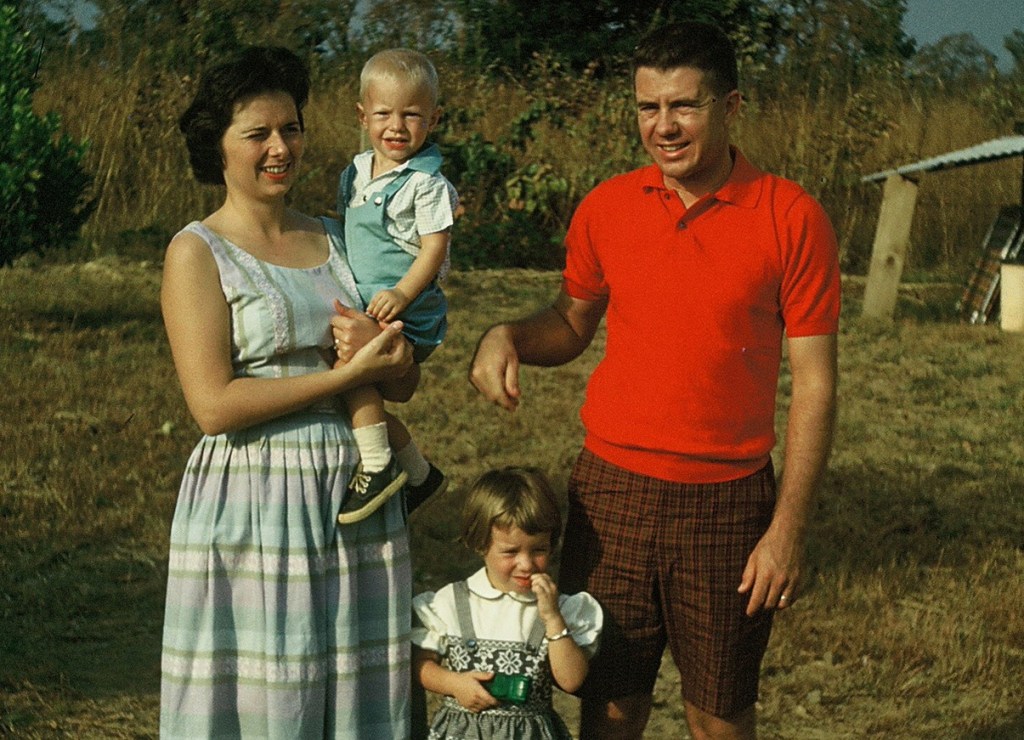
Her husband, Ralph, preceded her there by 10 years. And two of her children are already there: Dan and Diane, the two on the left in the photo (taken 18 years ago). She longed to be re-united with all of them, too.

The confidence we have that our Lord will receive us in this way changes death into the gateway to a wonderful new life.

Jesus himself said, “Do not let your hearts be troubled. You believe in God; believe also in me. My Father’s house has many rooms; if that were not so, would I have told you that I am going there to prepare a place for you?“ (Jn. 14:1 NIV)

And Paul explained: “So just as sin ruled over all people and brought them to death, now God’s wonderful grace rules instead, giving us right standing with God and resulting in eternal life through Jesus Christ our Lord.” (Rom. 5:20 NLT)

It breaks my heart that so many people have no such hope of life forever in that special place, in the company of our Lord. Many picture us becoming a part of the universe, the starry sky. Others say it is all over, a complete end of everything. This lack of hope shows up all over the world.

Mom and Dad Boese came to Côte d’Ivoire twice, spending several months each time. They adapted beautifully and learned to love the people there. Ever since, Mom has prayed for the Nyarafolo constantly, especially for our houseworker, Sikatchi, who she had helped train in our style of housekeeping. They had developed a very special attachment, so it was not a surprise that when we asked that a Nyarafolo name be chosen for her, it was “Siɛncɛnwɛ,” which means “beautiful person.” They shared no common language, but actions, kindness and facial expressions speak volumes. That smile!

One of the things she excelled in was saying “Thank you!” I remember hearing that response in many circumstances, but especially in her last days of her life, when she was still lucid. Whatever any of us did to help her, we heard “Thank you!” It was one of the characteristics that made her a “beautiful person.”

Names matter more to the Nyarafolo than they do to most of us in American culture. Every name has a carefully chosen meaning. In our early days there, I asked my closest Nyarafolo friends to choose a name for me, since “Linn” was unknown to them, and many were calling me just “madame.” Saly, a close friend, consulted other women, and they named me “Penyuɔnɛkuɔ.” When I asked the meaning they told me that it says that after you help people, they forget to be grateful.  “Really?” I said. “I wanted a good name!”  “It is a good name,” they assured me. “It’s so true!”

It took me a while to realize that it is like a proverb, which is loved in that culture, and that it appears all over in the Bible. I began to write my name next to verses that underlined how often we humans forget what we owe to our Rescuer, and are ungrateful. Israel often forgot and turned away from him; this led to disaster. So the Lord said: “I brought you into a fertile land to eat its fruit and rich produce. But you came and defiled my land and made my inheritance detestable.” (Jer. 2:7 NIV)

We are often so wrapped up on our own plans that we forget to even thank our Rescuer, our Healer, like the nine men that Jesus cleansed of their skin disease or leprosy, who ran off to rejoin their community without acknowledging who had healed them at all. Only one man returned to thank Jesus, falling down before him, when he realized the healing that had taken place (Luke 17:12-19).

Do we forget to be grateful to God for all he has done for us? It is all too easy to fall into that trap. So today I want to thank him for the gracious favor he gave me in this mother-in-law named Elva Boese.

The gift of her son, Glenn, is the first thank-you that I owe her. I am so glad that she raised him to be responsible and loving, and encouraged him to be a cook! She truly accepted me as her daughter, caring for me and my children in many loving ways – even taking us in to live with her and Dad Boese for three months in 1983, doing the cooking, cleaning and much childcare while I wrote my master’s thesis. She told me that after the time she spent with us in Côte d’Ivoire she no longer was hoping that we would only stay there a few years; no, she knew it was the best place for us to serve our mutual Master and she completely released us to keep on keeping on. She gave us some of her handmade items, keepsakes. She openly shared her spiritual journey and her prayers. And this past year, she was the one who incited me to publish some of my poetry by telling me that the only gifts she wanted from us for her birthday and Christmas were books of my poems. Sorting them, deciding which ones to print for her, led me to notice the theme that I published this year as When He Whispers: Learning to Listen on the Journey. The Lord used her to prompt me, and I am grateful!

I could say more, but that gives a sampling of the gift that Mom Boese was to us. I’m glad that now she is receiving her reward from the One who loves her more than any of us can.

Thanksgiving is just around the corner! It is an annual prompt to remember to be grateful, not only for all that we enjoy but also for the One who made us, and loves us:

Give thanks to the LORD, for he is good; his love endures forever. (Ps. 107:1 NIV)

How Long?

Father, our hopes are drying up
just like the earth, turned to dust;
just like the leaves, shriveled to paper.
No sign of change; no rain. 
How long must your people wither,
shiver in thirsty air
that claims all moisture as its own?
Tears are gone with the wind.
Our hearts ache and find no solace.
How long must our eyes burn,
longing, searching the horizon
for some glimpse of hope?

Slap the violent out of their arrogance!
Pull their stolen chairs out from under
their fat bums, grown gross 
from slurping up the profits of the poor!
Nail them to the crosses
they’ve erected for the innocent,
judging them guilty
for their names or point of view!

How long, dear King, our Father?
We know you rule the universe.
Let us see your justice—
we beg this of you!
Hear our prayer, this petition
signed in anxious trust. . . 
all our hope is in you.

The gorgeous colors of Michigan’s autumn are fading away; leaves are mostly on the ground. The tree skeletons wait, ready for winter. When I wrote the lament “How Long?” we were in a similar season in northern Côte d’Ivoire: the glorious greens of rainy season were gone. Leaves were either withered and fallen or covered with dull brown as the harmattan wind blew in, plastering everything with dust from lands north of us. It seemed like a picture of the divided country’s hopes. Withered. Dried up.

We were dealing with years and years of rebel rule all around us, with political figures in government in the south who seemed most interested in amassing personal glory and wealth. The south was deeply suspicious of anyone from the north. The stories of violent oppression were circulating. A woman had been pulled off a bus heading toward the Ghanaian border she disappeared. Her name labeled her a northerner. A man heading into the southern territory from the north on a bus was shot at a police stop; he had the wrong name, too, one associated with a Muslim people group but widely applied to others as well. And a man in our town was killed by a rebel unit when one of his actions disgruntled the local rebel leader.

We were trying to help certain students from local families get accepted into vocational training programs in the south. After a while it became clear that one had to give a huge “gift” of money to those in charge, or there was no hope of getting accepted. These poor northerners were constantly left out.

Could there ever be peace? Could the country become reunited?

“How long” has been a theme of countless followers of our Lord, for centuries.

 I am absolutely terrified, and you, LORD – how long will this continue? (Ps. 6:3 NET)

O Lord, how long are you going to just stand there and watch this? Rescue me from their destructive attacks; guard my life from the young lions! (Ps. 35:17 NET)

How long, LORD, must I cry for help? But you do not listen! I call out to you, “Violence!” But you do not intervene! (Hab. 1:2 NET)

And there are multiple times in the Scriptures when those same words are launched back at the people:

“You unbelieving generation,” Jesus replied, “how long shall I stay with you? How long shall I put up with you?” (Mk. 9:19 NIV)

“How long will you simpletons love naiveté? How long will mockers delight in mockery and fools hate knowledge? (Prov. 1:22 NET)

Is the “how long” song familiar to you? My prayers still lean that way at times. Just reading the news headlines confirms that violence is a daily norm, that fake news spreads like wildfire, that the pandemic is not over since cases are actually rising.

It may not be the national or world situation that is so distressing. Other social fractures, or sickness, or loss and grief that do not seem to get healed, all fuel the same kinds of lament.

From our limited perspective there often seems to be no hope, no response to our prayers. This is when we need to renew our trust and notice the answers that may be sliding in sideways. God’s purposes are often hidden to us. We need to dismantle naiveté and keep our eyes and hearts open to what he desires, to grow in knowing him and his ways.

At the same time that all that corruption and disunity was breaking our hearts in Côte d’Ivoire, the Lord was doing some amazing things.

One of the young men from Tiepogovogo, where we had been planting a church, had just finished one year of pastoral training when the war and crisis forced the school to close for a while. So Fouhoton Pierre was back home in his village. He used that change in plans to spend time visiting people in neighboring villages, telling them about Jesus and how he had changed his life. Suddenly the struggling little body of believers in Tiepogovogo was growing, welcoming lots of new believers walking from neighboring villages to fellowship with them. Fouhoton realized that some people in more distant villages were needing to be discipled as well, meeting with them where they lived.

Not squelched by the dangers all around, the Nyarafolo Group that had been meeting to make songs in their traditional musical style began to plan Bible conferences, choosing a different village each year so as to encourage the various groups that were scattered in the region. The first one to take place after our return in 2006 was at Pisankaha, where the very first small group of Jesus Followers had begun in 1964. For years they had been the only group of Nyarafolo believers. At the conference the Pisankaha believers told stories of how the Lord had brought them through years of persecution from the Sacred Forest (the men’s society in the traditional religion), and how much they had learned to trust their Lord. The Nyarafolo Group put on a dramatic skit that told how Abraham’s faith was tested as he offered his son Isaac as a sacrifice, obeying God, and how God answered with a great solution, confirming Abraham’s faith as real. Everyone came away encouraged. And for the first time ever, they heard part of God’s Word read to them in Nyarafolo. My co-translator, Moise, and I were working on translating Genesis, and the Abraham story was now in their language. As he read it they were transfixed.

There were many other things happening, too. But those are examples of the way that the Lord was still at work, even when the broader country situation did not seem to be changing.

We need to rest in the confidence that the King of the Universe knows every detail of our sorrows before we even express them, and is not shocked at our cries of distress. He has heard them for thousands of years. And even though we may not see the answers we are hoping for right away, or in the way we are hoping to see them, we can trust his goodness, kindness and love. He still has undercover projects going on. He still is at work drawing people to himself and testing the solidity of the faith of others. We are indeed being sifted, or you could say that true colors are showing up through these processes.

May we choose trust! And when we cry out to him, may we be willing to wait to see how he will work, always listening for his voice! We know that he accepts our petitions and loves to see us lean on him, honestly expressing our needs as well as our confidence in him.

All our hope is in him.

I call to you for you will answer me, O God. Listen to me! Hear what I say! Accomplish awesome, faithful deeds, you who powerfully deliver those who look to you for protection from their enemies. (Ps. 17:6 NET)

Waiting on You

No dark corners, Lord –
set the lamp high,
turn up the glow,
show up the shadows
for what they are
	dust that needs sweeping,
	empty spaces,
	or hidden wonders.

My soul is before you,
the wide-open mouth
of a mammoth cave,
hungry for light,
 hungry for you:
	fill up the cavern
	with Spirit of God,
	light me with you!

This long night walk, Lord,
saps my courage.
I can’t see clearly,
I come to a crossing
and have no clue:
	should I continue!
	should I turn left?
	is right now right?

My life is before you,
mid-chapter, mid-verse,
an open book with
the page almost turned,
the plot complicating –
	turn the page swiftly,
	shine your light on it,
	move the plot on!

You have probably been at that point too, once or several times, that moment when a choice must be made but the way forward is unclear. Those of us who have decided to trust the Good Shepherd and his guidance can find it hard to understand which way he is pointing. We long for clarity, but in that critical moment the one thing we are sure of is that we do not yet know which way to turn, or what the consequences of each choice might be.

Back in 2006, we had been evacuated for three-and-a-half years from the country where we were serving as missionaries. Our son had reached adult status and was a freshman in college, so we would no longer be taking a minor back into an extremely volatile situation if we were to return. The country, Côte d’Ivoire, was still divided in two, with the government ruling the south and rebels holding the north where we had been living. If we returned, there would be danger, with no rule of law and supply chains fractured. But other mission partners were there, dealing with it all.

I was finishing my last classes for my M.Div. at Michigan Theological Seminary, even doing some of them long-distance while accompanying my younger sister through her battle with leukemia. That blessing of being able to be with her during her last months on earth kept us confident that we were to be in the U.S. Then she passed away. Knowing that we had much yet to accomplish in our various ministries, we felt it was time to return. We’d had enough of that mid-chapter phase.

Once that decision was made, we received confirmation from the Lord, that peace within that comes when you take one step forward and sense that you must continue in that direction, that he will guide the next steps too.

We went through the heartbreaking familiar process of saying goodbye to our kids and our parents, and headed to Côte d’Ivoire. Re-entry brought back the memories of that wrenching evacuation, with no closure back in Ferke since we had been at a training session in Bouake when war broke out, with no opportunity to say goodbye to our national friends and ministry partners. But now there was great joy in being reunited with precious “companions of the Road” in the Nyarafolo community. Glenn had been back a few times on short trips to ensure that co-workers could continue their various new ministries, adapting to the new restrictions. I had not been back at all.

The drive north from Abidjan on the coast, passing through the government checkpoints in the south, and then the numerous rebel barriers across the roads in the north was an introduction to the next years of living in the divided country. The north was without government services, so there were no police anywhere. There were frequent water and electricity cutoffs which the government was using as weapons to weaken the hold of the rebel forces.  

Fear became a continual challenge for me. Did I really trust my Father’s promises to watch over me? Did I have confidence that he would provide a way when there seemed to be no way? People were dying at the whim of any rebel leader in their area who became upset with them. We missionaries had a certain amount of protection due to our status as caregivers, with the mission hospital (where Glenn worked) the only one still open in the region. This definitely helped us pass through all the road barriers. But we knew that those desperate for gain also viewed us as “rich.” Could I let go of my anxieties and pursue the kinds of ministry that were still possible?

It was a story the Lord was writing, and the plot seemed to be at an ongoing climax with no resolution in sight. This forced me to actually put my trust in him, come what may, and focus on navigating the part of the path that I could see before me. I got back into Bible translation work. It had been on hold since the rebels had taken over in the fall of 2002, with my Nyarafolo coworkers doing what they could in literacy work, outreach, and literature development, and one of them down south studying at the seminary that was dealing with most faculty evacuated as well. Delving into God’s Word with purpose, discussing the treasures with my coworkers, hearing their stories –it all grounded me again in the walk of faith.

God answered my prayers, daily. I asked; he gave peace and encouragement. He used the difficulties to show me what was hidden in shadows in my heart. He is the Light in the darkness, and I learned to trust that truth in a whole new way as he clarified my purpose and opened me to his promptings:

35 Take care then, that the light in you is not darkness. 36 If, therefore, your whole body is full of light, with no part of it in darkness, it will be entirely illuminated, as when a lamp shines its light on you.” (Lk. 11:33 CSB)

He is good, and although his answers may not be just what we expected, they are what will accomplish his purposes in us and through us. Luke 11:9-13 spoke to me as I asked for guidance:

“So I say to you, keep asking,and it will be given to you. Keep searching,and you will find. Keep knocking, and the door will be opened to you. 10 For everyone who asks receives, and the one who searches finds, and to the one who knocks, the door will be opened. 11 What father among you, if his son asks for a fish, will give him a snake instead of a fish? 12 Or if he asks for an egg, will give him a scorpion? 13 If you then, who are evil,know how to give good gifts to your children, how much more will the heavenly Father  give the Holy Spirit  to those who ask Him?” (Lk. 11:9 CSB)

I have many more stories to tell, and they will be coming. But right now, I just want to reach out to any of you who are dealing with scary circumstances or shadows on the path, and encourage you to keep on trusting the Guide, the Author not only of our salvation but of his plan for each of us. He loves us with a depth that no one else does. He just asks us to trust his heart, believing that he will show a way when there seems to be no way!

The Forest Dance

White bark peeling but holding on,
the birches spike high into the sky,
into the blue, craving sunlight.
The pines do too, brown bark firm,
graciously extending multiple arms
fringed with green lace to hug their neighbors.
The birches’ golding leaves whisper gratitude
as wind incites community dance.

Breath of heaven, may we respond
this same way, growing together,
drinking in light, mutuality our song
as we embrace unity and grow together,
our palette of colors stunning the world.

Let’s take a moment to go up north again into the forest in the Upper Peninsula. The community of trees fascinated me; I took photos every time I walked around the lake. But most of all I drank in the daily beauty of the evergreens and birches right in front of the window where I sat each morning.

There was a surprisingly obvious face silhouetted on the left side of the birch closest to me. Yes, it was sculpted by the peeling birch bark. He was so contemplative, and I guessed he might be watching all that was going on in neighboring trees and enabling me to see some new truths in the way that they were growing together.

The trees each obviously had one ultimate purpose: shooting straight up to get the sunlight essential for their health. They were close together, with a few lower branches reaching out to touch a neighbor, whether it was another birch or a pine. But most of their leaves, especially for the birches, were higher up. When the wind blew and the rain fell from the sky they all danced, especially the birches, whose leaves were also turning golden and falling one by one. Their neighbors, however, stayed dark green, while dropping some needles and cones. Very different species, but living in harmony. They touched each other, branches waving, heads bowing.

All the turmoil going on in our world these days, even in our church communities, is often like that strong wind and rain as it pummels the pines and birches. They sway, their branches sometimes hitting each other, but they stay together. When one gets toppled it often lands in the arms of its neighbor, who holds it up as long as it can.

The birches and evergreens really differ from each other, and other trees add to the diversity, such as oaks and beeches. People are also very different from each other in our communities of believers. Maybe the difference is ethnic or racial, maybe it’s political opinion or musical preference. Whatever it is, we are called to stand together, held together by the bond of mutual affection:

For this very reason, make every effort to add to your faith goodness; and to goodness, knowledge; 6 and to knowledge, self-control; and to self-control, perseverance; and to perseverance, godliness; 7 and to godliness, mutual affection; and to mutual affection, love. (2 Pet. 1:5 NIV)

And what is that reason? To share in the divine nature (v. 4), which means to be like our Lord! A series of virtues is listed, each one important. But when I think of community living, it is the last two that intrigue me. What is the difference between “mutual affection” and “love”? Mutual affection is what many translate as “brotherly love,” which is caring for one another in the Family of faith. “Love,” here, is agape. A great way to understand agape is (according to the Danker Greek New Testament lexicon) “a relatively high level of interest in the well-being of another.” That can reach beyond the boundaries of mutual affection in the Family. Say someone is in a difficult or bad situation, in or outside the group; “agape” love reaches out to offer help. It is like the love of God expressed in John 3:16, his love for the world. While we were still sinners, Jesus died for us!

Growing in this kind of love cannot be done if we ignore each other, or just lash out instead of listening to each other.

So even though we may be very different people, we are to live out this truth that we need to grow together, demonstrating unity. We all need to seek the Light (like those very tall trees reaching past all other growth to absorb the light that gives life). How do we do that? By growing in our knowledge of the One who is the Light of the world, through his Word, and by living in his Presence and following his instructions. And the two commands that englobe all the others are, as we keep reminding ourselves, to love God with our entire being, and to love our neighbor as we love ourselves. If we can grow ever upwards in the Light, and ever more in harmony with our diverse neighbors, we will be a forest full of beauty even as the seasons change or storms sweep through. Like the tree that provides a resting place for the branch or trunk that is blown over, we can find ways to provide support for the weaker person and forgiveness when we take a hit:

Bear with each other and forgive one another if any of you has a grievance against someone. Forgive as the Lord forgave you. (Col. 3:13 NIV)

White peeling birches, mysterious dark pines, sturdy oaks or other varieties – whoever we are, let’s each do our part to grow together into a beautiful community!

Drenched but Keeping On

Somber clouds seemed to be
on the horizon, but suddenly
they spread overhead
and the sky was weeping.

Unprepared, I was still
two miles from my goal,
the cabin across the lake.
No umbrella. No hood.

Forty-eight-degree-Fahrenheit
water was chilling my head
and shoulders, soaking
through jacket and jeans,

leaving pearly droplets
all over my glasses
My normal gait turned
into an energetic power walk.

I kept my path under branches
leaning over the road
but autumn was passing,
leaves mostly crunching underfoot.

My calming hour in nature
had become almost a run.
Would rescue come?
Should I keep on keeping on?

A voice within chuckled,
urging me to notice
“this long obedience
in the same direction.”*

It would take determination;
this trial would breed patience,
perseverance. I could indeed
make it home, drenched but fine.

My fast pace thumped rhythms
of joy in the challenge,
and I sang “Amazing Grace”
as I weathered the storm. 

Did you notice that serious staring face in the cloud just over the road, in the image above? I took that photo several days before I got drenched by such a cloud, but I should not have ignored the warning. Those dark clouds can sneak up on you and have unexpected impact!

Intermittent rains punctuated our last days at Piatt Lake, so whenever the sun came out we knew it was time to get outside. I am a walker, and the 3.6-mile (according to my step-tracker) trek around the lake was not only exercise but a time for meditation on the beauty of creation. I just had to stop and take pictures along the way: a village of mushrooms, lily pads on the lagoon or by the bridge, and the autumn colors of crimson and gold even as they turned to deep rust.

Sometimes I grabbed the umbrella found in the closet, one my mom had left behind as part of the whole cabin’s legacy. Of course, those days it did not rain. But on this last trek I shrugged off the threat of rain, left the umbrella by the door, and got caught in a long downpour. Two miles of speed-walking a muddy road in that cold weather was not in my game plan. I have often commented that my preferred temperature is 79 degrees and above. The wet onslaught felt icy. It was soaking through my gloves and fall jacket, and there was no forest shelter left over the road.

When joy penetrated the slight panic in my heart I realized that I was being made to see an obvious parallel with that teaching in James:

Consider it pure joy, my brothers and sisters,whenever you face trials of many kinds, because you know that the testing of your faith produces perseverance. (Jas. 1:2 NIV). Okay, so here is another test run, I said to myself. Can I experience joy in this increasing freezing downpour and make it home? It should be good training!

I did make it home. But to keep myself going, I sang, silently, and “Amazing Grace” repeated itself over and over as I pressed on. I have already been rescued, not only from doom but also from a long walk with no meaning: God’s grace has truly brought me through many “dangers, trials and snares” during my life journey. I do have adventures and challenges to write about, memories that encourage me because every time, it was the Lord who made a way where there seemed to be no way.

Perseverance on the race here on earth will make us “mature and complete” (James 1:4). That is a much higher goal than the desire for physical fitness that keeps me walking! Rain penetrating my hair and coat, I was no longer feeling the intense cold now that my heart was doing a great job, circulating warmth to my body as I pushed ahead with my power walk. Grab that imagery and apply it to the long walk of obedience Home: as my heart beats more and more in rhythm with my Lord’s heart, he builds endurance into my character and walks with me all the way to destination, each time that there is a challenge along the way. And eventually I will reach full maturity, my fears put in perspective, his song breathing joy into the journey.

It was not my idea of a great last circuit of this lovely lake. Underneath my jeans my skin felt frosted. I had to hang up my garments to dry and take a hot shower. But my heart was stirred by the message from my Lord, and I can see that the rain was a blessing, after all.

Something like that cloud-face might spook me, and I might get caught in a downpour, but I just need to remember who is always with me, no matter what happens. He can remind my heart that he is the source of my joy, even in the tough times. He will help me finish the race.

Are you feeling drenched by a storm? Don’t focus on the dark clouds. Rather, remember to exult in the confident hope that those of us who belong to the Good Shepherd share: his goodness and love will pursue us, ALL the days of our lives!

Surely your goodness and unfailing love will pursue me all the days of my life, and I will live in the house of the LORD forever. (Ps. 23:6 NLT)

Like me, you may have learned that verse as “Surely goodness and mercy will follow me all the days of my life.” It was in the process of struggling to translate it into Nyarafolo that I learned that “mercy” was hesed in Hebrew, what is now mostly translated as “unfailing” or “steadfast” love. No English word can convey the whole meaning, but this kind of love is faithful. It can be counted on. And it does not just “follow me,” which I picture as just coming behind me like a shadow. The Hebrew word there is radap, which means “pursue.” That is powerful. My Shepherd’s love is constant, purposeful and chases me down, never leaving me alone; his goodness does the same thing.

He walks with us, and he can give us the strength to do whatever kind of “power walk” is necessary to face the challenges. We just need to be aware, thankful for this amazing grace, and persevere.

This Momentary Mist

Powdery mist lifts
off dark waters
as the sun calls out
from the lake’s far end,
beckoning morning to begin.

The translucent clouds 
obey, heading east
then gradually vanishing
into the light,
having finished their course.

I am like these vapors,
called to come
by the Son,
made to live this moment
where I am.

I might have just
one minute left.
May I reflect Him
and the grace He gives
before I am no more!

We have been spending this past month in Michigan’s Upper Peninsula in Chalet Shalom, the legacy left our family by Mom and Dad (Dwight and Barbara Slater). The Chalet is on the south shore of Piatt Lake, surrounded by forest. My morning haunt has become the ancient desk in the Pine Room that looks out through evergreens and birches at a stretch of lake bordered by forest on the other side. Most mornings as sunlight begins to edge over the eastern edge of the line of trees, mist rises off the waters. The wind blows it gently toward the sun. And then it slowly disappears.

I’ve been meditating on James 4, and the parallels cannot be missed.

One of our quests in this early retirement phase is to discover what we should plan, what activities we should join at church or in the community, how we should spend our time. James warns, in 4:13, that the danger for believers is to focus on self-interest. His example is making plans to enrich ourselves by focusing on some business that we will accomplish somewhere, next year. Then he says:

Why, you do not even know what will happen tomorrow. What is your life? You are a mist that appears for a little while and then vanishes. 15 Instead, you ought to say, “If it is the Lord’s will, we will live and do this or that.” 16 As it is, you boast in your arrogant schemes. All such boasting is evil. (Jas. 4:14-16 NIV)

The older we get the more we realize that it is true:  we are “a mist that appears for a little while and then vanishes.” Only our Lord knows what tomorrow holds for us. Planning my activities without relying on his guidance is arrogance! This also requires letting go of control and of my fixation on what I desire. My existence is dependent on the Lord’s will; if it is in his plans, I will “live and do this or that.”

This actually takes the pressure off me and leads me to a place of quiet rest, waiting for him to show me how to live out his plan, moment by moment. It means remaining alert to his directives. He may open the door to certain ministries; he may indicate that it is time to rest after running a marathon, or time to deal with physical infirmities. What is key here is recognition that life will not last forever, and in each moment my responsibility is to be tuned to him.

Verse 17 rounds out this segment with another warning:

If anyone, then, knows the good they ought to do and doesn’t do it, it is sin for them. (Jas. 4:14 NIV)

Ouch! If I see an act of kindness or justice that I should do, but I turn my head away, this is not right. (The word “good” can also be translated “right”, cf. ESV, NAS.) Something I had not realized until studying the book of James more in depth is that when the author talks about the “law” he refers to the “perfect law that gives freedom” (1:25), and that those who truly love God and who will inherit his kingdom (2:5) and life there (1:12) will persevere and keep on doing the key thing he has asked them to do, the right thing:

If you really keep the royal law found in Scripture, “Love your neighbor as yourself,”1 you are doing right. (Jas. 2:8 NIV)

James points out that this includes caring for the needy, practicing impartiality, being a peacemaker – the list goes on. So here I am, in this moment. How is the Lord asking me to live out his royal law, doing what is right, right now in this gift of time?

The unpredictability of life’s span was underlined for us this spring when Glenn’s sister, just a few years older than he is, died suddenly during the night. She had traveled from Pennsylvania to Michigan to spend several days with her mom, Elva Boese – the one who just turned 100 this month. Diane was known for her kindness and her affectionate ways of encouraging people, and that week she cared for her mother with those giftings. She expected to leave early Good Friday morning to go home for the holiday weekend, but she woke up in heaven instead of here on earth. Her husband, Pete, now reminds us all frequently to always remember to say, “I love you,” never knowing what may come next. Those words are powerful acts of kindness too.

Jesus told his disciples that if they practice loving their neighbor, as well as loving their God with all that is in them, they are actually keeping the whole law (Mat. 22:22:38-40). Living out those two will prevent breaking the other commandments.

We are here on earth momentarily, but if we do right, we can make a difference in the lives of others. And that is what our loving Lord wants. So today, and tomorrow if it comes, let’s do our best to listen for his prompting and follow through, living this moment the way he wants us to. Working at being more like him.

P.S. The poetry that I journaled over the past 20 years, about becoming sensitive to the Lord’s promptings, was published this year, When He Whispers: Learning to Listen on the Journey. You can find the book on the following marketplaces:

Direct from the publisher, WestBow Press: https://www.westbowpress.com/en/bookstore/bookdetails/824658-when-he-whispers

Amazon: https://www.amazon.com/When-He-Whispers-Learning-Journey/dp/1664224106/ref=sr_1_1?dchild=1&keywords=when+he+whispers+learning+to+listen+on+the+journey&link_code=qs&qid=1620606002&sourceid=Mozilla-search&sr=8-1

Barnes and Noble: https://www.barnesandnoble.com/w/when-he-whispers-linnea-boese/1139300248?ean=9781664224100

Christian Book Distributors: https://www.christianbook.com/when-whispers-learning-listen-the-journey/linnea-boese/9781664224100

100 Years: A Life Lived Well

Navigating a century, 
a span of 100 years, 
is no small feat!
But she did it with joy. 
That’s not saying it was easy!

What brought her through
was the realization
that she is never alone.
She is daughter of the King,
chosen and loved.
She clung to the truth
and let it overflow to others, 
wherever her life path took her.

And she has now arrived
at this outstanding milestone! 
We applaud her generosity,
her love poured out along the way.
Look around and see
the fruit of a life lived well!

The day that she was born
God’s plan for her took off!
She raised a family to be kind,
love others, use their gifts.
And here’s one special goal 
we know God had in mind:
to reach the Nyarafolo!
She helped to shape her son.
Now look what God has done!

When I met Elva Boese I had just begun to date her son, Glenn. She was 49 then, almost halfway to the century milestone she just celebrated. Of course I had no idea back then what she would eventually mean to me. But I will never forget some of those earliest moments that showed me her sweet character.

The first time I ate with Glenn and his parents in Saginaw, Mom had prepared a special meal of a roast, with potatoes and vegetables. I was just beginning to cut my slice of meat when Glenn and his dad got up from the table. They were done eating! Startled, I noticed that his mom had just slowed down in order to accompany me as I ate. That was the day that I learned that his family inhaled their food and moved on to the next activity. I was used to a family that hung out together at mealtimes – my parents’ medical work often meant that it was one of the rare times we could be together. But I was touched by Glenn’s mom’s selfless change of her norm, for my sake.

Another time, I was told that Glenn’s oldest brother, Dan, was celebrating a birthday. Glenn was the youngest of six kids, and when I learned Dan’s age I realized that Glenn was only eight years younger than that firstborn! I told his mother that I was astonished at what she had done, giving birth to six kids in just eight years; what devotion and energy that must have required! She assured me that I had miscalculated, so I pointed out how true it was. She had never realized what she had done, just doing her best all those years of raising a family!

After Glenn and I had been in Côte d’Ivoire in ministry several years, she and Dad Boese came out to live with us and help as they could. I had just hired a young Nyarafolo man, Sikatchi, to help with housework so that I could devote more time to my linguistic work on his language and also begin homeschooling my daughter. Mom and Sikatchi had no language in common, but she mentored him, sharing her housekeeping skills. The most challenging was teaching him to sort the laundry by colors – not knowing that the Nyarafolo culture only has three colors (white, red and black)!

We were beginning to disciple the first believers in Sikatchi’s village, Tiepogovogo. Often we would go there just to develop our language ability as well as friendships. We were astonished at how much Mom loved being in that simple, traditional village setting. She became attached to one of the oldest women there, the chief’s wife, and would help her with whatever she was doing, such as shelling peanuts. No language was needed for trust and friendship to develop between them.

She still cares intensely for Sikatchi, asking for news about him, praying for him. We asked him to send her a message for her 100th birthday, and he did – we translated it. His special memory of her is the way she demonstrated her trust in him one night, grabbing onto his arm for security as she walked by a sleeping man that had some character issues. That gesture spoke to his heart!

She has touched the lives of so many people, from her youth to this milestone, dropping out of high school to work to provide for a younger sister’s needs (growing up in a poor family), giving her all to raise her family, sewing a huge number of items to send to needy people overseas or in her area. Now, she cannot do physical service, so she prays, tells her stories to friends, and reaches out to loved ones through Facebook!

Her life story can encourage all of us to live well too, never underestimating the impact of small gestures and selfless generosity. She passed that on to her son, my life mate, something that has blessed me as well as so many others in so many places. Loving a “neighbor” is, after all, the royal law of the Scriptures, the one our Lord and King sees as the key guide for the conduct of his people:

If you really keep the royal law found in Scripture, “Love your neighbor as yourself,”

you are doing right. (Jas. 2:8 NIV)

Most of us will not live 100 years, but we can make a huge difference in this world if we live every moment in a way that communicates love to those around us. In whatever circumstance we find ourselves, let’s be aware of how we can use our gifting or an act of kindness to meet a need or just build trust. We can cross the boundaries that indicate cultural and racial differences. We can work to meet the needs of the poor. And showing love might mean just accompanying a slow eater through their meal or helping someone shell peanuts. These are acts of grace. We never know how they can be used by our King!

Reminder: Notice What He’s Painting

Lord, I’m looking out
my picture window
into a perfect scene:
a sunrise shaft of orange
lighting up gold autumn
and smooth green leaves
and the rippling lake
in spite of looming clouds.
Center stage, the red-white-blue
flaps in the breeze,
picture-perfect.

And I don’t want 
to be here.

The still-dark woods
beyond the brooding mansion
better fits my yearnings.
The flag droops,
breeze lost.
My heart droops,
dreams lost.
If I go into the woods
I’ll lie in the shadows,
sobbing.

So I sit here,
holding my sore heart
up to your healing light, 
noticing the hope
painted by your finger
when I remember
to look for it.

All around us there was evidence of God’s fingerprints, but I often forgot to notice them as we approached the first year anniversary of our evacuation. We still had no idea if a return to our ministries in Africa would be possible. The wait became overwhelming. Lament seemed my one recourse. It was now early fall of 2003. The civil unrest in Côte d’Ivoire was ongoing; the country was divided with the rebels holding the northern half. So many friends, so many “sons” and “daughters” were left behind. I had just begun my personal involvement as Hebrew exegete in the Nyarafolo translation, and my co-translator Moise and I had been loving our first project, Genesis. Glenn and I were discipling new believers in a village very special to us, Tiepogovogo, and had just sent off one of its young men for pastoral training. Was our participation in all this to come to a grinding halt?

We actually had much to be thankful for, and needed to remember to take note of it. Bryn was doing well adapting to high school at Southfield Christian School. The mission and our supporting churches had granted me permission to continue my studies at Michigan Theological Seminary (which I needed for my translation involvement) while Glenn worked as a contact with pastors in the region. We had friends and supporters praying with us, and time with family.

When our six-month reservation of an apartment provided by our church for missionaries came to an end, and we had nowhere else to go, a loving family from our church, Lyle and Sylvia Algate, offered us their basement apartment. It looked out on a beautiful lake, and the sight of water has always been one of my places of renewal. It was exactly what we needed. But the morning that I wrote the poem above I was still struggling to find peace and hope in the middle of that “in-between” time. Was I doing all this academic preparation for nothing?

Those months of digging into the challenges of translating Scripture into Nyarafolo had seemed to show me that God had formed me to do this detailed research that required perfectionism. He had definitely prepared Moise to be my partner in the venture, placing a deep love in his heart for the Word, and giving him an intimate knowledge of Nyarafolo culture. We had already discovered some exciting solutions to essential key terms in Genesis, like “covenant”. I longed to get back into it.

On the other hand, I found out that the Hebrew professor at the seminary I was attending had just launched a new course developed for the four of us students that he knew were actually using our Hebrew! He provided a study of Hebrew poetry based on the book of Isaiah. It was scintillating. (And in the future, that background would convince SIL that our team could actually translate the Psalms, something usually only allowed as a final piece of a translation project!)

Glenn had also been able to go back to the field on his own for a few weeks to set things in place so that the Nyarafolo team could continue work in promoting literacy and encouraging believers, and he organized certain things at the hospital as well. For years it was the only hospital open in that northern region! His stories about the rebel activity, the lack of normal resources like fuel, electricity and water due to government cut-offs (a tactic to discourage the “northern” rebellion), and the suffering of friends made it clear that it was not yet time for our family to return. But our hearts yearned to be there.

Pouring out our hearts to the Lord is not a bad thing. As it says in the psalms,

Trust in him at all times, you people; pour out your hearts to him, for God is our refuge. (Ps. 62:8 NIV)

I needed to be honest about my fears and worries and download them into that safe place, my Father’s listening ear. But I also needed to recognize what he was already doing, and trust that he was indeed preparing a good way forward – whatever that might end up being.

There was more: in 2004 the Lord provided us with a house in Detroit to move into, affordable because it had been rehabbed by a mission agency associated with our church. We had no funds saved for a house at that time, but two couples gave us funds for a down payment so that we could negotiate a mortgage. And it was in a Black neighborhood; we knew the Lord had placed us there for a reason. Friends overwhelmed us with their offerings of furnishings. For the first time since we had left for Africa in 1978 we had a home of our own, a place to decorate with African art and store our belongings.

And in 2006 the Lord did open up the way for Glenn and me to return to the field. Bryn was in college. I had finished my M.Div., even while spending many of my last months of study doing it long-distance so that I could accompany my young sister through her bought with leukemia. She entered heaven. Since other things were in place, we went back to Ferkessédougou, knowing it was time to do so.

During that in-between hiatus we learned the importance of paying attention to the signs of the Father’s loving provision. Just as we had experienced in our first years of mission service, what was important was taking the next step that he showed us we should take. Sometimes we weren’t sure if we would land on concrete, mud or thin air. But we needed to trust his character, and he showed us his goodness over and over – even in the beauty of the lake and that early outburst of autumn glory in August 2003, in a place where we had been welcomed with amazing kindness and emotional support.

So if you are in a zone full of uncertainty or other hurts, do pour out your distresses to the Father, our truly solid safe place. He will accept that and respond, in his timing. As David wrote in another season of feeling surrounded by menace:

As for me, I will call out to God, and the LORD will deliver me. 17 During the evening, morning, and noontime I will lament and moan, and he will hear me. (Ps. 55:16,17 NET)

Even if it seems to take ages for the answer to come, he will provide what you need to keep on keeping on:

Throw your burden upon the LORD, and he will sustain you. He will never allow the godly to be upended. (Ps. 55:22 NET)

When Fear is Feathers in the Wind

fear is feathers in the wind
	unsure where to land
	and at the mercy
	of whiffs and puffs
maybes and maybe-nots
	could-bes
	scared to fall
	scared to fly
	scared to uncover 
	the real world yet unknown
too many feathers
	cloud my sight
	and make it hard to breathe
Breath of Spirit,
	blow your clarity
	into this air
	and take me
	to what you have planned
	your destination
light shines on a winding path
	and my soul lands
	at rest in his hands

When life is hanging in an “in-between” zone, fear can take on a whole different character. What does the future hold? No one knows. Except our Lord, of course.

After evacuating from the warzone in Bouake on September 27, 2002, we were trying to figure out what to do next. We were in Abidjan, which the rebels had not been able to take. But they were increasingly asserting their control over the north, city by major city. Our African friends, mission family, and my sister and her family (who had arrived just a few weeks ago) were still stranded up there. What would happen to them?

And what would our next weeks, months or years look like? We contemplated staying on in Abidjan, but were not at all convinced that it would be wise. Tension was high; violence was simmering. Many missionaries from there were heading to the States already. We were lodged at the main SIL center there, processing these things with friends. Word finally came that the American missionaries in the north (including my sister’s family, the Merrys), were being flown out to Accra, Ghana. So we decided to join them there.

It was a time of relief, especially some days at the beach together with Linda Sharp, a missionary nurse also from the north, and the Merrys. But we were all in that quandary of what-to-do-next. Steve (M.D.) and  Kayleen Merry decided to serve at a hospital in Togo, for at least a year, while waiting to see if the war would calm down. We decided to go stay with friends in France for a month, since we had been asked to use the training we had just received (to facilitate Sharpening Your Interpersonal Skills workshops) at a workshop in France in a few weeks. We had already been planning to take a six-month home assignment in the U.S. beginning December.

Glenn had to make a trip back to Abidjan to set financial things in place for the mission. He made it safely back to Accra, with stories to tell. And we flew to France to live with Jean and Holly Richerd in their guest apartment: a former wine cellar that looked out across Grenoble to the amazing snow-capped alps that framed the view.

This too, was refreshing. But we could not escape the sense of being in some unknown space between the known and unknown. It continued during the next year, when we were in the U.S., still waiting. The mission would not allow families with minors to re-enter the war-torn Côte d’Ivoire, so we were in hiatus. The country was not divided north and south, with the rebels in control of the north, just south of Bouake up to the borders with Mali and Burkina Faso. The Baptist Hospital in Ferke was struggling and dealing with rebels seeking medical treatment (no guns allowed past the entry!!) and promising to pay later (which never happened). The single women missionaries who were medical personnel had re-entered and were at work. But we knew that since we had a son in high school, we were in the U.S. until the unrest was resolved or at least until Bryn graduated.

It was all a season of spiritual formation, the hard kind. We feared that we would not be able to go back to the field. We had no place to live if we stayed, after our first 6 months in the church’s mission apartments (they were already reserved after that, for others). We followed the news best we could, and realized that no solutions were being found to the civil crisis Côte d’Ivoire. French troops were there to help keep peace, but tensions were rising and so was the violence.

Then friends from church; Lyle and Sylvia Algate, opened up their home to us, ceding us their basement apartment. It was just what we needed, but still in-between.

Prayer was our recourse, and we cried out continually for the Lord to show us the way forward. He did. That story will be continued next time. But it taught me once again that the Lord’s promises are true. The following verse had been one of my childhood anchors, and it has become a thematic place of refuge in times of waiting for direction. I like the New Living rendering:

Trust in the LORD with all your heart; do not depend on your own understanding. Seek his will in all you do, and he will show you which path to take. (Prov. 3:5,6 NLT)

We all learned it as “he will make your paths straight.” What we were experiencing was that they did not seem “straight” at all, but winding between “maybe this” and “but this door just opened, didn’t it?” The note for the verse in the New English Translation explains well what “straight” meant to the Hebrew audience:

The verb ) יָשָׁרyashar( means “to make smooth; to make straight” (BDB 444 s.v.). This phrase means “to make the way free from obstacles,” that is, to make it successful (e.g., Isa 40:3). The straight, even road is the right road; God will make the way smooth for the believer. (NET note)

The “right road” may not always be an expressway, and we may not be able to see beyond the curves. But the Lord will lead us step by step as he works to remove obstacles, often one by one. I think of Paul’s travels and the way he thought he knew how long he could stay in one city, but things would change and he would need to move on to the next destination God had for him. In the end it resulted in much “fruit.” He did not see a direct path from “here” to “there” the way we might expect.

And that became our story. We were definitely shown the way, but it seemed more like a winding road sometimes requiring detours, and often leading through other crises. All the way, the Lord led us, and we are here to make that known.

I hope this is encouraging to you if you are in a phase of uncertainty and challenges. TRUST in the LORD – he will show you what he has planned, in his timing.