Hang in there:
spin your web,
that intricate weaving
of who you are.
Wait there
in the interval
between up and down,
swaying in the wind,
hanging on by threads
that hold you in place.
Do what I made you
to do—
be what I made you
to be.

Rest there
in the caresses
of my breath
while I take care
of the world
spinning around you,
the hum of flying things,
the babble of masses.
Hang in your silent space
and wait,
ephemeral,
here today, gone tomorrow
but my design.
Mine.

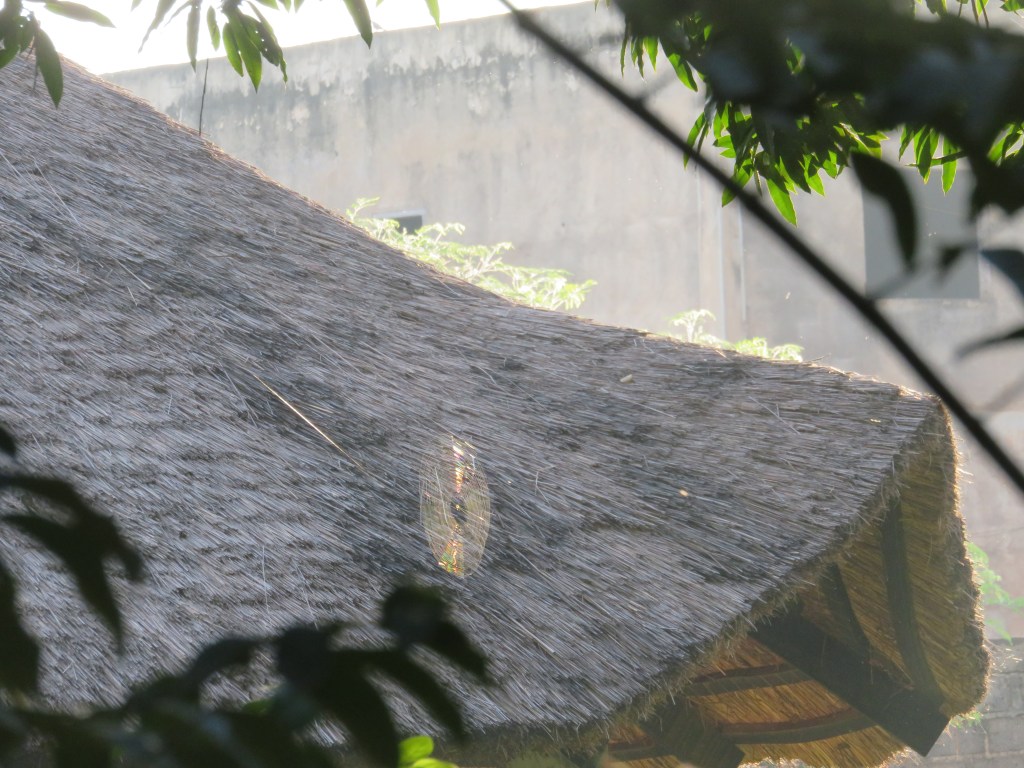
I admit that it’s rare that a spider speaks to me, but this spider web mesmerized my eyes and spoke to my heart in a way I could not ignore. I was in my backyard in Côte d’Ivoire, enjoying the private quiet space reserved for me there on Saturday mornings, reflecting on the whirlwind activities of the past week and the exhaustion in my body and soul, trying to “be still and know” and finding it impossible. Then I looked up and saw the rising sunlight illuminate the ornate oval web, a laced work of art hanging quietly in space, held in place by long invisible strings attached to branches above us. Its job was to do what it was made for: wait, and be there for the critical moment when lunch would fly into its welcoming embrace.
I pulled out my pen, opened my notebook and began contemplating the intricacy of the web and the patience of the spider, quietly waiting. The words flowed out and touched my heart. I had been made for a purpose; my job was to do it, even if it was full of waiting and the challenge of trusting that I was being held by supporting threads I could not see.
My inner being relaxed, reassured of the Creator’s design and plan.
He was teaching me the spiritual discipline of reflection! I did not have a name for it then. But I knew that day after day he was using nature to impress truth on my heart. The birds were singing as they welcomed the new day; I was urged to praise the Risen Son. The smell of coffee as I raised my cup to my lips reminded me of his provision, delight coming out of earth and plants. Insects voraciously devouring a fallen mango could remind me to “taste and see that the Lord is good!” I might touch wet leaves and relish the memory of that rain we had been praying for, that had finally come last night.
The impact of the five senses as contributors to my spiritual growth was not something that I had noticed early on, even though it had been happening all my life. When I began to realize that the Lord was truly speaking through the world around me—whether I was at the beach or dealing with dangerous mudslides on a country road during a storm—the impact was even greater.
This underlines the essential element in reflection: “C.S. Lewis once said that our greatest dignity as creatures is not in initiative but in response. God speaks, we hear. He knocks, we open. He sows the seed, we receive it. Sowing those seeds is God’s attempt to restore Eden to the wilderness of the human heart. Receiving them is how we work with Him to do it.”[1]
We have to be receptive—we have to pay attention! God gave us our five senses for many reasons, and one of them is to be aware of the truth singing out to us from the world he made. “The reflective life is a way of living that heightens our spiritual senses to all that is sacred.”[2] An intentional pursuit of living reflectively involves developing other aspects of our spiritual formation, like practicing God’s presence. If we really believe he is with us and in us, and that his Spirit breathes wisdom and guidance to us, we need to be sensitive to that. Doing so will help us grow in our awareness of what he is teaching us, as well as in the process of transformation that he is accomplishing inside us as we keep company with him.
Contemplation is a key spiritual discipline in a reflective life. It “invites us to enter in to the moment with a heart alive to whatever might happen . . . Contemplatives are open to seeing the unseen world. They sift the days for symbols and scan the universe for meaning.”[3]
Ken Gire writes that as he learned to practice this, even paying attention to the arts, movies, books, and other people, they “all became my mentors, guiding me into a deeper relationship with the world around me. Which eventually led to the world inside me.”[4]
When that “world inside me” is also being fed by the truths of Scripture, the meaning of the symbols becomes clearer. Gire cites passages from the book of Proverbs that picture wisdom calling out in the noisy streets and the city square (Prov. 1:20-21) and at the crossroads and entrances to city buildings (8:1-5). I remember when the Lord called out to me those mornings when my quiet space in my “sacred grove” was being hammered by mechanics working nearby, or politicians broadcasting, or trucks revving up motors. Was my God still there, in the noise? Yes!
Wherever I am, in a quiet moment or in raucous hubbub, wisdom is there, God’s wisdom, “calling us to a different way of living.”[5]
Am I listening?
One of the other books that I believe the Spirit put in my path this year is This Sacred Moment: Becoming Holy Right Where You Are, by Albert Haase. It is rich in many dimensions, but this section leapt out at me:
“Over the years, every spiritual director I had challenged and encouraged me to develop a reflective lifestyle—an unhurried way of living that short-circuits spur-of-the-moment emotional outbursts or reaction. A reflective lifestyle incorporates meditative behaviors and contemplative habits that lead to informed and thoughtful responses. It also values time spent reviewing what’s going on in daily life and reflecting on what the five senses are experiencing, knowing such practices foster sensitivity to the variety of ways in which God calls us . . . It is about looking out the window and cultivating selfless openness to this sacred moment. The authentic fruit of such a lifestyle is the emptying of self for the enrichment of others.”[6]
What strikes me is that there are multiple pay-offs to living this reflective practice. Some of those mentioned are self-emptying, wise responses to words or circumstances, keeping company with God, listening to the Spirit’s prompts, and enjoyment of God’s creation.
All of this is aligned with our citizenship in the kingdom of God:
For the kingdom of God is not a matter of eating and drinking, but of righteousness, peace and joy in the Holy Spirit, (Rom. 14:17 NIV)
Life in God’s kingdom has different priorities than those of the world. It is not about “disputable matters” (Romans 14:1), daily habits and preferences that are not spiritually significant. But it is about doing what is right, promoting and experiencing peace, and being joyful in the Spirit! What does it mean to have joy in the Spirit? In addition to the grace we receive as he leads us, he also gives us that enjoyment of God’s creation and its deeper meaning. Even an exotic spider web can whisper a message in that sacred moment when the heart’s eyes and ears are open to observing and listening.
“Hang in there! . . . Do what I made you to do, be what I made you to be . . . Rest there in the caresses of my breath while I take care of the world . . . Hang in there!”
[1][1][1] Gire, Ken. The Reflective Life: Becoming More Spiritually Sensitive to the Everyday Moments of Life. (Chariot Victor Publishing: 1998), p. 49.
[2] Ibid., p. 75.
[3] Calhoun, Adele Ahlberg. Spiritual Disciplines Handbook: Practices that Transform Us. (Downers Grove, Illinois: IVP Books, 2005), p. 49.
[5] Ibid., p. 45.
[4] Gire, p. 43.
[6] Haase, Albert, O.F.M. This Sacred Moment: Becoming Holy Right Where You Are. (InterVarsity Press: 2010) pp. 75-76.
 Linnea's Lines