On a Thread

It’s a quick walk on a fine thread,
this gift of life, this privilege
of breath and beating heart
and strength to step ahead.
So many disappear, flash out of sight,
thread cut off before its final length
unwinds. We shout “no!” and cry,
and move along, subdued, with more
awareness of the dangers, right 
and left, above and underneath.
It’s a wonder that we live at all,
considering the tragic possibilities
inherent in our threads’ trajectories.

And yet we push ahead, and marvel that 
we share the lavish brilliance of
sunrise, sunset, moon-glow, star sparks,
the precious wash of rain and winds
to dry us off again, the vibrant greens
of grasses and the trees, and sunshine on
the panoply of swimming, crawling,
flying, running, purring, playing,
living things on their own threads.
Woven all together, we are 
the tapestry of Earth. Creation.
Devotion. Delinquency. Destruction.
Survival. Commotion. Celebration.
Revival. Departure. Graduation.

Just one thing holds it together
and keeps it winding towards
a meaningful conclusion, resolution
of stories silenced early
with translation of anomalies 
into the fabric of Truth – one thing:
the Hand of God. I rest in this.
And breathe. And vow to use 
the energy of every heartbeat to 
contribute to his Grand Design.

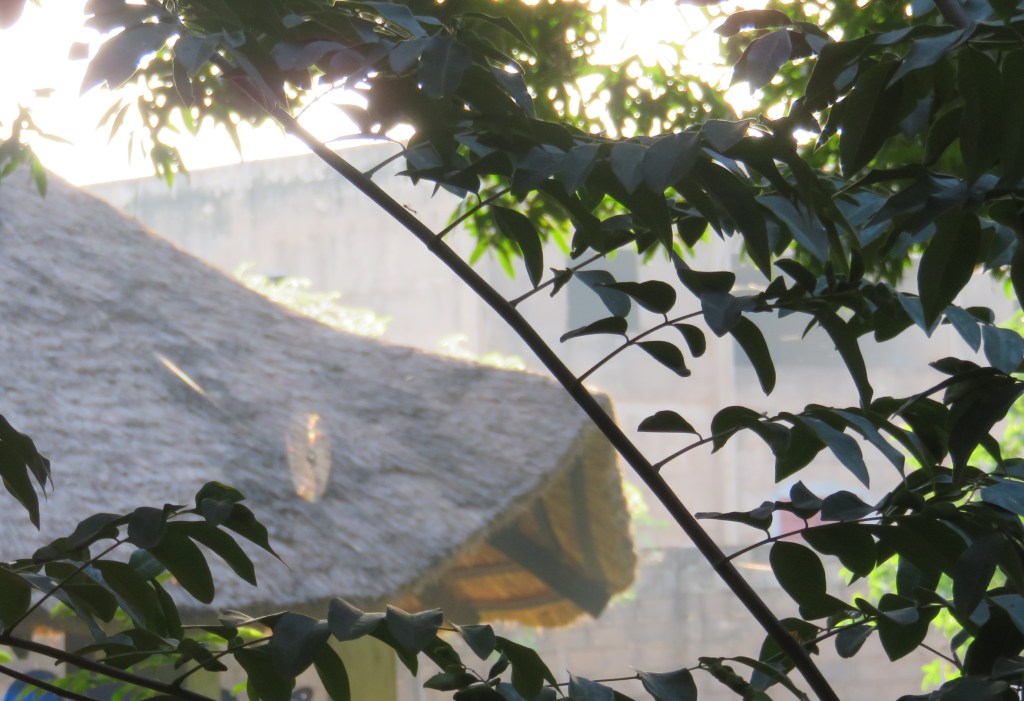
I sat in my “grove” in Ferkessédougou the morning these words came flowing into my notebook, watching a spider move silently along her nearly invisible thread. She had woven a complete and intricate oval that was shimmering in the sunlight, a miracle of expert lacework framed in the air between two leafy branches. Elsewhere there were leftovers of other webs, tangled threads hanging down, broken off, those spiders gone. All it would take was a strong wind to carry away this masterpiece too.

My mother-in-law has lived a long and fruitful life. At 99 ½ years, she has woven a strong web supporting many loved ones with her prayers and love, and now that her lungs can barely breathe even forced oxygen, her thread is coming to its end. She’s been on hospice for over a week, and although it sometimes seems as though that endpoint has come, she is still hanging on.

Her daughter, Diane, came to help with the long hours of care and accompaniment that were being managed by Bev, Diane’s older sister. After four days, she wanted to leave to go home for the Easter weekend, but was tired so decided to sleep there in Saginaw one more night. She did not wake up here on earth; sometime during the night, her “thread” broke and she left for Glory. Her parting was a shock.

She had truly contributed to the Grand Design, letting her love for the Father overflow to bless others around her. When I picked up my dishrag this morning I remembered that she had made it for me when we were first moving into this home, evacuated from Côte d’Ivoire by war, unexpectedly putting things together in Detroit through the kindness of friends. The red dishtowel was one she brought me just one week ago, the last time I saw her, when we visited the family in Saginaw. She was gifted in giving. After news of her passing had gone out, the husband of one of her immigrant friends back home in Pennsylvania wrote me that Diane was going to be deeply missed: she was his wife’s best friend, and every week she cooked brown rice and brought it over to her. Diane also told the truths of the Word to children in the form of stories that enthralled them. She loved the Lord and his Word, and was a woman of prayer. And I will never forget our last conversation, just last Wednesday – she grabbed me aside to ask how the Lord is leading us in ministry in our new phase, retirement. And she listened. Her spiritual fervor is unforgettable. She left many silken threads woven into God’s plan.

And my mother-in-law still awaits her turn to go.

Diane graduated on Good Friday, when we take time to remember that Jesus offered himself as the sacrifice that would open up the way to life forever with him. And Sunday we celebrate his resurrection. He is alive! Those of us who trust in him pass over from this fragile thread to a real, solid life that will never end.

It moves me to renew my commitment to live a purposeful life, aware that my thread is also only temporary, but part of the Creator’s Grand Design. He knows his plan and how he wants me to participate in it. And he is love; his purpose is one I can rest in.

The same is true for you: may you also find peace in the truth that his Hand holds the world, and you. May we pay attention and savor the moments we are given as we take this brief walk on the fine thread of life.

Worshiping Like Mary

Victorine praying — commitment service at Tiepogovogo
(John 12:1-8)

If I were to honor you
like Mary did that week
before you died, what could I do?
My worship seems so paltry.

Mary, the disciple who
had sat at your feet, learning,
brought expensive perfume –
worth a whole year’s wages—
and humbly rubbed it on your feet,
that sacred space for her.
She anointed the Anointed One!

The aroma filled the room
like an offering of incense,
worship made tangible
for those who were sentient,
prayerful reminder of 
the Presence in the Holy Place. 
Perfume also drenched the cloths
wrapping a corpse for burial.
Had she heard him share
that he would soon die,
giving his own life to save his sheep?

Her offering was sacrifice
to honor the one who would be
the ultimate sacrifice, the one
whose death would rip open
the curtain that separated
the incense altar 
from the Most Holy Place. 
Mary’s hair wiped the ointment
from his feet as she knelt,
the perfume of her prayer
now with her wherever she went.

I have no such costly perfume, 
just the incense of my heart
when the words of my prayer
rise to the skies, gratitude
for your self-sacrificing love
swirling out in hesitant speech
and growing into song.

My white hair can testify
that you are faithful.
It can spread the aroma
of who you are to those
who understand the scent,
the truth that knowing you
has changed me, made me
your disciple, your sent one, 
more and more like you. 

Like Mary, I will kneel and pour out
my love and thanks in worship.
Like Mary, I need to honor you
by offering what I have, all for you.

Mary was a woman who could not let go of an opportunity to be close to Jesus. Her yearning to learn put her in the posture of a disciple, at the feet of the Master. In the past, she had listened. Somehow his teaching, and the concurrence of events like Jesus’ raising her own brother from the dead, had made her desperate to show him that she knew he was God’s Chosen Servant whose climactic hour had come. So she took that expensive perfumed ointment that she owned and proclaimed his anointed status, not by pouring it on his head as was customary, but by washing his feet with it – a humble servant stance. Wiping the ointment on his feet with her hair strikes me as an intimate offering of herself in that act of worship.

Would I have had the audacity to act out my devotion so humbly in that public space?

Mary’s humble, loving worship in advance of the once-for-all sacrifice of our Savior can inspire us, we who live in the informed time following the resurrection, to offer what we have. “All to Jesus I surrender, all to him I freely give . . .”1 And if we do this in a worshipful way, spending time with him and getting to know him intimately, the aroma of who he is will flow out from us to fill the room, the space we inhabit. We can be proclaimers too!

But thanks be to God, who always puts us on display in Christ and through us spreads the aroma of the knowledge of Him in every place. (2 Cor. 2:14 CSB)

1 Judson W. Van de Venter (1855-1939)

Look Up!

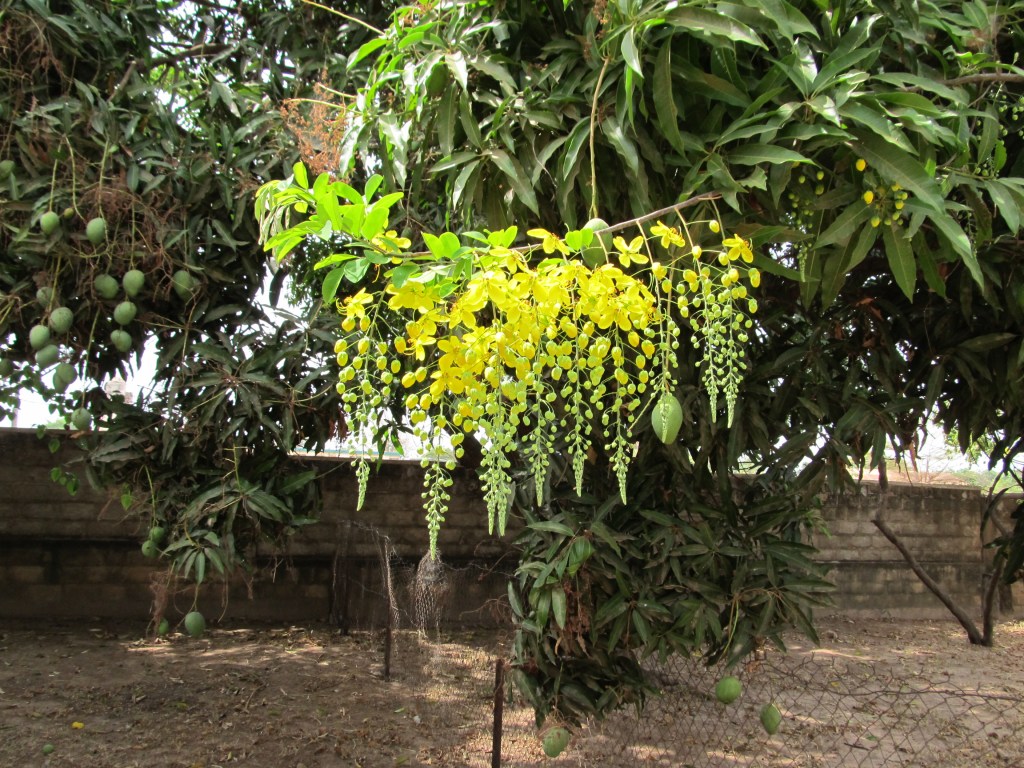
golden rain clusters and mangoes hanging above dry earth
Look down, and you see
withered leaves,
parched gravel,
litter blown in
caught on crushed twigs:
death, thirst and brokenness.

Look up, and you see
the tent of love
I’m making you,
tiny green popcorn
exploding each hour
to dangle like grapes of gold.

Remember, hope is high
above your world
and only seen 
when you decide
to focus upward
to what I’m weaving for you.

Here in Michigan we are excited: spring is here, theoretically!  The equinox has passed, and even though the trees and grasses are still dry brown, there are some buds popping out on the branches. And the weather is getting warmer.

I longed for this moment, this time of year, when I was in Ferkessédougou, Côte d’Ivoire, too. And without fail, by mid-March the bare branches of the trees in my yard would suddenly be festooned with flowers. The golden rain trees were my “sacred grove,” the quiet spot where I could meditate for a few hours every Saturday morning. From December through February they were like Michigan’s winter trees, stripped of their leaves. It was dry season, no rain. There was no grass, either. But even before the first “mango rains” would come in March, the green buds would show up in clusters and then, top to bottom, burst into golden blossoms.

This became symbolic of my journey, in many ways. There were long dry spells when it seemed like hopes were being dashed, when little fruit of ministry was being seen. Or the drudgery was just overwhelming. But then there would be these reminders of hope: the Lord is working his purposes even when it may seem impossible.

Maybe you have been going through one of those dry spells during these long months of waiting for spring or for freedom to gather with loved ones, for good news instead of one more crisis or for peace instead of crazy chaos. Instead of focusing on the debris and garbage, let’s turn our eyes upward to catch a glimpse of what our loving Father is creating for us. He is the Master Weaver, who knows how to take colorless thread or dry brown yarn and transform it into something glorious, even when the “rains” have not yet come and all seems hopeless.

We just need to focus upward. Our hope is in him and in what he is creating, while we wait.

Wait for the LORD; be strong and take heart and wait for the LORD. (Ps. 27:14 NIV)

See, I am doing a new thing! Now it springs up; do you not perceive it? I am making a way in the wilderness and streams in the wasteland. (Isa. 43:19 NIV)

The Pursuit of Peace

Chase after peace
when your world is in chaos!
Dodge rubber bullets 
and sharp cutting words,
and raise your arms
to the Prince of Peace,
begging him for the sweet release
of all who are captive
to arrogant whims
and violent solutions
that are just pollution
of all of our hopes!

Be one of those
who wades through the swamp
to wrap arms around
the marginalized!
Open your ears
to the reasons for tears,
wiping away the filth and the fears,
offering safety 
where dreams have been crushed
and the pleas for rescue
have been rudely hushed!
Find a way to make peace!

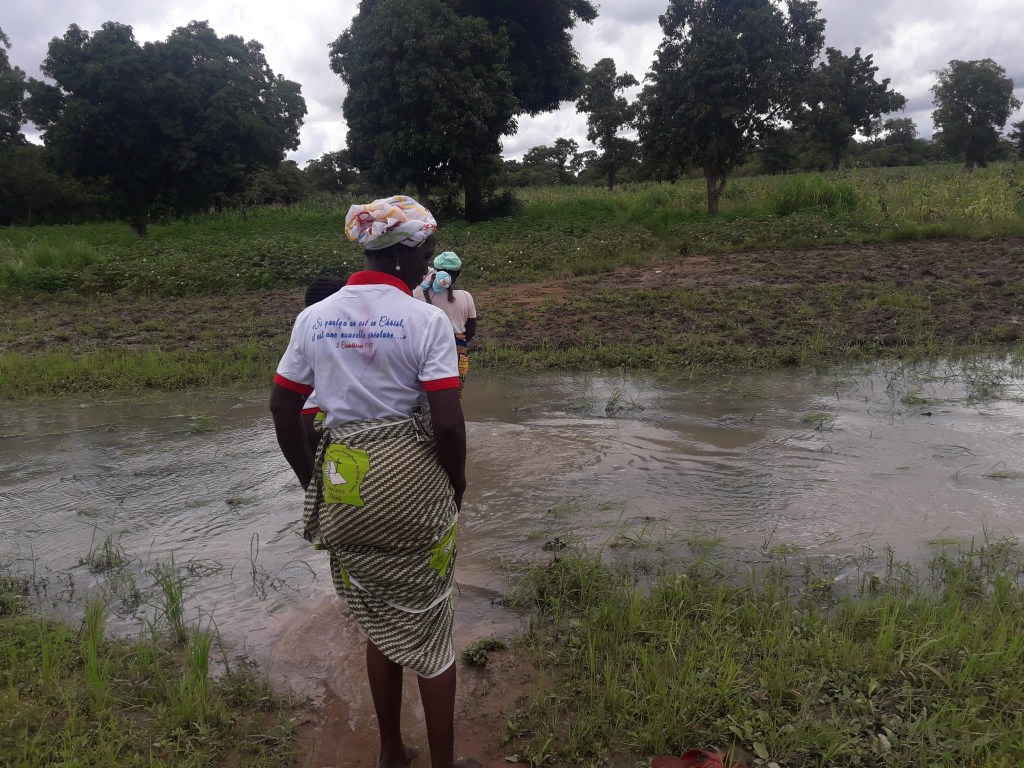
Picture yourself wading through a swamp. You take off your shoes and consider whether you should really do this – the water is muddy, you can’t see what might be lurking beneath the surface, and you’ve never been in this swampland before. Are there water snakes? How deep is it there in the middle?

But you see that others lift their skirts or pantlegs and wade on through, carefully lifting each foot out of the deep slush to take the next step. When you reach the shore, your feet are muddy. It’s time to shake it off and try to rinse your toes in the swamp water . . .

Crossing a swamp is not done without a purpose. You must have a reason to take the risk, and if there is someone on the other side who needs help or comfort, it is worth it.

The women in the photo are wading across because they were allotted land on the other side where they could plant a farm. Any profits they would make would go to help women in need. None of them have extra money, so this effort gives them something to work with. In their culture, widows and the fatherless are often dismissed as unworthy of honor or attention. These hard-working women want to make a difference, to spread love as well as the Good News.

It is interesting that “peace” in Hebrew is the word ‎  שָׁל֣וֹם  “shalom,” which has a broad scope of meanings, including these: well-being, health, prosperity, peace, peaceful relationship, kindness. In Psalm 34 David is giving instruction to young people and warns them that if they wish to have a good life themselves, they must keep from doing what is wrong or speaking lies, but instead “turn from evil and do good; seek peace and pursue it” (Ps. 34:14 NIV). Respecting the Lord means caring about what matters to him. To be like him, one key thing is to do what restores well-being to the needy. “The LORD is close to the brokenhearted and saves those who are crushed in spirit.” (Ps. 34:18 NIV) And he specifically blesses the person who does what is right, rescuing him from his troubles – even though he may have many of those (verses 17-19).

This should stimulate us to actually do something to reach out to those who are mistreated by society, or marginalized and neglected.

Jesus underlined this in the Sermon on the Mount, when he said that those who work for peace will be called God’s children (Mat. 5:9, NLT). I self-identify as his daughter; what am I doing to work for the well-being of those who are suffering?

Let’s Join the Dance!

circle dance at Tiepogovogo church
Check out this celebration dance video, the “poyoyo”:

https://vimeo.com/manage/videos/521089973

Neighbors, how can we leap
across this sad divide?
Too many barriers have been
meticulously constructed
to keep us separate –
if not by us in every instance,
at least by history:
the cutting words that sliced our pride
the thrust of our rejoinders that went deep,
surface smiles and habit handshakes,
memories of ancestral cruelty
and strict avoidance of transparency.

Now an excruciating moment
holds us riveted
before a vision of “perhaps,”
drawn in black and white
but etched in gold.

I find I cannot breathe
for aching to step on the scene
with you, those pushed aside,
to join the dance depicted there.
You’re holding out your hearts.
Wary, anxious as it is,
I offer mine. We share
the journey to forgiveness, 
understanding. And grace is
lacing my steps into yours.

I catch my breath again--
see! We are tentatively moving
to a beat we’d never heard
before we joined this learning curve:
blended you and me!

One of the things I miss most about the church community in Nyarafololand where we served for so long is the power of joining in the dance. At the all-night holiday celebrations there are hours of counter-clockwise circle dancing; at Sunday services when the drums or balaphones begin to call out a song, someone will take the lead and go to the space in front of the benches to begin the circle, others dancing their way forward to follow the pattern that best fits the song: meditation, unity, celebration, or working in community to reap the harvest.

It takes fortitude to dance in the night as the dust rises from pounding feet. It demands commitment to join the rhythmic group dynamic, a sharing of the space and message.

There, as well as here, there are ethnic and racial prejudices. There are those who maintain that their ethnic music is higher quality that that of the marginalized peoples. There are even some who, not understanding the redeemed meaning of believers’ worshipful dancing, have in the past pushed back against it. But with time and sharing, understanding and mutual acceptance has grown.

I see this as a picture of what desperately needs to happen here in the United States to heal the hurts caused by racism. Whether we feel ourselves personally guilty or not, the consequences of social inequity and marginalization (not to forget the outright suspicion of people who are black or brown) continue to infect our nation. It is indeed a pandemic.

Healing will require conciliation. This can happen through purposeful discussion processes that improve communication and help parties to work together toward mutually acceptable outcomes. In the Christian context it involves speaking truth in love, being quick to listen and slow to speak or become angry, and intentionally reaching past the distances caused by exclusive housing patterns. It means actually spending time together to build healthy relationships.

Wouldn’t it be wonderful to dance together with one great purpose?

P.S. Check out Be the Bridge by Latasha Morrison, and the Facebook page “Be the Bridge.” There is so much to learn and practice.

The Hardest Race

Tiepogovogo believers marching together, on mission

(A prayer in response to John 17)

You prayed your heart that last night,

surrounded by eleven men

who listened, and took note.

And after you had left

(having suffered, died and risen),

John remembered, wrote it down.

For me. For us. For generations still to come.

We need to know what yearning

you expressed for health and harmony:

that we would live in unity: be one.

And it’s the hardest race we’ve ever run.

Most of us have opted out

to run on our own paths, alone.

Some teammates seem so distant,

others’ tongues keep lashing out

with hurtful words, insinuation,

wounding those who pass too close

or whip on by, or stumble in the dark.

We’ve lost the goal! We do not run

to claim a prize for personal renown;

we run to honor you! If we could come

to understanding, and cheer each other on,

we’d make it home, together,

and be welcomed by your smile

at how we have obeyed you, being one.

~~~~~~~~~~~~~~

No, it is not easy. Jesus never said that it would be. In fact, he knew that we would need the Father’s protection in order to ever attain that unity (John 17:11).  So why are we so divided? All I know is that it is up to each of us to do what we can in our community to increase our unity and become the picture of oneness that Jesus prayed that we would be (John 17:20-23).

It’s a very hard race as we press on to the finish line, especially in these days of so much political and social division. We need to find ways to understand and respect each other. Forgiving the one who hurt me, asking forgiveness of the one I have hurt, rebuking lovingly the one who leaves the path and not rebuking with anger, encouraging the weak one to find strength in God himself while I do what I can to support them – these are all commands I must follow if I want to conform to the character of Jesus rather than to the patterns of this world.

In fact, this may be the hardest race we’ve ever run. Let’s do all we can to run as a team, to be one!

Why I Can Run

Prayer on a Rough Path 

 Sleep may slip out of reach,
 but you will send mercies, all new.
 Age may take its toll,
 but I find true health in you.

 I may hobble along the path,
 but you will keep me upright.
 I may wrestle with fear in the dark,
 but you are the light in my heart.

 The world’s disasters may trouble me,
 but I will find peace with you.
 Tangled emotions may strangle me, 
 but you will pull me through

 You hold my hand to guide me
 and keep me walking strong,
 you shade me from the burning heat
 and slake my thirst with song.

 If not for you I’d be a mess,
 crippled, fried and blue.
 Because of you I run with joy
 to the goal: forever with you!

It is not easy to keep walking strong, much less running, when it seems that every day there are hurdles to jump or frightening traffic at the crossroads, steep slopes to climb or just dull, dry desert. Worries, disease, injuries, traumas can deplete strength and mess up sleep patterns. Energy dwindles. Then there is the news, maybe not what you wanted to hear. How can you keep on running? And what on earth is the goal in all of this?

Over and over I’ve had to remember that there is just one place to find hope in the middle of mayhem and empowerment to keep on keeping on. And that is to open my heart, mind and soul to the One who is always present and be filled with peace as I remember his promises. Yes, he holds me, guides me, renews me. And best of all, I have that confident hope, the assurance that at the end of this race, I will be forever with him in a Reality beyond my current comprehension.

He knows when a sparrow falls. He knows when we stumble. He knows when we are hurt. When we belong to him, he holds onto us and keeps us running. And it will be worth it all when we see him at last!

I press on toward the goal for the prize of the upward call of God in Christ Jesus.
(Phil. 3:14 ESV)

Sowing Seeds of Love

oxen plowing in Côte d’Ivoire

Hosea 10:11-12

11 Ephraim is a trained heifer that loves to thresh; so I will put a yoke on her fair neck. I will drive Ephraim, Judah must plow, and Jacob must break up the ground. 12 Sow righteousness for yourselves, reap the fruit of unfailing love, and break up your unplowed ground; for it is time to seek the LORD, until he comes and showers his righteousness on you. (NIV)

 
 PRAYER
 You’ve made me your heifer
                pulling the plow,
 you’ve shaped me and trained me,
                showing me how
 to lean to the left when your
                strong hand presses,
 to walk straight ahead, 
                cleaning up messes
 and tearing out weeds, 
                preparing the way
 for planting the seed in that soil
                on the day
 when all is in readiness,
                soft dirt tilled,
 and we press in the seeds ‘til
                the rows are all filled.
 
  
 You bring out the seed: 
                it’s sorted, it’s good;
 it’s all about health and 
                the way that we should
 be loving our neighbor, 
                helping the torn,
 the poor, the lost,
                the hungry, the worn,
 carefully living,
                meticulously,
 the love of the Father
                for you and for me
 and for all the husbandless,
                all those alone,
 for all of the fatherless
                needing a home.
 
  
 You must give the seed;
                my own is diseased.
 You must show me how I should 
                plant it, then please –
 you must send the rain that will
                make the shoots thrive,
 the rain of what’s right
                and of hope that’s alive.
 The roots will go deep,
                the stems will grow tall,
 the leaves will shout green and
                the blossoms will fall
 to make way for grain 
                that is bred up above:
 a life-giving harvest 
                of unfailing love. 

When I think of “sowing seed” I think of taking the Good News – the parable of the sower and the different soils. This passage in Hosea is about action that results in hesed, that love that was my focus last week. When we do what is right, when we live out justice and mercy, the community is changed. Relationships become characterized by love as needs are met, wounds healed, honor given to those who are marginalized.


In this moment in our lives, how are we sowing this kind of seed? There is need for racial reconciliation. There are people hurting due to social isolation during the pandemic. We also need to forgive the hurts of harsh words and find out how to repair misunder-standings. What would you add? How are you finding ways to sow love?

May we reap an amazing harvest of unfailing love!

The Best Love Ever

Singing about God’s love at Abdoulaye’s thesis defense, Abidjan, Côte d’Ivoire
hesed: goodness, kindness, lovingkindness, loyal love, unending love . . .

 Your hesed is so deep and wide
 our words cannot contain it!
 We cast about for a way to expound
 love that never runs out,
 love that overflows with kindness,
 love that is deeply attached
 to its own, loyal but active,
 constantly reproving and teaching
 so that we can become like You.

 Like You: loving others
 with love that is kind,
 love that forgives, full of mercy,
 love that treasures the truth
 and works to bring justice
 to the forefront; love rooted
 in grace, goodness and compassion,
 always speaking out boldly
 to show the world Your ways!

 If only . . . ! Could it be?
 My soul cries out to You
 for hesed in my heart,
 in all my actions and my words!
 I reach, I run toward this goal –
 I stumble and fall. But You
 are always there to pick me up,
 heal my scraped knees,
 kiss away the tears, hug me –

 and show me once again
 (patient and kind that You are)
 the right path, holding my hand
 and pulling me along with You
 toward Your goal: a new world
 where the air we will breathe
 will be essence of hesed,
 a world with no more tears,
 Your love having made us like You.

Yes! Someday there will be no more tears! In these troubled times we do long for that. Here on earth it is hard to even imagine a place where everyone is kind, honest, loving and trustworthy. But the Word promises us that God himself is love, and that when we are with him he will wipe away every tear from our eyes. The only way that could be the end of sadness is if the whole community were just like him! No more nasty words, betrayals, slander, gossip, hate . . .

Two decades of working in Bible translation forced me to investigate the real meaning of words in the original languages, Greek and Hebrew, in a unique way. And then, what Nyarafolo word or phrase would accurately express those meanings? I worked with a team of native speakers of Nyarafolo, spoken in a small region in northern Côte d’Ivoire. They had previously read or heard the Word only in other languages, just like me.

One of our first huge challenges was figuring out how to express God’s love. I was the Hebrew exegete for the Old Testament, and this kind of work was a first, both for me and for my Nyarafolo co-translator, Moïse. We began with the life of Abraham in Genesis, and it was not long before we encountered the word hesed. When it refers to the love of God, it includes all the senses mentioned in the poem above. No translation has found it easy to define a love that is not fallible but constant, completely trustworthy and eternal, kind and loyal. This love never breaks a promise!

Nyarafolo did not even have a word for love!  The most common word used for the love of a spouse, or of children, was a verb best translated as “they please me.” So I asked, “What if you have a child who pleases you, but he becomes rebellious. Does he still please you?” The answer was “no!” That could not express the love of God, who loved our wicked world so much that he gave himself to die for us, to give us eternal life (John 3:16).

The new Nyarafolo believers were beginning to make Christian songs in their language, and my friend Sali composed a hit song about how God’s love flows on and on. The verb “to please,” dɛ́ni, had been changed to a noun by adding a suffix: dɛ́nigɛ. It now expressed “love!” The New Testament translator, Abdoulaye, wrote his master’s thesis on how to translate “love” in Nyarafolo, and when we attended his thesis defense he asked Sali to lead us in singing her song, to celebrate the way his people could now understand that essential concept. For the Scriptures, we added a word meaning “without end” to express hesed: unending love (bànguɔ dɛ́nigɛ).

Love that is unwavering, that can never fade away as so often happens in marriages and other relationships – someday that love will characterize us, too. Meanwhile our goal is to constantly let God change us so that we become more and more like him. And this requires us to “make every effort” to keep growing. Just “believing” is not enough. This is the progression listed for growth in 2 Peter 2:4-8: faith + goodness + knowledge + self-control + perseverance + godliness + mutual affection + love.

This is a high calling. And so worth it!

Dear friends, now we are children of God, and what we will be has not yet been made known. But we know that when Christ appears, we shall be like him, for we shall see him as he is. (1 Jn 3:2 NIV)

That Feast He Serves

A Table Set Before Me
  
 Dust swirls on the steppe, brushing barren paths 
 barer still,
 twisting away like hope from my heart.
  
 Danger lurks everywhere.  I’m not alone, 
 but that is 
 why fear tempts me; these are not all friends.  
   
 Some carry knives. Some have it in for me.  
 Some don’t care.
 Others think I’m playing children’s games.
  
 And then you say, “Come eat!” You spread clean cloth 
 on the rock, 
 makeshift table in the wilderness.
  
 It’s set with china, fired by the hot sun’s 
 noonday glares
 and hell’s darting flares.  Unparalleled.
  
 I sip ambrosia squeezed from suffering, 
 exquisite
 flavors pressed from courage and despair.
  
 The bread you slice is made from grains that died,
 a thousand
 crushed to powder, mixed with oil of joy.
  
 Those faithful ones have given their heart’s blood 
 to make this
 solid meal, a feast for Followers.
  
 I eat my fill and find, like them, that you
 alone can 
 satisfy.  Your love removes all fear.
  
 Some people see me, hand to mouth, and think
 it’s pretense,
 wishful thinking making up this scene.
  
 They only see the austere rock face, bare,
 a woman
 scooping empty handfuls of hot air.
  
 They will not taste and see, and so with eyes
 averted
 they walk by, for fear it might be true. 


Were you startled at the portrayal of this “feast for followers” as being food made out of a legacy of suffering, death, despair? Me, too. But as I’ve walked through hard times, I’ve realized that our Shepherd has unexpected ways of nourishing us. Sometimes it is through the company of encouraging friends. But how about when you feel alone, or surrounded by issues you cannot share with others? When I’m in that dark valley, how does he prepare a table for me (Ps 23:5)?

We had been evacuated from civil war in our beloved country about a year before I wrote this poem. The uprising had begun while we were away from home, attending a training seminar in a major city. Eight days of being hunkered down in hiding, waiting for freedom to leave the battle zone, taught us all a lot about depending on the Lord for actual food and protection. Then we drove out, and finally flew away without being able to say goodbye to those back “home.” And what came next was not easy either.

We had to learn to trust the Lord in a phase of new unknowns and ongoing conflicts of other kinds. And how did he provide what we needed? We remembered how he has been faithful to those going through tough times, their histories preserved for us in the Scriptures. Hebrews 11 underlines so many of them. Then there are the last verses, about those who did not see rescue on this earth, but would be “made perfect” with us, in the future – through the complete restoration that finally came through Jesus’ self-sacrifice (Heb 11:40; 12:1-3). The best part of all: we become united with him, walking with him now and forever.

Sometimes attacks come from “enemies” who are people, sometimes they are the tragedies that come from living in a broken world. But our Shepherd provides the strength we need by assuring us of his goodness, his love and his eternal plan, and reminding us of the many ways he has shown himself to be Protector and Provider throughout history. It’s true that some may think this is all a figment of our imagination. But as we experience it, we find it to be true. The feast that he serves us on a table in the presence of our “enemies” is not the usual one. It is what Jesus said when he was hungry and being tested by his Enemy to make real bread out of stones, “No! The Scriptures say, ‘People do not live by bread alone, but by every word that comes from the mouth of God.'” (Matt. 4:4 NLT)

There we find our “bread from heaven.” So let’s feast!