Blaze!

Across the bristling grasses
and the breezy palm tree dance
lies a long lagoon, all liquid,
mirror for the sky’s expanse.

Underneath a white-hot sun
it becomes a brilliant blast
and my eyelids squint to slivers
letting just a glimmer past:

just the essence of the power,
just the outline of the heat,
just impressions of the splendor
and the tantalizing beat.

If, laid open to God’s shining,
I could be but half as bright, 
mirror molten by reflecting
glory of the Living Light,

fire ignited in the noon glow
as I’m changed beneath his rays,
eyes around would have to notice
my resemblance to his Blaze.

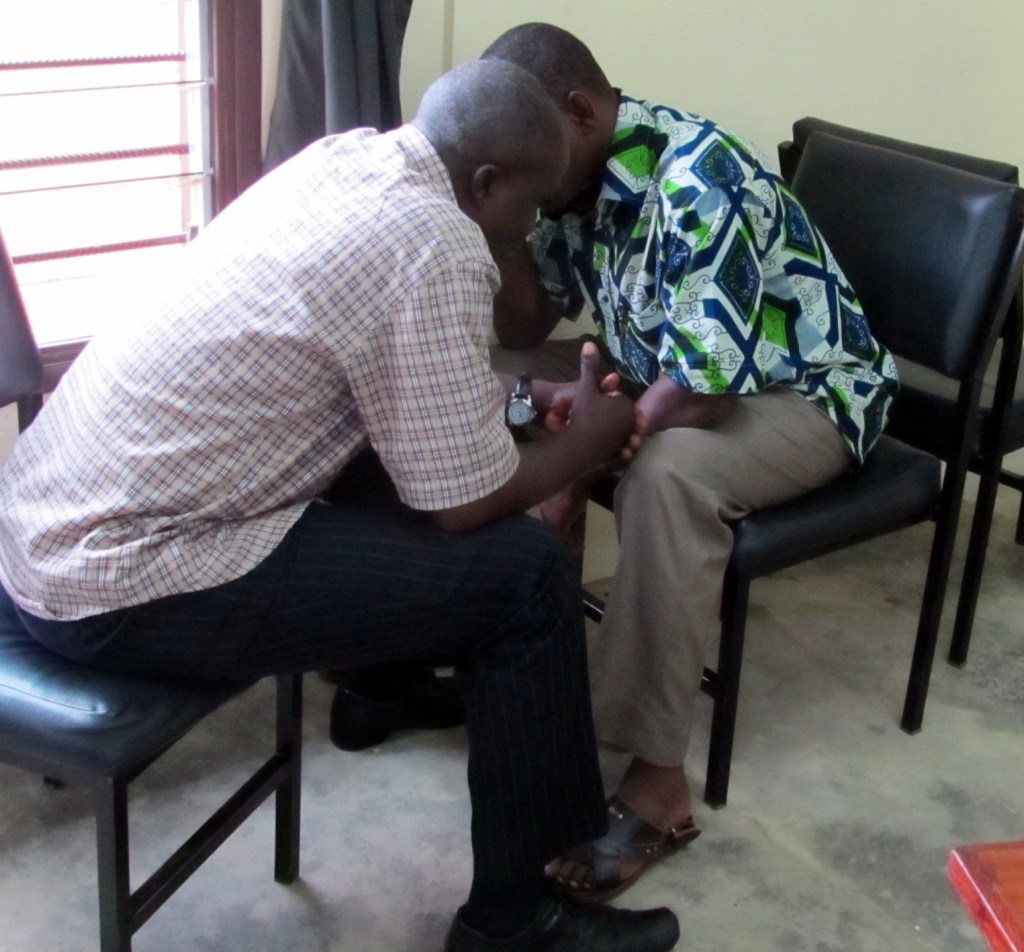
While walking down Ferke’s main road one morning I met the man in the photo above. He had no idea what the words on his shirt meant, but was excited to be greeted and delighted that I wanted a picture of it. I did try to explain to him that it was what followers of Jesus are told to do: to share the light that is actually Jesus, the Light of the World. He didn’t get it, did not even respond—I think he may even be one of those people who need mental help but have no way to access it. There are those in these streets.

Have you ever wondered what would really let your light shine? It’s interesting to contemplate:  Jesus is the Light of the World, yet we are also told to be lights!

When Jesus spoke again to the people, he said, “I am the light of the world. Whoever follows me will never walk in darkness, but will have the light of life.” (Jn. 8:12 NIV)

“You are the light of the world. A town built on a hill cannot be hidden. 15 Neither do people light a lamp and put it under a bowl. Instead they put it on its stand, and it gives light to everyone in the house. 16 In the same way, let your light shine before others, that they may see your good deeds and glorify your Father in heaven. (Matt. 5:14 NIV)

The only way we can be the “light of the world” is through our relationship with the Light of the World. When he lives in us, he can shine through us. If we follow him, letting him transform us to be like him, then his light shines more and more brightly.

Why do we want to shine? So that others “may see [our] good deeds and glorify [our] Father in heaven!” It is not about us, but about inciting praise of the one who is pure Light:

This is the message we have heard from him and declare to you: God is light; in him there is no darkness at all. (1 Jn. 1:5 NIV)

So we are supposed to stand out in a luminous way. For those of us with a strong tendency to introversion, this can be a challenge. I admit that it has taken years for me to realize that standing out, as someone different, can actually be a boon.

I actually had to learn to put up with it early in my childhood, growing up in Africa. When you have white skin and live in an area with few others like you, you draw attention. I went to the U.S. for my senior year of high school and found out I was so different (a Third-Culture Kid) that I could not fit into that American teen culture—it took a few months to accept that and discover other ways to make friends. When I returned as a missionary and had little children, it was never surprising when someone would reach out to touch their straight hair. They just looked so different than those around them. When we were living in high-risk times and were required to draw up plans for hiding out and escaping via back roads we kept muttering, “Anyone know how hard it is to blend in? We could not hide for long!”

But through the years it became more and more clear that we should turn things around and see how the Lord could use our difference.

As I did cultural research, one thing I kept asking was, “How have you seen missionaries do things that delight people, and what has been hard?” One outstanding comment was: “Nurse Linda Sharp always smiles! We love that.” And I heard it about others too, that it is deeply appreciated when they notice those around them and interact with them.

I learned that for me, usually in my office working on linguistics and translation, my unusual opportunities to shine, or stand out, came when I was walking in town, especially if I spoke to people in Nyarafolo. I would greet a vegetable seller and ask the price, and instead of answering she would turn to a neighbor to exclaim, “She speaks Nyarafolo!” She knew no other White who could do that! When I was walking from our courtyard to a church during our process of checking our Nyarafolo drafts of Scripture with groups, I would be carrying my bright locally-made computer bag. Several times a woman would ask me, “Where are you going every day? What are you carrying?” And I would tell them about the Bible being translated into Nyarafolo, and that we would have it read to an audience and hear their responses. Shock! Amazement! Seeds planted!

And it is still that way. During this visit I’m living in a different part of town than I used to, and the best way for me to get in my daily walk is to follow the main road from the hospital south to the big high school, Lycée Moderne, then back. It is early morning. Students are walking to class, women are putting out their garden produce to sell, men are opening up their stalls that sell all sorts of goods. If I were to just walk past them, saying nothing, they would definitely think I was just a tourist. I sometimes hear them comment to each other in the trade language, Dioula, “There goes a tubabu muso!” – a “white woman.” They are surprised when I turn and wave and greet them in Nyarafolo or French, whichever fits the case. And I greet the women who look at me as I pass, using Nyarafolo. Even if they are Nyarafolo, they often answer in Dioula (the trade language), assuming that is what I must speak, then the jaw drops and they switch to their mother tongue and test me to see how far I can go in conversation. Having been marginalized for decades, their language dismissed as too complicated, they are delighted and feel affirmed. The next time I pass them, they call out their greeting in Nyarafolo, or even shout my Nyarafolo name, “Penyuonekuo!” It has become not only fun, but an opportunity to tell some of them that their language is written, and that if they go over to the courtyard behind the monument (to those who died serving France in WWII, in the city square), there are books available and people who can teach them to read.

Now that is just a start. But it opens a door to communication. One student I talked with is Nyarafolo and attends a local church. As we chatted, she expressed her desire to have her own Bible! If I see her again we will arrange that. Another one only speaks French with me; she is Peul, or Fulani, from a Muslim family. She seems to really want to connect with this friendly American and even calls me in the evening. I am hoping we can meet to talk in more depth.

One morning I was in a Mauritanian-owned “Superette” at the far end of town, my first time there, so I was talking to the man behind the counter and he was telling me that he is a friend of Josh Wohlgemut, one of the other missionaries here. Then a young woman came up behind us, stocking some shelves, and she greeted me in Nyarafolo. After greeting her back I asked, “So do you know me?” “No,” she said, “but I know you speak Nyarafolo!” So word is getting around.

Now if only I were going to be here longer, I would be able to follow up on more of these contacts. But it is underlining for me how vital it is that an enticing light be shining from me, wherever I am. Jesus said that the way people will know we are his followers is if we follow his commands, and love one another. And he sends us into the world to tell others about his love, and to “shine”. That is what happens here when suddenly a woman passing me stops and greets me with delight because we’ve known each other in the past, and we begin sharing in whatever language we have in common. A Nyarafolo conversation starts a buzz among those nearby in the market, for instance—they can’t believe someone has actually learned their language and knows other Nyarafolos here! It is respect they rarely experience. When we turn and show unusual love in some way to others it is a moment that shines his light. People may not recognize it at first—just as many did not understand his light when he came (John 1) but it still shone, and many did eventually decide to walk in his light.

What if I just kept to myself and ignored everyone? What would that say about me, to them? Here, it would mean I don’t care, that I see myself as separate. There are those who don’t meet my eyes, looking down or away; that is their way of showing timidity or discomfort. So I respect that. But then there is the other side. Sometimes they will suddenly look up, see a smile, and smile back when they are noticed. Often they are the ones in rags, or limping. And if it is an older man in Muslim dress, sure, then as a woman, I should not connect. Wherever we are we can learn what is respectable conduct.

These past years of retirement we are back to living in Detroit, as we did during that evacuation 2002-2006 and then periodically for furlough/home assignment. Now it is home. Living in a mostly Black neighborhood, one thing that is extremely different from the suburbs is that people actually greet each other when meeting on a sidewalk or in a store. We really enjoy that. My husband Glenn leapt to the challenge of fitting in that way with delight. He goes up to an older woman working at a service desk, greets her and asks how her grandchildren are doing (if she is looking at photos or something that clues him in). The sparkle in her response shows that she sees she is being acknowledged as a real person, not just a clerk. Even at a busy cash register there is usually a good moment to say “Hi!” and ask how things are when it is so busy.

I do feel like a neon sign, in both worlds. There is no way not to stand out, my skin setting me apart as rare in these contexts. Seeing this as a phenomenon that the Lord can use to show acceptance, to cross racial barriers, to encourage people, makes a huge difference. And in this town where Americans are known to be connected to the Baptist Hospital, to the mission, people are watching to see what such Christians are like. Experiences have taught me that the Light of the World can definitely shine through when we do what he says, and show love rather than ignoring people and walking right on by.

When in a place where I don’t stand out that way, such as in a long line at an airport, there have been occasions when I felt that prompting to chat with the person waiting beside me. Once in a while it has led to truly unexpected openings. This can happen to any of us when we pay attention!

I still have learning to do. I want to “blaze” in a way that will draw people to the Light, wherever I am, not push them away. This is our calling, all of us who are the light of the world, to show God’s love in what we do and how we act toward others. We are not to hide our light, but to let it light up “everyone in the house” (Mat 5:14). Wow!  Blaze!

A friend recently posted this C.S. Lewis quote that is truly relevant:  “Don’t shine so others can see you. Shine so that through you others can see him.”

The Story God is Writing

You make us your heifer, pulling the plow,
you shape us and train us, showing us how
to lean to the left when your strong hand presses,
to walk straight ahead, cleaning up messes
and tearing out weeds, preparing the way
for planting the seed in that soil on the day
when all is in readiness, soft dirt tilled,
and we press in the seeds till	the rows are all filled.

You must give the seed; our own is diseased.
You must show how to plant it and tend it, then please –
you must send the rain that will make the shoots thrive,
the rain of what’s right and of hope that’s alive.
The roots will go deep, the stems will grow tall,
the leaves will shout green and the blossoms will fall
to make way for grain that is bred up above:
a life-giving harvest of unfailing love.

Back in the ‘80s, when we were just beginning to disciple the slowly growing group of believers in the little village of Tiepogovogo, one of the little boys sitting on the big tree root for Sunday School was Pekaly. I was mentoring young Mariame as the teacher, and she was amazing. The boys were entranced. Who knew that we were participating in the beginning of something bigger than we could have imagined?

It is only with time that pieces of the story have come together, and God’s fingerprints are all over it.

We were at Tcherigaha this past Sunday, celebrating what God has done with the believers there and from all the villages where Pastor Pekaly and his wife Tchomachen have been ministering. There were over 100 people there, and not everyone could make the long trip—transportation is a challenge, and this village is at the edge of Nyarafolo terrioty. In fact, it is peopled by the Palaka, a related language group. Our company of travelers that took off from Lafokpokaha, where Pastor Pekaly and his wife live, included a couple of motos and a three-wheel moto hauling about 9 people in its wagon. When we saw the new church building, unfinished though it is, we couldn’t help having flashbacks to how the story started about 50 years ago.

A few years before Glenn and I arrived in Côte d’Ivoire to begin ministry (that was 1973), a young man in Tiepogovogo was lying down in his little man-hut to go to sleep when he looked up and saw a man robed in glowing white standing at the foot of his bed. “Are you awake, Lacina?” the man said. “Yes!” Lacina answered, “But who are you?”  “I am Jesus, and if you follow me many others in this region will too!”  Lacina was shocked. “But I don’t know you! And I’ve never been school! How can I find out about you?”  “You will see.” And then Jesus left.

Lacina told his good friend Sikatchi, and together they began searching for information. They went to a Catholic church but only heard the name “Mary” repeated. They were with a sick relative at the Baptist Hospital but all was taught in other languages they could not understand. Then it happened: to their astonishment, a young white couple walked into their village, hoping to learn more Nyarafolo—their language helper, Laji, was son of the village chief.

Years later Lacina and Sikatchi told us that they looked at each other and said, “Ah! We are chosen!” They knew that Glenn and I came from the Baptist Hospital. Maybe someday we would be able to inform them. And so eventually it did happen. About four years later they asked us to teach them about Jesus. Using Laji as a translator (he knew a little French), Glenn began teaching them on Wednesday nights. We were in a courtyard gathered around a fire. Some others became believers, so they built a little thatched roof shelter where we could meet on Sundays. By the ‘90s they had built a small cement building where about 20 people could gather. Up until then, Sunday School had been held under the big shady tree; it moved into the thatched shelter.

And Pekaly was one of those kids, truly devoted to Jesus. He was Lacina’s son, an interesting connection! When Mariame and her husband moved south for his education to continue, and civil war began, there was no longer anyone around to teach Sunday School. So Pekaly and his friend Kifory began teaching the kids. He also helped lead church services. When another son of the village, Fouhoton, came home from Bible school to pastor the growing church, Pekaly finally shared with him how much he yearned to also get pastoral training. So he was sent to the Bethel Bible Institute and graduated in 2012. His senior thesis was on the history of how the Good News had come to the Ferke district, where Nyarafolos lived, a testament to his motivation to do evangelism among his people. So few had been reached!

The Baptist Association allowed him to stay in that district since his home church, in Tiepogovogo (population 70), had agreed to send him on mission to plant a church in nearby Lafokpokaha (population 1,000), the largest village in that eastern area. Both Pekaly and Fouhoton had attended the elementary school there and knew the need. Many people identified as Catholic, but few followed any of the teaching once they had a baptismal certificate. We were with the delegation that was sent to Lafokpokaha to meet with the chief and ask for permission to plant a church there. We did not expect the response we got! Yes, the chief said, he would like to have Baptists come: perhaps they could build a hospital there. But the clinching reason was this: when Baptists come, curses stop!

What did he mean by that? Another miracle explained it! Pastor Fouhoton’s wife was from that village and her older sister still lived there. She was married but had never been able to have a baby that lived. Eight babies had either been born dead or, after a few months, had developed blisters all over the body and died. It was known that the woman’s mother-in-law hated her and had put a curse on her. Victorine, a woman of faith, told her sister that if she were to give herself to Jesus, she could have a living child! And her sister began walking the long path between Lafokpokaha and Tiepogovogo every Sunday, learning the Good News and devoting herself to Christ. The next time she was pregnant she gave birth to a live baby girl. Sure enough, in a few months the blisters showed up, but she lived! The whole population saw the miracle,  and the little five-year-old girl now also had a little brother, a toddler, who was healthy.  The chief saw that as proof that a Baptist church brought good things and should be planted among them.

It was not an easy beginning. Not all the village elders were convinced this should happen, so it took at least a year for Pekaly and his wife to be allotted land there. While waiting, they lived with us in Ferke and commuted to Lafokpokaha weekly. In October 2012 Pekaly had his first meeting with the interested villagers there, gathering under a mango tree adjoining Fouhoton’s in-laws’courtyard, Victorine’s sister’s family. By November ten people had decided to enter the Jesus Road and others were expressing interest. Four of them brought their occult paraphernalia to be burned by the believers as they committed themselves to the Lord. A year later, there were 16 committed believers meeting in a small mud-and-thatch gazebo structure.

It was taking a while for the village elders to agree to give them land for a church, but nevertheless God was at work. On October 27, 2013, we joined the enthusiastic congregation at the church plant in Lafokpokaha for their first birthday. Yes, in just one year the Lord had added 15 new believers to the one that was already in that village, and they had finally been granted land at the edge of the village to eventually build a church. We arrived in time for Sunday School and saw the meeting place filled with about 40 kids eagerly listening to the story of how Jesus healed people, showing his power as God. Then the space filled up again with the congregation and visitors joining for the special day. The emphasis of the message, Glenn’s words of encouragement, and even of the closing song was on continued growth that comes as each one shares with others the Good News. Glenn had gotten ants down his back, necessitating a couple of quick exits to try to shake out the critters, so he used that to remind them that small things can have a very big impact! And in the weeks after that, two more people decided to follow Christ.

By August 2015 the group in Lafokpo had built a church building. It had a roof, windows and doors, no floor yet when we visited there. We had become very close “family” to Pekaly and his wife Tchomachen, and their children, during the time they lived with us before being given land for a home there. Glenn kept on mentoring Pekaly, and was encouraged by his devotion to reaching out with the Good News. By 2017 Pekaly was also discipling new believers in three other villages. One of them was Tcherigaha, where we visited this past Sunday. He was planting seed, plowing the ground like God’s heifer (see Hosea 10:11-12), sharing God’s love through his own heart reaching out with kindness to those God placed in his path.

How did a church get started in another language group, at Tcherigaha, so far away? Here is the story:

In 2016, Pastor Cissoko, from the Bromakote Baptist Church in Ferke, was on his way home to Ferke from a meeting in a distant Lobi town (further east of the Palaka region). He stopped by a little shop along the road to get fuel for his motorcycle and struck up a conversation with the shop owner, Jeremie. Cissoko is Jula, so was talking to him in the trade language Jula about Jesus. Jeremie was intrigued and said he would like to learn more. It was a few months later that Pastor Cissoko told Pekaly about this connection he had made. So Pekaly rode his “moto” out to meet with him, and found that Jeremie was truly ready to come to Jesus! The problem was that he is Palaka, so needed to understand more of the Good News in his own language. Then Pekaly remembered that he had an uncle who lived in Tcherigaha, a half-brother of his mother, who had come to know Jesus at the Baptist Hospital. Pekaly looked him up. He spoke both Palaka and Nyarafolo so he became his nephew’s translator, and Pekaly began discipling his Uncle Doulaye, Jeremie, and another young man. As others heard about this more people kept joining them, including some from a neighboring village, all thirsty to hear about the Living Water.

This was a challenge for Pekaly, commuting back and forth each Sunday after the morning service in Lafokokaha to teach at Tcherigaha Sunday evenings—financially as well as physically fatiguing. But his passion kept him going. He worked on several side projects to support his family (raising pigs, harvesting honey) and so did his wife, Tchomacen.

By May 2017 there were 43 people in Tcherigaha who had declared their allegiance to Jesus, more than half of them women and children. This is unprecedented here, such growth across language and ethnic boundaries, happening much more quickly than in the Nyarafolo areas where Pekaly and Fouhoton had both been evangelizing. This was fertile ground where people were receptive! An asset for watering the growing harvest was the work of missionaries with Ethnos 360 (formerly New Tribes) among the Palaka, which provided valuable materials like recordings of Palaka believers’ songs. Music in Palaka took off in the Tcherigaha meetings, and when we were there last Sunday with the mixed group of Nyarafolos and Palakas, one of the main singers was a Palaka woman with songs everyone loved.

Their mutual love and encouragement was so obvious as we danced and sang together for two hours on the church’s dirt floor. They, too, have walls and a tin roof but no flooring yet. Two women kept splashing cups of water over the dirt so that the dust would not fill the air, but our feet sure got dirty. Who cares? What matters is that we all love Jesus and are so grateful for him and all he has done in us and our families. And Glenn’s message fit the scene as he reminded us all that it takes energy and hard work to produce a harvest—you cannot just throw out seed and then sit back, doing nothing, and think there will be a good crop.

Let’s put together the pieces in this plotline: Jesus appearing to Pekaly’s father (Lacina), Pekaly’s call to ministry, his heart for evangelism and perseverance through tough times, the “chance” meeting of Pastor Cissoko with Jeremie from that Palaka village, Pekaly’s mom’s half-brother who “just happened” to live there and was bilingual and also ready to know more about Jesus, and a group of people from another language group who were ready to come to Christ, two ethnic groups accepting and loving each other!

God had a plan! I am reminded of Jesus’ words that still echo throughout the world today:

I have other sheep that are not of this sheep pen. I must bring them also. They too will listen to my voice, and there shall be one flock and one shepherd. (Jn. 10:16 NIV)

The Palaka and the Nyarafolo are still among the least-reached people groups in Côte d’Ivoire, but Tcherigaha’s story is an example of how Jesus is bringing his sheep into his flock from different groups, and showing them how to be one flock under his care! And it shows that what Jesus said would happen, when he appeared to Lacina, is happening. Many people in this region are entering the Jesus Road!

Unexpected Paths of Grace

Her face was crushed
when the taxi crashed;
all her hopes were dashed.
What she did not know
was how God would show
ways his love will flow
to sheep in his flock
and turn twisted plots,
unexpected knots,
into paths of grace
when they seek his face
and keep running the race.

I heard the call at the door, “Kaw kaw!”—the way people knock in Ferkessédougou. There outside the porch door was one of the Baptist Hospital nurses, Jonathan, with a young teen girl beside him. I invited them in, gave the normal cup of water to each one, and then Jonathan said, “This is Mariam, who has been at the hospital for treatment for two months after the taxi she was riding in had an accident. While she was there, she came to know Jesus. She is Nyarafolo so I am giving her to you!”

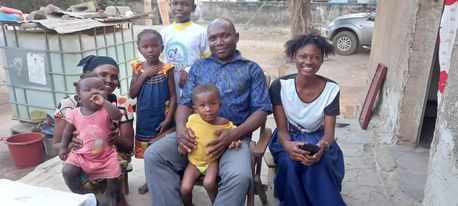
That was a first for me, and the beginning of a deeply moving story that began about 25 years ago. Mariam (to the left in the photo above) and I met together frequently for prayer. She needed much encouragement, since her father was a strong Muslim who was not at all pleased with her decision to follow Jesus. One day she came over to our house with deep anxiety. He had told her that he had pledged her to become the fourth wife of an old man in the community. What could she do?

Glenn and I were perplexed. We asked national pastors for advice, and they said we should “hide” her. A young man that we had sent away for training at the seminary in Abidjan, Abdoulaye, in preparation for future work in Nyarafolo translation, agreed to accept her in his family home to protect her. His wife Mariame was an outstanding young mom and had taught Sunday School with me at Tiepogovogo, so I knew that this young Mariam would be in good hands. She helped with housework and childcare, living there for a couple of years.

Then she came back to Ferke, staying on the other side of town, still not in touch with her family. She was attending the Baptist church in that district and met a young man there who asked him to marry her. It did not turn out as hoped. He got her pregnant then left for Mali. She gave birth to a little girl, and decided to reach out to her father for help since we were not around (evacuated for three years when civil war broke out). Things took an unexpected turn: her father was entranced by the baby girl, his new granddaughter, and took them both back into the courtyard.

Mariam continued her walk of faith, and some of her older sisters decided to follow Jesus too. But a physical problem was continuing. Her eyes were constantly draining fluid, and the medical treatments she received were not changing that. We had been trying for years to get the taxi’s insurance to take care of her medical bills without success. Finally, a reliable lawyer in Abidjan was able to partially crack the corrupt justice system and get some payment—but her father took the funds to use in other ways.

Tene, her daughter (the girl at the right in the photo), was growing up. When we returned she would often stop by to see me on her way home from school and get a welcome drink of water. Mariam was beginning to develop a small business, braiding hair. And then a young Nyarafolo man in her church began to court her. Even when he was completely informed about her physical issues, even when his pastor told him he was too poor and she was too poor to consider marriage, he was determined. Pedjouyaha married her and they found space in a courtyard where other members of his family lived.

She set up a small booth for her business. He was still looking for other work—he had been rising at 4 a.m. to catch transportation out to the sugar plantation to do hard labor. It was long hours, very low pay. So he found a job cleaning at a new hotel in town, but after two months of work, he still had received no pay. He came to us for advice. We had just heard that there was an opening for another guard at the hospital, and recommended him. He was hired, and is still there!

Two years ago Mariam was able to see a doctor specializing in eye surgery down in Abidjan, and went through six hours of surgery. The specialist finally found a small piece of bone (broken in that taxi accident) that was causing the chronic infection and constant drainage! Because Pedjouyaha was working at the Baptist Hospital in Ferke, the insurance that covered staff at that time paid for this procedure. Now, one gland is still draining and the doctor wants to operate again, but the insurance at the Baptist Hospital no longer covers expenses outside its own services. So they wait.

Nevertheless God is using them in another unexpected way. Tene is now a lovely teen with three younger brothers and sisters, one of them born shortly after that eye surgery two years ago (center in the photo, in her father’s arms). Then one year ago the couple was “given” a newborn to raise, a little girl whose mother (Pedjouyaha’s sister-in-law) had died while giving birth. So Mariam has been mothering her own two-year-old as well this baby now one year old (the baby in Mariam’s arms). It is common for families to expect female relatives to take in motherless babies, but the story behind this case is startling.

One month after taking in the little girl they named “Grace,” they had also been given a second baby to care for, a little boy whose mother had also died while giving birth! Both deceased mothers were sister-in-laws of Pedjouyaha. It turns out that the two women had hated each other, and they had each gone to a sorcerer to have a curse put on the other one. They had been heard taunting each other as their pregnancies advanced, “You are going to die in childbirth!” “No, you are going to die!” Both of them died, going into labor one month apart!

The two babies both became ill, just two days after the boy joined the family. Both were hospitalized. The boy needed oxygen. Just two days later, died. He was only three weeks old.

But Grace recovered and is still doing well, a jolly little toddler with fat cheeks who keeps getting hugs from her big sister, one year older than she.

This story reminds me of this meaningful verse:

He will feed his flock like a shepherd. He will carry the lambs in his arms, holding them close to his heart. He will gently lead the mother sheep with their young. (Isa. 40:11 NLT)

Isn’t the grace of our Lord evident in this story? Out of ongoing tragedies, the Lord has put together a generous family that has welcomed more than just their own children into their loving arms. They still live at a poverty level. With all the little ones to care for, and the eye issues and surgery, Mariam has had to drop her hair braiding business and make do selling some things. Pedjouyaha’s job as a hospital guard gives them enough to live on, but not enough for extra things. If it were not for the compassion fund that has supplied payment for so many of their medical needs over the years, they would be truly in despair. That is how the Lord uses his worldwide Family to take care of each other. Thank you, thank you to all of you generous hearts!

They continue to walk forward in steadfast faith, laughing with the children, caring for each other. And we are now praying that we will find out how much the remaining eye surgery will cost, and that there will be funds to pay for it. The Shepherd does provide for his sheep!

The Fellowship of the Living Ring

Her feet stomp right
then to the left,
from front to back
and round again
just like her sister
leading the line
just like her sisters
following behind
arms all swinging
back and forth as if
cutting ripe grain
to bring in harvest,
or now bent low
they pump the air
like shovels plunging
into the earth
cultivating
working hard for
Jesus their Lord
who called them
rescued them
made them a Family
his own beloved
daughters who join
the circle of praise 
the pulsing line
of Life and Truth
that dances joy
in the welcome shade
protective shade
out of the angry
merciless sun
delight in the beat
that glues them tight
in this harmony
of Body life
then the leader hears
the call of the song
to pump it up
surrender all
her feet together
her body leaning
into the ring
she jumps it forward
one two three
a pause to swing
those muscled arms
and pump them into
living praise
and sisters follow
one two three
and back and forth
and one two three
not minding the heat
the babes on their backs
going to sleep
in the soothing pulse
of their mother’s leaps
and the melodies 
of the balaphones
rippling north
and south on the keys
while the calabashes
clack and shush
and the drumbeat
punctuates the air
one calling others
to come and share
the fellowship
of the living ring
the daughters of
the one true King
as the circle grows
a smaller one forms
inside for the youths
who pump it up
and the women watch
and keep the beat
the solid rhythm
of passion shared
as they circle
their loved ones
spinning now
and a little girl
follows mom in the ring
learning the way
to shuffle and pray
in the Family way

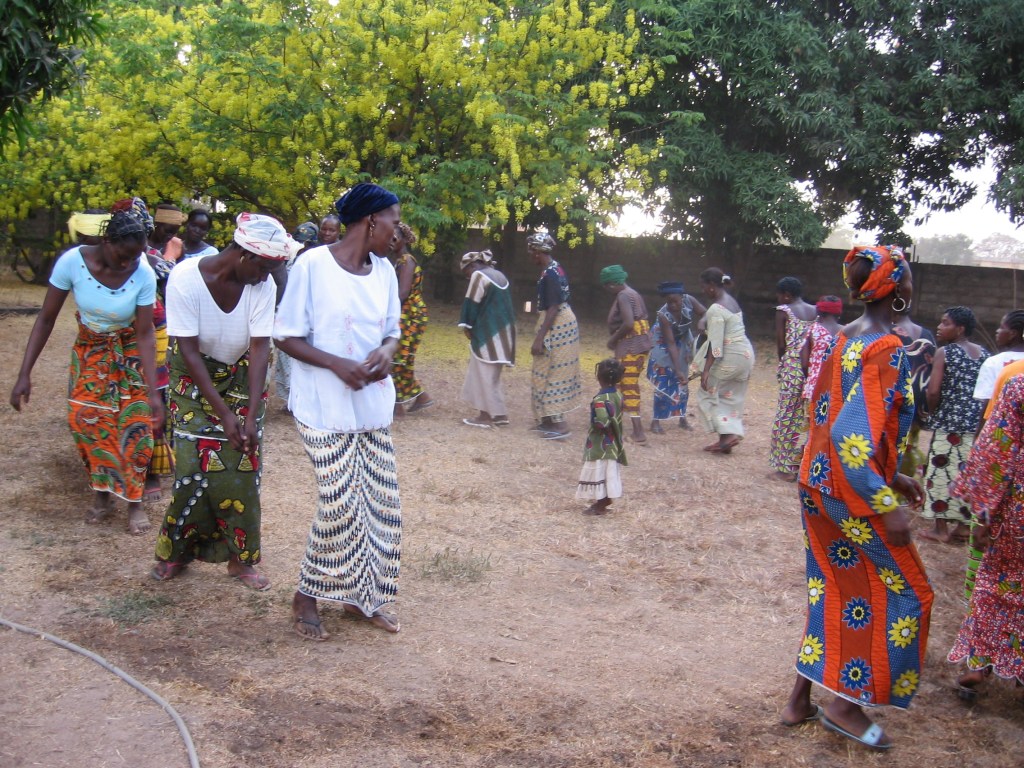
The balaphones were rippling wild praise, calling the villagers to come to the service. I sat in the third row, jumping up to give hugs or shake hands, delighted to be back at this other “home church,” one the Lord brought into being by sending us out as his servants. Now I could hardly wait to serve with my sisters. The service started, and as the singer began to call out his song, the congregation responding by singing their repetitive response, Mineta rose from her seat on the first row. Her metal scraper rhythmically accompanying the beat, she began to shuffle quietly forward and then counterclockwise to lead the dance. I jumped from my seat to join her and the other women leaping up to shuffle forward into the widening circle. Listening to the song, they chose the arm movements and joined the response to the call. I felt joy seep into my soul. Here I was again, after so long apart, dancing praise with my sisters in the house of the Lord!

That was last Sunday!

When you live in northern Côte d’Ivoire, dance is a normal part of the worship service in most evangelical churches. Do you find this unsettling? It is worlds apart from what is often experienced in the United States! I admit that I was one of the American missionaries who found joining in the circle dance a wonderful release of the yearning to move that was inside me.

Praising the Lord is meant to include the dance, wherever it is meaningful to the worshippers:

Let them praise his name with dancing! Let them sing praises to him to the accompaniment of the tambourine and harp! (Ps. 149:3 NET)

Praise him with the tambourine and with dancing! Praise him with stringed instruments and the flute! (Ps. 150:4 NET)

Another element in this form of worshipful dance is the expression of community. The dancers are following each other, blending into the whole, each one free to interpret the song with their arms or full-body movements as long as it does not disrupt the circle. Children are welcomed in. Young men and women sometimes create a smaller circle inside in order to put more energy into their joyful dance.  

If the song is praise, some will lift their hands and faces upward. When there is an exhortation to serve, they may bend over and swing their arms as though threshing the grain, or join their hands and pump them as though pounding in a mortar. (You can watch a snippet of this dance here: Serve the Lord with all your heart video https://youtu.be/rZsQtaJJg7Q  and the vigorous last measures here: Serve the Lord, dance ends with children https://youtu.be/mIkpLXHNm6o )

Those elements are all particularly aligned with dancing to the music of balaphones, long instruments like xylophones made of wood with gourds serving as the resonance chambers—and the scale is pentatonic, five notes per measure. That is what has been retained in many spirituals and gospel music in the U.S.

The Nyarafolo Group has been meeting in the courtyard behind the house where we used to live for decades, in Ferkessédougou. We joined them on Sunday afternoons; this was the one place in the town where they could pray, sing and study the Word in their own language, until just this past year! They began their music ministry with balaphones, but when the balaphones became worn out they could not afford to repair them. So their leader, Moïse, brought in the “pire” (pronounced pray), which are two drums traditionally used to incite energetic work when young men were brought together to prepare a field for farming. Now this group has become well known for saving the musical culture as well as for making a new genre of believers’ songs!  They were even invited to sing at a concert sponsored by “Afrik Arts Culture” in a nearby big city earlier this month. The bass and the tenor drums answer each other, and the dance follows along. This time it is done in rows with different foot movements, but the arm motions are much like the onese in the dance to the balaphone. (You can watch a song and dance from this past week here: Let your light be seen (shine),with pire drums  https://youtu.be/T7Z6zRmsHOI )

Once again, this is all about serving the Lord with songs that tell his stories, that evoke jubilation and praise, or that even become personal testimonies.

I’ve learned so much from these brothers and sisters about whole-body worship! It makes it difficult for me to stand completely still in the U.S. churches, but I work at adapting. And I know not everyone experiences that same call to worship or to joining the Body through dance. It may even just be distracting to many who have not experienced it before. We are different personalities with different responses to music—that has become an issue in many churches as generations change in the congregation, or diverse cultures express longing for what speaks to them.

It seems evident to me that the Lord understands and loves diversity. He made all those kinds of flowers and trees and birds and animals and people! What matters is using what he has given us to honor him: our bodies, our voices, our instruments, and most importantly, our hearts. We must be focused on him as we sit quietly and sing, or as we join the circle with humility and love. When the Body of our Lord joins together to praise him, he is delighted.

24 Your procession, God, has come into view, the procession of my God and King into the sanctuary. 25 In front are the singers, after them the musicians; with them are the young women playing the timbrels. 26 Praise God in the great congregation; praise the LORD in the assembly of Israel.  (Ps. 68:1 NIV)

I have three more Sundays to enjoy Nyarafolo worship to the fullest! May you worship the Lord with all your heart and soul too, wherever you are!

Nomad

I am only, always
just a resident alien
on a yoyo between worlds,
with a foreign address,
borrowed rooms,
and a “home” 
where I never live.
At least not yet.
Someday.

Meanwhile everything
is temporary.
A modern nomad,
I have no herds,
just other moveable goods:
my books, my music,
practical clothes,
and indications 
of my nesting instinct
like candles, chocolate,
the essential coffeepot,
and photos.

Not even family
stays intact:
I trail children 
in my wake,
some here, some there;
siblings halfway
around the world,
parents all back 
where we come from.
Friends are lost to distance
or to silence.

Memories of
discarded nests
of back and forth
and torturous goodbyes
move in succession
through my thoughts.
Airports have sanded
off my heart
until it’s raw.
Togetherness and roots
are the  elusive stuff 
of dreams.

Just call me Sarah,
partnered with my Abe,
inevitably
packing up
and moving on,
risking everything
on promises
and for the sake
of the Voice.

We do have resting places;
we’ve left our
markers there,
something permanent
in all the transience.
They stand as 
firm reminders 
of epiphanies.
Whenever we can circle back
in thought or fact,
we do.  

And there,
we find that gratitude
and confidence renewed
give hope a boost,
and keep us headed
in our true direction:
a country where
we’ll turn in suitcases
for all the comforts 
of Home.

Twenty years ago I wrote that poem about our nomadic lifestyle, on mission, going where the Lord told us to go. We had recently been evacuated from civil war in Côte d’Ivoire and were in temporary housing in the U.S., uncertain about what moves the future might have for us. Three years later we were able to return to our work in that West African country. It was indeed our other home, but it felt very different: the country was divided, and that northern section where we worked was under rebel control. Every moment was underlined with uncertainty. Once again, the Lord brought us all through it, the country was reunited and we continued our ministry there until retirement in 2019.

But the moves were not over yet. We now had roots in Detroit (where we still live), and it did feel like home. Nevertheless both Glenn and I are still associated with ongoing projects in Ferke, our other “home,” and every year one or both of us have gone back for short visits to contribute to their progress.

That’s where we are right now, again! On January 13th we flew out of Detroit, and by late afternoon on the 16th we arrived in Ferke. We are in a different house than the one we lived in most of those previous decades, but we did live there once before for one year while another family needed our space in town. Here, we are out at the Baptist Hospital station where I grew up, and where we lived during our first term back as a family. It is no wonder that every time I go from one room to another, or out and about, memories come sliding into internal video play. Right now, I am “circling back” into those epiphanies.

So I am going to take a break from digging into the Sermon on the Mount in order to offer you an opportunity to accompany me on this particular journey. Some of you have had to uproot yourselves and move as well, and you can empathize with the way it is indeed possible to be deeply rooted in drastically different places on this wide earth.

Many characters in the Bible had those kinds of lives too. I think right away of Abraham and Sarah and their family, of Moses, Joshua, Ruth, and others. Each one had to trust their Lord God YHWH to accompany them. Jesus lived that way as well, from Bethlehem to Egypt to Nazareth to travels without a permanent home all over Israel and in Samaria. To begin with, he had left his forever-home in heaven to become a human being in order to rescue us from all our wrong choices, all our wandering down the wrong paths. He truly understands what it means to be a traveler—in my imagery, a nomad.

We had first arrived here in Ferke in 1979, and retired forty years later. You can imagine the wealth of adventures we had during those years, hard stuff and wonderful stuff. Going back to the States to retire put us on a new path of learning the culture around us in Detroit and following the Lord’s guidance in our use of time. Meanwhile, we’ve had the benefits of the technological revolution that have allowed us to keep connected to many of our dear African friends. And we’ve been back and forth, as I mentioned.

So here we are again. Where are you? Are you in the place you’ve called home for a while? Or is it a new place? Wherever you are, the Lord YHWH is with you. Psalm 139 has been a theme of my life ever since my prayer partner at Wheaton College (both of us MSU graduates) underlined it for me. Some people I’ve shared it with since have found it scary, especially the part that has God basically looking over your shoulder and knowing everything about you. I have found it reassuring. No matter where I am, as his child I am with him, and he is with me—nothing can be more essential to peace:

You have searched me, LORD, and you know me. 2 You know when I sit and when I rise; you perceive my thoughts from afar. 3 You discern my going out and my lying down; you are familiar with all my ways. 4 Before a word is on my tongue you, LORD, know it completely. 5 You hem me in behind and before, and you lay your hand upon me. 6 Such knowledge is too wonderful for me, too lofty for me to attain. 7 Where can I go from your Spirit? Where can I flee from your presence? 8 If I go up to the heavens, you are there; if I make my bed in the depths, you are there. 9 If I rise on the wings of the dawn, if I settle on the far side of the sea, 10 even there your hand will guide me, your right hand will hold me fast. (Ps. 139:1-10 NIV)

I am now back on the far side of the sea, since Detroit is now “home.” But this is still “home” in my heart as well. We had long visits with 10 people yesterday and this morning, the flow to our house a reminder of close relationships formed through the years. There are more visits that we will also be making. The deep cultural value of community is a treasure here. And it is a privilege to see the fruit of hard work, a harvest we never would have expected during the early years. People are excited that they have the New Testament and Pentateuch and Psalms in their mother tongue. More and more Nyarafolos are becoming fluent readers, even those who never went to school at all, due to their hunger for the Word. Friends who have battled serious physical distress are grateful to God and to all who helped them, sharing their stories of healing and progress forward.

The little things matter too, reminding me that the Creator has put delights here that trigger joy: bulbuls singing in the dawn light, tiny baby mangoes on certain trees and fingers of pink-beige blossoms on others, a white butterfly swooping by, a stately baobab standing guard beyond a village, the long fronds of a banana tree waving in the wind outside my window. They are markers of this place—along with the dust blown in by the harmattan wind from the Sahara and the teeny ants craving water and clustering around leaky faucets.

Best of all are the memories of God’s Presence. He protected us when in the war zone, then in rebel territory with no rule of law. He opened our “home” village of Tiepogovogo to us back in those early days, having already put hunger for Jesus in the hearts of two young men there by appearing to one of them. Now there are over 100 believers meeting there, coming from surrounding villages as well. He brought us through bouts with serious diseases. He gave us three children (two of them born here) to raise in this other world and provided the right educational opportunities for them. He gave us Family here, a panorama of sons and daughters and grandkids we could never have imagined. He had a purpose in making us and then sending us here, very vague to us at first; he opened up new paths along the way:

13 For you created my inmost being; you knit me together in my mother’s womb. 14 I praise you because I am fearfully and wonderfully made; your works are wonderful, I know that full well. 15 My frame was not hidden from you when I was made in the secret place, when I was woven together in the depths of the earth. 16 Your eyes saw my unformed body; all the days ordained for me were written in your book before one of them came to be. (Ps. 139:13-16 NIV)

Each of us has a unique story. Those of us who have followed the Lord’s leading can look back and see his hand on our lives, wherever he has placed us. I just want to obey the Father and share some of what he has done for me and through me and Glenn together—all credit going to Abba—so that it might encourage the faith of any who might need that:

We will tell the next generation the praiseworthy deeds of the LORD, his power, and the wonders he has done. (Ps. 78:4b NIV)

Give thanks to the LORD and proclaim his greatness. Let the whole world know what he has done. (Ps. 105:1 NLT)

Where are you now? Where have you been? To whom can you share what the Lord has done, for others and for you? Wherever we are, our good, gentle, gracious God is with us, giving us protection and provision and purpose. So let’s move forward with him!

This is my command — be strong and courageous! Do not be afraid or discouraged. For the LORD your God is with you wherever you go.” (Jos. 1:9 NLT)

18 Jesus came and told his disciples, “I have been given all authority in heaven and on earth. 19 Therefore, go and make disciples of all the nations,baptizing them in the name of the Father and the Son and the Holy Spirit. 20 Teach these new disciples to obey all the commands I have given you. And be sure of this: I am with you always, even to the end of the age.” (Matt. 28:18-20 NLT)

When we follow Jesus, we know where the Road we walk with him will end up: at our forever home. We will be totally at home at last, a place where no roots will be wrenched out, secure in a completely good world filled with joys we cannot even imagine from down here. I’m sure we will see how we have been formed into who he had in mind from the beginning, using all of those changes and moves, enriching us with more understanding of him and of the world. Nomads that we’ve been, we will join the crowd of travelers (like Abraham and Sarah) who have seen God at work. Just read Hebrews 11!

About Asking and Receiving

Like your disciples 
on that day between
your murder
and your return to life
I wait, longing to see
what you have promised.

You said that,
if I would just believe
even a little tiny bit
I could make a mountain move,
I would receive
 from your loving hand
what I am begging for.

So I wait,
and scrape up hope,
asking you for mercy.
Help my unbelief!

When I prayed that prayer, I needed to be reminded of what Jesus told us in his Sermon on the Mount, where he reminded us of how God is our Father, and gives good gifts to his children (Mat. 7:9-11). Good human parents love to give their kids what they need, whatever is good for them and their purposes. God is good, and can be trusted way beyond any humans.

When Jesus said, “Ask and it will be given to you; seek and you will find; knock and the door will be opened to you.  For everyone who asks receives; the one who seeks finds; and to the one who knocks, the door will be opened “(Matt. 7:7-8 NIV) it sounds like an all-encompassing promise. Ask, and you get it. But in the context of his message it is clear that certain parameters are in place, such as which actions and attitudes are eligible for reward from the Father in heaven. Even in his model prayer, he underlined that we are to want God’s will to be done on earth. So when we ask, we need to ask him for things that are in line with his teaching and his purposes. We can trust our good Abba to listen to us and answer in the way that is best for us—like a parent who truly does want their child to have a phone, but will wait to give it when the child is mature enough to handle one appropriately. But if the child wants help for a friend who just fell down then the parent will run to help.

Many commentators find the teaching about asking and receiving, then about good fathers and our good Father, as teachings pasted in rather randomly in this passage. But Dallas Willard, in The Divine Conspiracy, sees a meaningful connection between all the teaching in Mat. 7:1-11 passage, and his analysis makes sense to me. I will try to summarize what he says. We are not to judge others, condemning them and pushing them away. If we truly want to help them, we can often get them to open up by asking open-ended questions that invite them to friendly sharing, even in situations of disagreement or when correction is needed. Condemnation pushes them away. But asking and trying to understand them often will result in understanding, even change. And rather than trying to help guide the conversation on our own, we should turn to our Father and ask him to help us and them. He has told us to reach out to our brothers and sisters, and even to the wider community in the world. This is how Willard puts it:

“We should note that the ask-seek=knock teaching first applies to our approach to others, not to prayer to God. . . .Asking is indeed the great law of the spiritual world through which things are accomplished in cooperation with God and yet in harmony with the freedom and worth of every individual.[1] , , Prayer is nothing but a proper way for persons to interact. Thus Jesus very naturally moves in Matt. 7:7-11 from asking for what you want of others to asking for what you want from your Father. . . “[2]

Most of our English translations miss an element in the Greek text that make this statement ask-seek–knock more than just a one-time deal. Whether drawing out someone with the purpose of helping them, or asking God to help them or yourself, this is meant to be done with perseverance. Here is the grammatical information:

“The three imperatives of v 7 as well as the three participles of v 8 are all in the present tense, conveying the idea of a continual asking, seeking, and knocking. This implied notion of persistence in asking is found in the teaching of Jesus (Luke 18:1–8; 11:5–8).”[3]

Here is an example of a translation that conveys this truth:

Keep on asking, and you will receive what you ask for. Keep on seeking, and you will find. Keep on knocking, and the door will be opened to you. (Matt. 7:7 NLT)

That is another truth I needed to consider when I was writing the prayer-poem above, waiting for an answer that I truly longed to receive. Keep on keeping on!

The example of God as a loving Father shows that he is not offended by our asking, even our persistent asking. He wants us to come to him and let him know our needs and concerns.

Do not be anxious about anything, but in every situation, by prayer and petition, with thanksgiving, present your requests to God. 7 And the peace of God, which transcends all understanding, will guard your hearts and your minds in Christ Jesus. (Phil. 4:6 NIV)

To be like our Father, we need to be willing to engage with others and listen to them. But it is clear that there are some people we should not pressure to participate in such a discussion, particularly about spiritual truths. Verse 6, coming right after the command not to condemn others without careful consideration, is difficult: “Do not give dogs what is sacred; do not throw your pearls to pigs. If you do, they may trample them under their feet, and turn and tear you to pieces. (NIV) Willard, along with many others, takes this to refer to not persisting forcefully in sharing the Good News or proper correction with those who resist completely. Characterizing them as “dogs” and “pigs” makes it clear that these are unbelievers:

“They are an exceptional group of stubborn people who are ‘dogged’ and even ‘pigheaded’, one might accurately say, in their decisive rejection of Jesus Christ. Reluctantly we have to drop them. But if verse 6 is the exception, verse 12 is the rule, the Golden Rule. It transforms our actions. If we put ourselves sensitively into the place of the other person, and wish for him what we would wish for ourselves, we would be never mean, always generous; never harsh, always understanding; never cruel, always kind.”[4]

This “Golden Rule” has its place as the conclusion to this part of the Sermon on the Mount! It is not randomly inserted, but actually starts with “therefore,” which, as we know, is there for a reason:

Therefore, however you want people to treat you, so treat them, for this is the Law and the Prophets. (Matt. 7:12 NAS)

And how does treating people that way complete what is taught in the Law and the Prophets? It obviously comes from a key verse in Leviticus:

You shall not take vengeance or bear a grudge against the sons of your own people, but you shall love your neighbor as yourself: I am the LORD. (Lev. 19:18 ESV)

If I truly love my neighbor, I will reach out to them to help them, not to condemn them, because that is how I would like to be treated. And I am not to assume that I am able to do this on my own. It is a huge challenge to always act that way—way beyond me! But I am not alone. I have my Father to call on, persistently. He actually desires that mutual interaction, that connectedness. It is such a strong attachment that it is what gives us life, and the health to live out that life and to bear good fruit. Think about what Jesus said about our need to be attached to the Vine (John 15)! I love Jesus’ prayer for his followers in John 17:18-23, where he contemplates the importance of “being one” with each other and with him, our God. This is an amazing unity. The more we grow in it, the better we will know how to pray and to show love.

We are so blessed to have that kind of Father, who loves us and wants us to converse with him and depend on him for help. We can trust his goodness! That is what produces faith in him, and willingness to wait when that is what he wants us to do! And, as members of the community of prayerful love (as Dallas Willard calls it[5]), we interact prayerfully with Abba and with others, working together with God and our brothers and sisters to promote healthy life:

“So in Matthew 7:1–12 Jesus has introduced us to these basic relationships. At their centre is our heavenly Father God to whom we come, on whom we depend and who never gives his children other than good gifts. Next, there are our fellow believers. And the anomaly of a censorious spirit (which judges) and of a hypocritical spirit (which sees the splinter in spite of the plank) is that it is incompatible with Christian brotherliness. If our fellow Christians are truly our brothers and sisters in the Lord, it is inconceivable that we shall be anything other than caring and constructive in our attitude towards them.”[6]

We need to live this out with all our energy and with God-given wisdom. As the Word says:

The end of the world is coming soon. Therefore, be earnest and disciplined in your prayers. (1 Pet. 4:7 NLT)


[1] Dallas Willard, The Divine Conspiracy: Rediscovering our Hidden Life in God (HarperSanFrancisco, 1997), 232.

[2] Ibid. 234.

[3] Donald A. Hagner, Matthew 1–13, vol. 33A, Word Biblical Commentary (Dallas: Word, Incorporated, 1993), 174

[4] John R. W. Stott and John R. W. Stott, The Message of the Sermon on the Mount (Matthew 5-7): Christian Counter-Culture, The Bible Speaks Today (Leicester; Downers Grove, IL: InterVarsity Press, 1985), 191–192

[5] Willard, 215.

[6] Stott, 191–192.

Distorted Vision

I’m sitting with my Abba, here,
laying out the pain I’m feeling
after so much fell apart!
I had thought my words right on,
only pointing out the truth.
But they were heard as harsh put-downs,
and their heart slammed its door on me!
How could they push me away so hard
and tell me to just shut my mouth?

Abba listens. He lifts my eyes
to look into his, and quietly asks,
“Were they right? Did you speak
in a way that did shut them down?
Were you fondling your grudge
when you took them to task?
Were you showing the kind of love to them
that you’d like them to show to you?”
Ah! I see things now from his point of view.

The wounds (the stabs, the power grabs)
have sliced my sensitivities
and I have let them fester there,
infection that has made it hard
to even want to reconcile
or try to understand their side.
My inner eyes are now aware
That I have sidelined making peace.
Instead, “revenge” has displaced “care.”

“Forgive me, please!” Then comes release.
I feel my Abba wipe out pus,
the rank disgust that has distorted
what I see. Now I’m free to understand
what caused their hurt and those hard words.
I’ll find a place that will feel safe,
where I can ask them to forgive
my thoughtless jumping to conclusions.
Abba will clean up this mess!


I remember several days when I felt like that, when conflict sent me to a solitary place to cry out to God for relief. What I did not expect was when what the Lord said was that I should stop focusing on my hurt and on the fault of the other person involved. Instead, what had I done that had sounded judgmental to them? How had I put them down, or pushed them away?

That was not easy to take. After all, I had thought that the person needed to be corrected for their own good or the good of the community we were in. Are we not supposed to challenge wrongdoing?

Those times, what was pointed out to me was that I had not spoken with gentleness. And I had responded to their reaction in a way that only made them feel more rejected. I needed to let them know that I cared about their well-being. I needed to say that I was sorry for choosing hurtful words, or the wrong time and place.

What I needed was first of all to ask the Lord for his forgiveness. That always brings a sense of unexpected peace—I think it is like being hugged and comforted. Then what is needed is to figure out what Abba is saying about how I might reach out and make things right with that other person.

There is a verse that is extremely applicable to this situation:

Brothers and sisters, if a person is discovered in some sin,you who are spiritual restore such a person in a spirit of gentleness.Pay close attention to yourselves, so that you are not tempted too. (Gal. 6:1 NET)

“Pay close attention to yourselves!” When correcting someone it is so easy to become judgmental in such a way that they feel condemned instead of encouraged to change. This is usually because we are so convinced that we are right and they are wrong that we do not take the time to examine ourselves first, to become aware of any way in which we are ignoring our own propensity to react in anger, for instance, instead of showing loving concern.

Jesus talked about this very thing in his Sermon on the Mount:

“Do not judge so that you will not be judged. 2 For by the standard you judge you will be judged, and the measure you use will be the measure you receive. 3 Why do you see the speck in your brother’s eye, but fail to seethe beam of wood in your own? 4 Or how can you say to your brother, ‘Let me remove the speck from your eye,’ while there is a beam in your own? 5 You hypocrite! First remove the beam from your own eye, and then you can see clearly to remove the speck from your brother’s eye. (Matt. 7:1-5 NET)

If I cannot see clearly because my own vision is messed up and even blocked, then it would not be possible to help someone get a speck of something out of their eye. I am near-sighted, and if I am not wearing my glasses I would only hurt the person whose eye I was trying to clean out. Self-examination in the presence of the Father is a way to avoid doing this, a way to see the whole situation with accurate vision and be able to get that speck out. Kind of like putting on corrective lenses!

Paul followed up on Jesus’ teaching in his letter to the Galatians, urging them to take a careful look at themselves. He said “pay close attention to yourselves” in order to not fall into sin as well. What kind of sin? It could be this: not showing the gentleness required. It could be leaping to conclusions without listening first, which is judgmental. It could be rejecting them instead of recognizing one’s own tendency to stumble, and lovingly drawing them in. It is easy to wear blinders that we are not even aware of.

There is a spiritual practice that is essential for avoiding this trap: “confession and self-examination.” As Adele Ahlberg Calhoun explains, this is about opening ourselves up to the Holy Spirit in a posture of trust in our loving God. We can come to him without fearing censure that will have the goal of shaming us. Instead we know he longs to forgive us when we admit our wrongs and desire transformation. These are some of the “God-given fruit” one can expect as a result:

  • “Keeping company with Jesus as he helps you with how much or how little you change
  • Being transformed into Christ-likeness
  • Thinking of yourself with sober judgment, awareness of your blind spots
  • Gaining insight into your temptations and God’s work in your life
  • Having compassion toward others in their faults
  • Seeing yourself as God’s loved and forgiven child no matter what you have done
  • Living in thankfulness for God’s work in your life

“We invite God to come right in and look at our sin with us. . .  we hand over the pretense, image management, manipulation, control and self-obsession . . .We lay down our ability to change by the power of the self. We turn to Jesus and seek forgiveness.”[1]

I can affirm that the process is worth it. There have been times when reconciliation and better mutual understanding happened in a follow-up effort on my part. There were also times when there was still bitter resistance, too. You cannot be in control of the other person’s response. But it sure is worth it to be breathing the comfort of being God’s loved and forgiven child, having done the right thing in accordance with his leading.

Here is a sampling of Calhoun’s wise recommendations for moving forward in self-examination—I recommend her book for incredible help with spiritual growth:

  • Name sins, don’t cover them up with generalization
  • What experiences have affected your ability to give and receive forgiveness?
  • When have you experienced the joy of forgiveness?
  • Ask God to show you what you need to confess.
  • How have you hurt someone? Ask for forgiveness and the grace to forgive them.
  • Pray through Ps 32 or 51. How can you relate to David’s confession?
  • What motivates anger, other strong emotions in you? Confess any sin related to those.
  • Practice this self-examination and develop a habit of immediate confession.[2]

In the beatitudes at the beginning of the Sermon, Jesus pointed out that those who are gentle and self-controlled (meek), who show mercy, who hunger and thirst for righteousness, and who seek peace and pursue it, these would all be “blessed.” They would be in a state of well-being in the Kingdom. This is what we desire—let’s work on it!


[1] Adele Ahlberg Calhoun, Spiritual Disciplines Handbook: Practices that Transform Us (InterVarsity Press, 2005), 91-92.

[2] Ibid., 93-94.

Glow!

My fire is lit by You,
by true pure love,
pursuing, wooing, just because
You made us for Yourself,
so when we open up
and let you shine within,
you light us up.

So, like a candlestick
melting down,
quietly cheering all around,
I’ll glow where you choose
to light the dark.
Where you place me I will be
Your loving spark . . . 

spreading the fire,
                      the flame,
                                 the light. 

We just celebrated Christmas, and in my house we are not yet finished: the candles and lights are still all around, waiting for the day when we welcome in a new year. The advent candles are on the dining room table, and every evening we still light them all. Now the song that we sing is “Joy to the World,” because the anticipation of Messiah’s first coming has been resolved in the celebration of his birth.

This year the symbolism of “light” has been made yet more potent by its underlining in Week Three of the Advent readings we’ve been using as a family: “The Promised One,” from Christianity Today 2022. Consider these verses that were contemplated as the six days passed:

The people walking in darkness have seen a great light; on those living in the land of deep darkness a light has dawned. (Isa. 9:2 NIV)

“I, the LORD, have called you in righteousness; I will take hold of your hand. I will keep you and will make you to be a covenant for the people and a light for the Gentiles, (Isa. 42:6 NIV)

When Jesus spoke again to the people, he said, “I am the light of the world. Whoever follows me will never walk in darkness, but will have the light of life.” (Jn. 8:12 NIV)

But whoever lives by the truth comes into the light, so that it may be seen plainly that what they have done has been done in the sight of God. (Jn. 3:21 NIV)

For God, who said, “Let light shine out of darkness,”1 made his light shine in our hearts to give us the light of the knowledge of God’s glory displayed in the face of Christ. (2 Cor. 4:6 NIV)

The light shines in the darkness, and the darkness has not overcome1 it. (Jn. 1:5 NIV)

That last verse has a deeper meaning than we can see at first glance, which is why there is a note on the word “overcome”: 1 Or understood.  It is because the Greek word that is in the text contains the idea of “grasping,” which can be taken as grabbing it or understanding it. Either meaning is powerful here. The light, which is God revealed to the world in the incarnation of Jesus, has not been put out by the darkness that is all around in the world. It was shining in a special way while he was in human form on earth, and it still shines. The dark world usually does not understand what the light really means, or where it originates. Nevertheless, when someone chooses to personally come into the light of the world, they come out of that darkness (Jn. 8:12). And they then understand who God is as they come to know Christ with increasing understanding as they keep walking in the light (2 Cor. 4:6).

Then there is transformation. Knowing the light of the world (Jn. 8:12), those people become the light of the world!!

“You are the light of the world. A town built on a hill cannot be hidden. (Matt. 5:14 NIV)

For months now we’ve been going through Jesus’ teachings in the Sermon on the Mount, and we did not skip over this. But having finished two-thirds of the recorded message, it is more than ever clear to me that it teaches us how to be that light. Just as God told his people, before he came as the Christ, that he would “make you to be a covenant for the people and a light for the Gentiles,” (Isa. 42:6), he makes his disciples into a light for those who do not know him yet. The Sermon shows us how to let that light shine.

“To let one’s light shine is to live in such a way as to manifest the presence of the kingdom.[1] . . .The disciples—the blessed recipients of the kingdom—are thus of vital importance for the accomplishment of God’s purpose in the world. They constitute the salt and light without which the earth cannot survive and remains in darkness. Their mission is accomplished, however, not only in word (cf. [Mat.]10:7; 28:19–20) but in the deeds of their daily existence. Others observing their conduct will know that the priorities of these persons have changed—that before them is something of inestimable value, something that gives light and results in the glorifying of God.”[2]

Our conduct is thus what shines that light of Jesus through us to the world. As Jesus detailed it in his Sermon, that light radiates to others when we show love not only to our friends but to our enemies (Mat. 5:43-48), and when we serve and love only one Master, our God and Father (Mat. 6:24). Then we can be like a tree that bears good fruit (Mat. 7:11-19). Our actions actually should surprise others! And they count!

There are many times when we cannot say the words we would love to say to point certain people to Jesus, the Light of the World. But we can live them out. We can show our love for him by worshiping, by singing, by promoting and doing what pleases him. And we can love the people that he puts in our life path, whether they love us or not, and whether we approve of all their choices or not.

We can continue to grow in our knowledge of Jesus and, by spending time with him in intimate communication, we become able to radiate his light in an increasingly noticeable way. All of this must be done for his glory, not ours (Mat. 6:1). We are reflecting his light, who he is, because he lives in us!

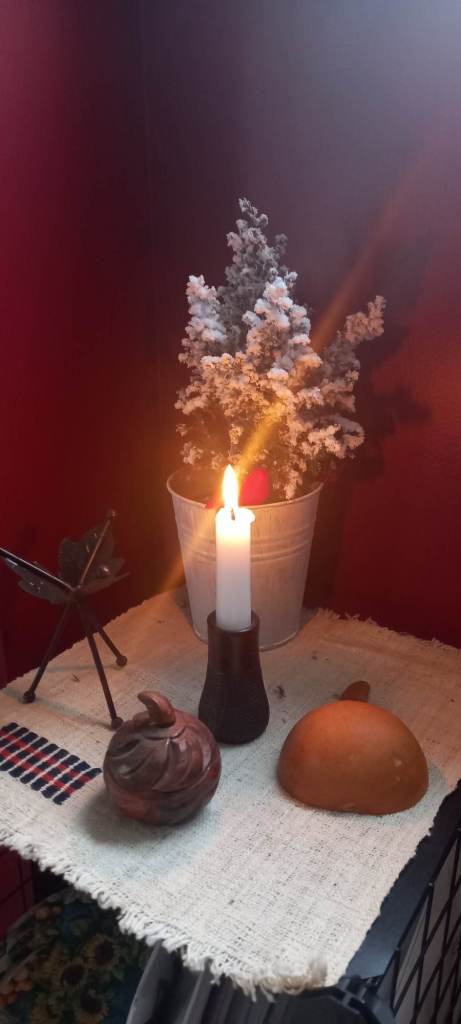
In this way I see myself as a candle lighting the dark. Even as my wick, or life, gets shorter and shorter, the light of Christ can still shine to be seen by the community around me. That is how tiny me, one out of billions on earth, can be a light in this world. You can, too!

“This little light of mine, I’m going to let it shine!”


[1] Donald A. Hagner, Matthew 1–13, vol. 33A, Word Biblical Commentary (Dallas: Word, Incorporated, 1993), 100.

[2] Ibid., 102.

All for that Harvest: Unfailing Love!

You’ve made me your heifer pulling the plow,
you’ve shaped me and trained me, showing me how
to lean to the left when your strong hand presses,
to walk straight ahead, cleaning up messes
and tearing out weeds, preparing the way
for planting the seed in that soil on the day
when all is in readiness, soft dirt tilled,
and we press in the seeds till the rows are all filled.

You bring out the seed: it’s sorted, it’s good;
it’s all about health and the way that we should
be loving our neighbor, helping the torn,
the poor, the lost, the hungry, the worn,
carefully living, meticulously,
the love of the Father for you and for me
and for all the husbandless, all those alone,
for all of the fatherless needing a home.

You must give the seed; my own is diseased.
You must show me how I should plant it, then please –
you must send the rain that will make the shoots thrive,
the rain of what’s right and of hope that’s alive.
The roots will go deep, the stems will grow tall,
the leaves will shout green and the blossoms will fall
to make way for grain that is bred high, above:
a life-giving harvest of unfailing love!

Can you picture yourself as a heifer? The imagery of being cow in the field is not one we would choose in our culture. But let’s take ourselves back to when the prophet Hosea was speaking to farmers in Israel, encouraging them that the Lord was indeed using them for his excellent purposes. He was using them to work out his plans for justice in the world. So he was telling his people to “sow righteousness” because then they would get a harvest of unfailing love!

11 Ephraim is a trained heifer that loves to thresh; so I will put a yoke on her fair neck. I will drive Ephraim, Judah must plow, and Jacob must break up the ground. 12 Sow righteousness for yourselves, reap the fruit of unfailing love, and break up your unplowed ground; for it is time to seek the LORD, until he comes and showers his righteousness on you.  (Hos. 10:11-12 NIV)

Jesus also used this imagery when he was calling out to his disciples to commit themselves to working together with him for his Kingdom purposes:

“All things have been committed to me by my Father. No one knows the Son except the Father, and no one knows the Father except the Son and those to whom the Son chooses to reveal him. 28 “Come to me, all you who are weary and burdened, and I will give you rest. 29 Take my yoke upon you and learn from me, for I am gentle and humble in heart, and you will find rest for your souls. 30 For my yoke is easy and my burden is light.” (Matt. 11:27-30 NIV)

So what is a “yoke”? The note in the NET version says: “ 52 sn A yoke is a wooden bar or frame that joins two animals like oxen or horses so that they can pull a wagon, plow, etc. together.” If disciples are being guided by the “yoke” that Jesus would put on them, their experience is in stark contrast to what it would be like to follow the nit-picky rules that other teachers were insisting were necessary. He said that his yoke was “easy” and the burden he would put on them “light” because his guidance would always be correct, never leading them off the path!

Just as God had told his people through the prophet Hosea, this would not be a life chained to mere legalism. Instead, they would be working together to spread the truth about Kingdom righteousness, righteousness that the Spirit of God would shower on them. And this good news would bring spiritual rest to them. They would no longer be chained to worry about doing it all through their own effort!

Jesus was making the same priority explicit for anyone who wants to be his disciple when he said in the Sermon on the Mount that their primary goal had to be to do the work of the Kingdom:

31 So do not worry, saying, ‘What shall we eat?’ or ‘What shall we drink?’ or ‘What shall we wear?’ 32 For the pagans run after all these things, and your heavenly Father knows that you need them. 33 But seek first his kingdom and his righteousness, and all these things will be given to you as well. 34 Therefore do not worry about tomorrow, for tomorrow will worry about itself. Each day has enough trouble of its own. (Matt. 6:31-34 NIV)

The command to prioritize the Father’s kingdom and his righteousness is sandwiched in between two injunctions not to worry. The first one concerns anxiety about daily provisions; the second one is explicitly about focusing on the “what-ifs,” the hardships that might come tomorrow. Trust in the goodness and power of the One who is in charge of the future releases the disciple from that kind of worry.

So Jesus made it clear that If his disciples have their priorities straight, they will stop making anything worth more to them than working for their Father the King’s purposes and for personal transformation, to be righteous like God is righteous.

Paul reiterated this when he told Timothy that it is easy to put one’s trust in wealth and personal accomplishment, but instead “you, man of God, flee from all this, and pursue righteousness, godliness, faith, love, endurance and gentleness.” (1 Tim. 6:11 NIV)

It is a pursuit! A farmer plowing a field needs to stay on course, row after row. A runner needs to keep to the route laid out for him, not veering off in another direction. A disciple of Jesus needs to run after the qualities that will make him or her effective in participation in Jesus’ Kingdom purposes.

How can one seek the Father’s righteousness and pass that on, “sow” it? As Dallas Willard explains, the Greek word that is usually translated “righteousness” is dikaiosune which should be understood as “true inner goodness” –the “relationship of the soul to God.”[1] A disciple makes the development of that relationship his priority, so that his reflexes become increasingly like God’s—he sees a need or an opportunity and reacts the way his Master reacts. His bonds to the Master are that strong! Or if we continue with the imagery of being in the Master’s yoke, the disciple is directed the way the Master wishes.

It’s true that we cannot earn our right standing before God through our own efforts at building our character; no, he makes it clear that faith is what makes it possible for us to enter his Kingdom, to become his disciples (cf Rom. 4:3-5). But that is not an endpoint but a new beginning—he has prepared specific things for us to do:

For it is by grace you have been saved, through faith– and this is not from yourselves, it is the gift of God– 9 not by works, so that no one can boast. 10 For we are God’s handiwork, created in Christ Jesus to do good works, which God prepared in advance for us to do. (Eph. 2:8 NIV)

That is why we are like the cattle being directed by the farmer to plant seed that is going to produce the desired harvest—as Hosea 10:12 underlines, a harvest of “unfailing love.” God is love, and when we are driven by him, in his yoke, we are sowing that inner goodness that is characterized by love. It is shown by our commitment to spread the good news of the Kingdom of love and rescue, and in our personal pursuit of becoming like Jesus, gentle, humble and loving. He “showers his righteousness” on us through his Spirit (Hosea 10:12) so that we can live out those qualities, “sowing” right living, reaping a harvest that is unfailing love!

That is the “easy” yoke?? Yes, because instead of stumbling around, on and off the right path, when we are directed by Jesus we know that we are truly partnering with him, and he keeps us going the right direction. He transforms our inner person so that we can be that “trained heifer” (Hosea 10:11) that can accomplish his work. That righteousness, “true inner goodness,”[2] is to be our Kingdom priority (“but seek first his Kingdom and his righteousness” Mat 6:33.)

Bound to him in purpose and in love, we are then true disciples with no more worries about what may happen next. He directs the journey and provides all that we need along the way.


[1] Dallas Willard, The Divine Conspiracy: Rediscovering our Hidden Life in God (HarperSanFrancisco, 1997), 145.

[2] Ibid.

Worry is a Trap

The price of gas keeps peaking
(we think it’s over, lower,
then it’s not)!
Insurance for our home, our car,
is suddenly becoming
beyond what we expected.
Christmas season brings good cheer,
expensive food to share
and gifts to buy . . .
I think that I’ve decided that
my spending is all done.
I’m shutting down.

But they’re extending super sales!
Black Friday isn’t over,
it has become Black Week!
My sheets are old, my blue jeans
and my skirts and shirts
all out of style!
Should I make sure I catch this sale?
Or should I wait
and not give in?
But then, this also is the time
to triple impact, give yet more
to help the poor!

My anxious thoughts are winning,
dimming Christmas lights,
humming worry versus carols.

I pray. He says, “Just breathe!
Remember the true sense
of why I came,
that baby in the feeding trough,
the joy I brought,
and all my suffering,
the life I live, the love I give
to all my dear ones,
everywhere.
Just trust me! I provide!
Your worry is a trap.
Rest on my lap!”

Is your inbox flooded with ads these days, so many it’s hard to weed through them to find any real mail? Mine is. And sometimes I take advantage of good deals that come just at the right moment. That’s fine, when I choose well. But the temptation to step outside of my “real needs” box is there, every day. Then we open the mail that comes in envelopes, and to our chagrin, we get news that shows that our budget is indeed going to be stretched.

It is easy, then, to either blissfully ignore one’s over-spending or to become anxious. For most of us who are contemplating this together today, our needs for daily food and adequate clothing are already being met. We also know that there are people suffering in severe poverty, both in Western countries and around the world. We know that there are street people not too far away who are wondering what they will eat tomorrow, or how they will deal with winter cold. And then there are those in the slums of cities like Calcutta, in the villages in warn-torn nations in Africa, and people who have lost all they owned in Ukraine. We may have empathy for these needy people and give to help them.

But it is also easy for those of us with “normal” plans for improving our housing, replacing an old car, or updating our wardrobe to become swept up in the kind of idolatry that Jesus was talking about in Matthew 6: 24, when he stated, “You cannot serve both God and money.” Last week we dug into the meaning of the word translated most times as “money”: “mammon.” In its original setting it pointed to a kind of idolatry. If we let the cultural approval of consumerism (the pressure to always buy what will improve our lifestyle) influence us to the extent that we shift our devotion away from our Father in heaven and focus on wealth or sales or increased comfort or today’s fashion, we are falling into idolatry. We are serving another master.

This does not mean that Jesus did not understand our need to provide what is good for ourselves and our families as well as our neighbors. That is why he points to the birds as an example of how the Father provides: They don’t just sit in their nests and expect to be fed; they go out and search for their food every day. But they are not focusing on storing up an exorbitant pile of future provisions in a barn somewhere. How does this apply to human beings? Is it not a good thing to know that your pantry has what you might need if a storm comes and shuts down access to groceries? No, it is about what becomes the driving force behind our accumulation of food or other goods.

As Donald Hagner says, “a life dominated by concern for such matters is misdirected and will of necessity lack full commitment to what is really important.”[1] What is really important? It is trusting God and having him first in our lives. If we believe he is good, and that his promises to provide what we need are solid, then worry will not rule our emotions.

I’m sure you have heard the injunction: “Whenever you see a ‘therefore,’ you need to look to see what it is there for.” In this section of the Sermon on the Mount that we are considering here (Mat. 6:24-32) there are several of these, but the one that gives us the overall answer is at the beginning:

“No one can serve two masters. Either you will hate the one and love the other, or you will be devoted to the one and despise the other. You cannot serve both God and money. 25Therefore I tell you, do not worry about your life, what you will eat or drink; or about your body, what you will wear. Is not life more than food, and the body more than clothes? (Matt. 6:24 NIV)

When we have entered the Kingdom of the King of the Universe, our Father in heaven, we now have one law which is to guide all our decisions and actions: 

“‘Love the Lord your God with all your heart and with all your soul and with all your strength and with all your mind’; and, ‘Love your neighbor as yourself.’” (Lk. 10:27 NIV)

Our Father does not guarantee that we will never face difficulties. I think of what his emissary Paul went through (cf 2 Cor. 3:23-27), suffering which included “labor and hardship, many sleepless nights, hunger and thirst, often without food, cold, and lacking clothing.” (2 Cor. 11:27 CSB) Nevertheless, Paul said, through those sufferings he experienced God’s grace in his life as never before, and was strengthened in his complete devotion to Christ (2 Cor. 12:10).

John Stott summarizes our situation this way: “So then God’s children are promised freedom neither from work, nor from responsibility, nor from trouble, but only from worry. Worry is forbidden us: it is incompatible with Christian faith.”[2]

The Lord’s model prayer does tell us to come to the Father with our needs, such as “Give us today the food that we need” (Mat 6:11 NLT). That is an example of unloading our worries onto him, letting him take the concern off our minds and hearts. That is often a challenge for us, but it is not impossible or he would not have told us that we must do it, choosing to trust him and his character.

When we worry, we are allowing the Enemy to weaken our faith. Instead of falling into that trap, we are told to: Cast all your anxiety on him because he cares for you. (1 Pet. 5:7 NIV) If we trust the Father’s love, then we know that he is taking care of us. I love the way the French translates this verse: Déchargez-vous sur lui de tous vos soucis (1 Pet. 5:7 BFC), which could be understood as “get that load of worries off of you and put the load on him”. It is a kind of unloading that leaves us free to carry on with a different focus, serving him in whatever way he has put in front of us. “We cannot be serving God by glorifying him if we are constantly filled with doubt about his ability to take care of us.”[3]

My parents had a collection of LPs that satisfied my longing for music whenever I was home from school. One of my favorite songs from one of those records has been humming through my mind today while writing this: “His Eye is on the Sparrow,” sung by Ethel Waters (https://www.youtube.com/watch?v=_QbeNSatFFo):

“Why should I feel discouraged, why should the shadows come,
Why should my heart be lonely, and long for heaven and home,
When Jesus is my portion? My constant friend is He:
His eye is on the sparrow, and I know He watches me;
His eye is on the sparrow, and I know He watches me.

I sing because I’m happy,
I sing because I’m free,
For His eye is on the sparrow,
And I know He watches me.”

Yes!  I know He watches over me with love! Worry cannot hold me captive!


[1] Donald A. Hagner, Matthew 1–13, vol. 33A, Word Biblical Commentary (Dallas: Word, Incorporated, 1993), 163.

[2] John R. W. Stott and John R. W. Stott, The Message of the Sermon on the Mount (Matthew 5-7): Christian Counter-Culture, The Bible Speaks Today (Leicester; Downers Grove, IL: InterVarsity Press, 1985), 168

[3] James Montgomery Boice, The Sermon on the Mount: An Expositional Commentary (Grand Rapids: Baker Books, 1972), 221.