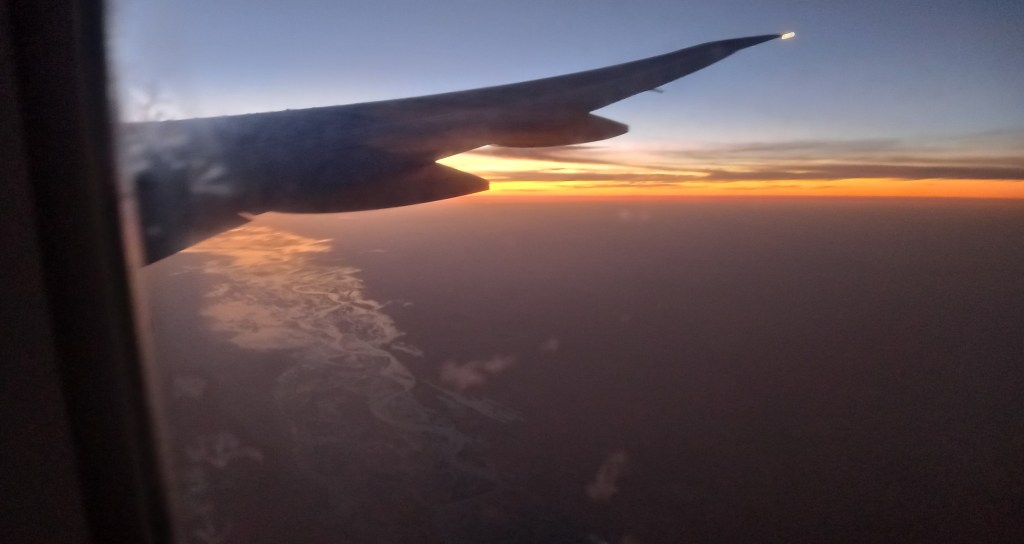
I greet distance once again,
geographic separation
that clips my best
strong heart connections,
separates close friends,
my loved ones.
The threads of tenderness
trail tears over continents
and disappear into
the salt of seas.

“Goodbye!” is the word
that stabs me,
punctuation to
the phrases of my life
even while it sends
my love after a heart.
Delight moves through
shared sequences
(some catapulted into
meaning far beyond
mere words), and ends
in exclamation points.
(Gone, impossibly!)

But some insist
on semi-colons,
endings that
anticipate an encore
or at least
the whispered continuity
of messaging;
I pile up semi-colons
greedily—soul-mates
and dear companions—
defying periods and
loathing question marks.

I’ll choose the punctuation
for my soul
that lets me
run the distance
and stay whole.
Have you ever felt that “goodbye” was your least favorite word? There are those moments when it can mean “good riddance!”. But most of the time it evokes separation, temporary or long-term—sometimes heart-wrenching separation.
My life has been full of comings and goings, between Africa and the U.S. as well as in each country or state where friends or family have moved and settled. Even within my nuclear family this applies: one of my daughters and her family have moved to Norway. They visit once a year, and we hope to go there someday to visit as well, but the distance and travel cost are a big hoop to leap over.
Back when my kids were growing up we faced the challenge of providing them with an education that could carry them through to American schools. We did years of home school, but for some of them the lack of community sports and discussions (not available where we lived) made it too lonely. Boarding school became the best option. Some have criticized that choice, saying that it would have been better for us to return to the U.S. than to send them there. It’s true that each family has to get to know their kids and meet their needs the best they can. But what does God say about such separations? Are they off the docket?
This story has captured my attention: Moses, a runaway from danger in Egypt, left his wife and children with his father-in-law in order to obey Yahweh’s command given him at the burning bush, to go back to Egypt and bring the Israelites out (Exodus 3). Moses resisted as God explained that this would not be an easy task (Ex. 3:10-13). After God showed him some miraculous signs he would be able to perform through Moses, and assured him that his brother Aaron would be with him as well as Yahweh himself, he finally agreed. But given the dangers, he left his wife and kids with Jethro in Midian, a land far away from his destination. A long time later Jethro heard the news about the Israelites’ rescue and that they were camping in the desert at “the mountain of God” (Ex. 18:1-5). He brought Zipporah and her sons back to Moses, to join him on his journey to the promised land.
That means there were two huge goodbyes in that family, one when Moses went off to Egypt to see how God would deliver his people, then when Zipporah’s father left her with Moses on the next huge adventure. She, along with her sons, would never see Jethro again. How could this have been God’s good plan?
What we see as the events unfold is that they all learned that Yahweh is “greater than all the gods” (Ex. 18:11). His plan was bigger than just their family ties. Even Moses had been separated from his birth family for decades in order for the Lord to prepare him for his leadership of his people. His parents took a huge risk, giving him up, but it was the right thing.
That prompting or definite “call” from God is what must be obeyed, even when it means separation from loved ones—something many in our culture today cannot accept.
My parents left their parents to follow that leading to Congo and then Côte d’Ivoire. I was four years old when I saw my mom crying as she read a telegram that had arrived, bringing news of her mother’s death. I saw Mom cry (and I had tears too) when my parents took me to boarding school at the age of 10, when Ivory Coast Academy (ICA) first opened. She had home-schooled me with great creativity up until then. We never found the partings easy, but we did not question the conviction that this was what was “His Plan,” and I learned many key lessons in all the leavetakings and homecomings. The same situation became mine as a parent on mission in that same country later, sending my daughters to ICA when they each chose to go. Some churches questioned our wisdom. Even this year one friend told me that good parents would never do that.
So why did we go overseas, leaving my husband’s parents and siblings behind? Eventually we had to say yet more grueling goodbyes to our kids as we left them behind to continue their university studies, then beginning their own families and occupations. Why?
When God clearly points the way, we must follow. When we trust him completely we will let him be the guide, not ourselves. It is easy to assume that we know better than he does. Instead of trusting his goodness and his overall plan, we tend to question any order that comes from the Counselor, who knows everything, and tell him that we will not do that but this. In everything we need to listen to him. We don’t know what lies around the bend. He does.
We just went through wrenching goodbyes again when we dropped my daughter Ariane and her family off at the airport to return to Norway. On the other hand, we had heard so much from each of them, kids and parents, about the things they are learning, the opportunities opening to them to serve the community and their Lord God, that we could see the plan unfolding. There are many affirmations that God had a purpose when he gave them peace, after several years of prayer, about making that decision to move. For them it began with an ongoing invitation to Tom, Ariane’s husband, to serve as a professor at the university there where he had done his sabbatical. Now we also see Ariane moving into international ministry in trauma counseling. The kids are excited about their friends, many immigrants from around the world, and about learning Norwegian. It gives our hearts peace. It changes a fearful goodbye into a confident one, with a “semi-colon” attached as I said in the poem. We are deeply grateful for connection via WhatsApp and emails as well as visits. Communication is much easier in this modern time than it was decades ago.
It is easy to sing “I will go where you send me,” and harder to just listen to the Guide and do it. If only we could be as willing as Isaiah was:
Then I heard the voice of the Lord saying, “Whom shall I send? And who will go for us?” And I said, “Here am I. Send me!” (Isa. 6:8 NIV)
I myself wrestled with that full surrender for years, especially as a teen. I had felt several strong promptings pushing me to go wherever the Lord wanted, but I was scared he would send me into wars, or have me serve as a single woman (there are so many dedicated missionaries who never married!). I had a boyfriend named Glenn as I started college, someone who had never talked about feeling called to mission. Then there was that critical turning point that happened at the Urbana ’70 Missions Convention, when (without sharing our decision with each other) we each jumped up to affirm the invitation of God to go wherever he would send us. The rest of our life story took a key turning point, and we have never regretted it—even though it did come with many goodbyes, signposts of separation on the journey.
For many people these promptings will not include such geographical distances. On the other hand, many of my friends have children peppered across the U.S. or Europe or other countries too. It comes with the opportunities of modern times and connections for work, or marriages.
The Guide might also convince you to volunteer for a service position at church or in a community non-profit that is reaching out to the vulnerable. It might be deeper involvement in your neighborhood, or reaching out to family that needs you. It might mean mentoring someone who is longing for connection. Whatever it is, let’s go where we are being sent! Whatever the challenges we meet along the way, our Yahweh is with us, showing us step by step what he has planned on the path he has chosen.
This verse comforts me, one written when the psalmist was going through very tough abuse by those around him:
21 When my heart was grieved and my spirit embittered, 22 I was senseless and ignorant; I was a brute beast before you. 23 Yet I am always with you; you hold me by my right hand. 24 You guide me with your counsel, and afterward you will take me into glory. 25 Whom have I in heaven but you? And earth has nothing I desire besides you. 26 My flesh and my heart may fail, but God is the strength of my heart and my portion forever. (Ps. 73:1 NIV)
Yes, he guides us throughout life as well as beyond, into “glory”, with him forever. The promise of his presence is a forever one! When we keep him first in our lives, trusting him even when it means making decisions that lead to long separations (like Moses went through, and his parents before him), then each step of obedience is accomplishing this: that his “will will be done here on earth as it is in heaven.” (Matthew 6:10)
I’ll choose the punctuation
for my soul
that lets me
run the distance
and stay whole.
 Linnea's Lines
This is so touching, Linnea. I know this has been a big part of your life, and your words about it are very healing.❤️🙏
LikeLiked by 1 person
You certainly understand this too!
LikeLike