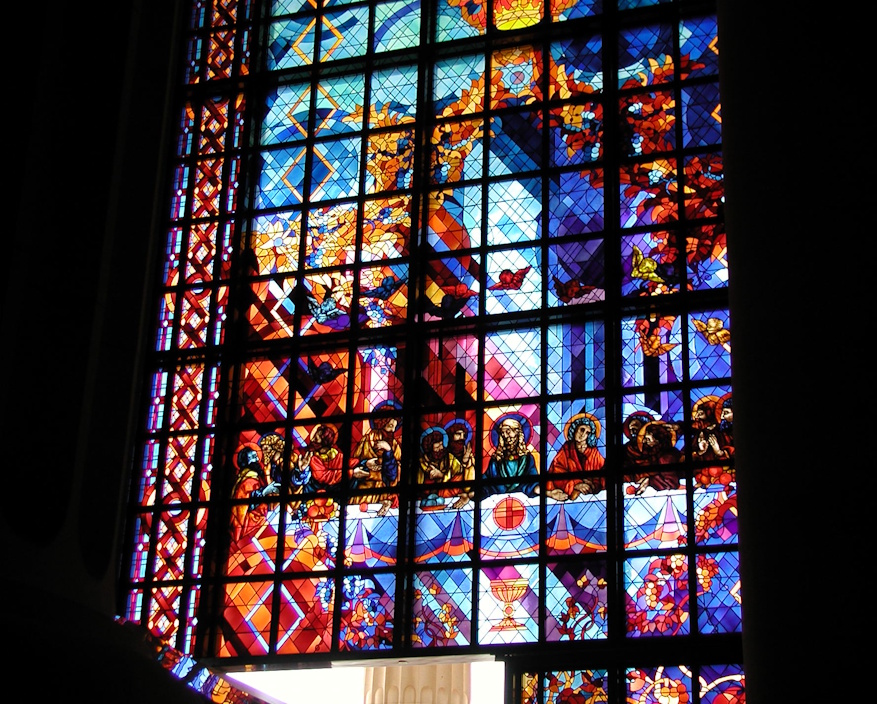
Extraordinary hyper-power
pulsates inside this fragile jar.
Its fried glass, splintered to
a mosaic of prisms,
splits the beams
to violet, green and red
(shocked with gold)
and casts pictures through
the night onto dark walls:
images of glory,
stained glass come alive
and radiating metaphors:

a king bathing slaves’ feet
while a woman’s hair
wipes his with tears;
sliced and swollen shoulders
piled with brutal baggage;
bloody hands dealing out
clean mercy to the world;
the face of love.

Infinity cubed, crammed
in a container, is a time bomb
waiting for dénouement.
When it explodes, this jar
will blast into a new dimension
where its very cracks will be
revealed as finest art,
unique in all the galaxies --
created for delight,
refined by every pressure
into silken glass
on fire with holiness.
7 But we have this treasure in jars of clay, to show that the surpassing power belongs to God and not to us. (2 Cor. 4:7 ESV)
This imagery is meant to make us stop and think. It struck me hard when it came to mind and the poem flowed from my pen. We are clay, yet we have divine power living in us!
Jesus was that kind of “infinity . . . crammed in a container.” It is such a wonder that God could come to earth in human form, to accomplish his purpose of love: salvation. He is light, he is love. When he showed his glory, like in the transfiguration, it would have been breath-taking.
In the Bible the metaphor describing us is that we are made from clay, which is inept and opaque, so when the Spirit of God lives in us and works through us it is obvious that the action is not human; it is Jesus living in us through his Spirit, transforming us, accomplishing his purpose in and through us. He did tell us to to let “our” light shine:
In the same way, let your light shine before others, that they may see your good deeds and glorify your Father in heaven. (Matt. 5:16 NIV)
So how do we get our light to shine before othersbwhen we are jars of clay? God makes it happen, working in us:
For God, who said, “Let light shine out of darkness,” made his light shine in our hearts to give us the light of the knowledge of God’s glory displayed in the face of Christ. (2 Cor. 4:6 NIV)
So as I contemplated the gift God gave us when he promised to fill us with his Spirit when we are devoted to him, I couldn’t help but picture how the diverse spiritual gifts that he blesses us with (see the list in 2 Cor. 13) would shine in different colors in a jar that is no longer made of hard clay,[1] but transformed into stained glass that could be brilliantly lit by that inner light and shine his glory!
The only place I saw stained glass in Côte d’Ivoire was at the Basilica in Yamoussoukro (see the photo above), so it really made an impression. The stunning temple was built by the first president of the country, after independence. To me it seems an exhorbitant use of money when the people were so poor and could have used help. But it’s true that beauty like that, the sunlight shining through the varied colors of stained glass, is powerful when seen inside darkness.
That impact expresses for me what happens in us when we are filled with the Spirit who shines his light in us, and the way that impacts the world.
Yes, stunning changes happened to those who first experienced this new filling at Pentecost. Philip, for instance, had been one of the seven men chosen to make sure that no one was discriminated against in the Jerusalem church’s daily distribution of food. It was evidently a new step for Jewish leaders to give Greek-speaking widows equal status with other believers. They got classified as foreigners. But all seven leaders chosen had Greek names; they needed to reflect the diversity in the community and bring the excluded into the fellowship. “The narratives that follow [Pentecost] concern two of the Seven: Stephen (6:8–8:1a) and Philip (8:4–40). convert to Judaism. A former Gentile who at some point received circumcision and entered the covenant people of Israel.”[2]
Stephen became a famous martyr for his faith. Philip became an outstanding foreign missionary, the first one we hear about in Acts. His first trip was to Samaria, north of Jerusalem, to a people group despised by the Jews as mixed-race and heretics. There in the coastal area of Caesarea he shared the Gospel and performed many astounding miracles that reflected Jesus’ ministry. And people believed his message. This was such astounding news to the believers that they had to corroborateit. “In light of the historical hatred and mistrust between Jews and Samaritans, the Jerusalem church ‘sent Peter and John to Samaria’ as an official delegation to check out the claims of Samaritan conversions.[3] (Acts 8:14)
Then, after they had testified and spoken the message of the Lord, they traveled back to Jerusalem, evangelizing many villages of the Samaritans. (Acts 8.25 CSB)
Peter and John were realizing that yes, they were to put in practice that command of Jesus to take the Good News to all nations, even the people who were minimized.
My life-connection to Africa takes me quickly to what happened next.
26 An angel of the Lord spoke to Philip: “Get up and go south to the road that goes down from Jerusalem to Gaza.” (This is the desert road.) 27 So he got up and went. There was an Ethiopian man, a eunuch and high official of Candace, queen of the Ethiopians, who was in charge of her entire treasury. He had come to worship in Jerusalem 28 and was sitting in his chariot on his way home, reading the prophet Isaiah aloud. 29 The Spirit told Philip, “Go and join that chariot.” (Acts 8:26-29 CSB)
That was a long road trip for Philip! (Did he walk?) “An angel sends Philip from Samaria south to Jerusalem (about 65 miles) and on to Gaza on the far southwestern shore of Israel (another 34 miles). Following Philips path is a journey of around 100 miles.”[4]
And he didn’t stop at Gaza: he continue to travel the desert road until he met that chariot. The man the angel had told him to find had much higher status than Philip. He was a eunuch (castrated to make him a safe dignitary serving the queen), a dignitary. Eunuchs “were not allowed to participate fully in Israel’s religious life (Deut 23:1).”[5] But he was obviously a strong believer in Judaism. He had been worshiping in Jerusalem and was now reading out loud a passage in Isaiah 53 that confused him. Philip was invited to join him in the chariot, and he explained it to him, showing how it depicted Jesus as the Messiah who would die to bring people into his Kingdom:
32 Now the Scripture passage he was reading was this: He was led like a sheep to the slaughter, and as a lamb is silent before its shearer, so He does not open His mouth. 33 In His humiliation justice was denied Him. Who will describe His generation? For His life is taken from the earth. 34 The eunuch replied to Philip, “I ask you, who is the prophet saying this about—himself or another person?” 35 So Philip proceeded to tell him the good news about Jesus, beginning from that Scripture (Acts 832-35 CSB).
There in the desert the two men came to some water and the eunuch asked to be baptized. Philip said: “If you believe comletely what I told you, I will baptize you.” Since the eunuch stated his belief firmly, the chariot was stopped and Philip baptized him. A miracle happened:
39 When they came up out of the water, the Spirit of the Lord carried Philip away, and the eunuch did not see him any longer. But he went on his way rejoicing. 40 Philip appeared in Azotus, and he was traveling and evangelizing all the towns until he came to Caesarea. (Acts 8:39-40 CSB)
Since Pentecost, Philip had traveled north of Jerusalem to preach in Samaria, then south to the desert road , then north again, spreading the Good News everywhere. This is powerful sharing of the Light of the Good News that the Spirit had shone in him. It also reveals the heart transformation that took palce when the Spirit took control, filling the believers. The fruit of the Spirit was now being produced, and one immediate impact was this focus on reaching foreigners. Philip’s mission shows us love erasing ethnic hatreds. And the Spirit has been doing this work ever since, leading certain disciples to “go tell” wherever he sends them!
The eunuch was from Nubia, called Ethiopia in this text, but not the modern Ethiopian area. It was “located in what is today southern Egypt and northern Sudan, between Aswan and Khartoum.”[6] He was the first known convert to take Christianity to Africa. Philip’s witness to him fulfilled what Jesus had said:
Jesus said, “You will be my witnesses, telling people about me everywhere—in Jerusalem … and to the ends of the earth” (Acts 1:8). One of the first places that the story of Jesus went was to Sudan when “the treasurer of Ethiopia” (probably Meroe in modern Sudan) believed the good news that Philip told him, was baptised, and took the message to Africa.[7]
From there it spread, with other apostles also evangelizing, notably Mark and Thomas, who are reported in tradition to have established the church in Egypt. Persecution came, and it actually led to the Good News spreading further. Check out this site that summarizes the history of Christianity coming to Africa : https://africa.thegospelcoalition.org/article/history-christianity-africa/
Christianity faded in importance and in congruence with the Scriptures over time in these early churches. But our Lord God continues to reach out to all the nations, all the peoples of the earth, including those in Africa who have still been living in darkness so long. That huge continent (you can fit the U.S. into it four times) has many ethnic groups separated from others by geographical obstacles (mountains, rivers, deserts etc.) or by disdain.
The Nyarafolo, the group my husband and I worked with, were subsistence farmers that were looked down on by other ethnic groups in the country. They had migrated south on foot from Mali several hundred years ago, looking for farm land. After they had settled near Kong, it was taken over by a Muslim empire and they were chased out. Eventually they found an unoccupied area northwest of Kong and not far from the Mali border in what has since become the Côte d’Ivoire (Ivory Coast),the place where they now live. It was a region with some seasonal wetlands, which they needed as farmers. The Bandama River flowed south next to that region and became a barrier that separated them from the neighboring group to the west. Farming has been a challenge; they remained poor, living off what they could harvest. Their traditional religion, worshiping a variety of false gods and other spiritual beings, has remained firmly ensconced in spite of Muslim and Catholic conversions. Those who understand the need to devote themselves entirely to the High God, who they thought was too distant and unconcerned to respond to them, but discover his love even for them, they are delighted. Those who are Jesus followers are reaching out to spread the Truth. They are still a minority, but want their people to know the Way to God.
They are like a stained glass jar that contains a light so radiant that it stuns the one who sees it shining in the darkness. Where is that coming from, that changed life and new conduct they see in the one who used to be like a hard clay jar? Is it true that Jesus saves people from this bondage of continual sacrifices to an array of gods in order to have a harvest and children and long life? When they see the Light, accept it as Truth and it shines into them as well, there is yet more Light radiating all around! This past week they spent each day evangelizing in villages in an area where persecution by those in the traditional religion has been violent. And Saturday, after worshiping together all night with music and praise, they dedicated a new church building in Pisankaha—the village where the church had been burned down ten years ago by the Poro, the men’s sacred society in the traditional religion.What a great witness, illuminating God’s protection and provision for his people in that area!
Let the Light shine through us believers, over there and wherever our Lord sends us—to everey ethnic group and those who are different from us!
[1] D. A. Carson, “The Gospels and Acts,” in NIV Biblical Theology Study Bible, ed. D. A. Carson (Grand Rapids, MI: Zondervan, 2018), 1967.
[2] Ibid.
[3] D. A. Carson, “The Gospels and Acts,” in NIV Biblical Theology Study Bible, ed. D. A. Carson (Grand Rapids, MI: Zondervan, 2018), 1968.
[4] https://www.think-biblically.com/10-lucubrations/108-philip-and-the-ethiopian
[5] Carson, “The Gospels and Acts,” in NIV Biblical Theology Study Bible, 1968.
[6] Ibid.
[7] https://africa.thegospelcoalition.org/article/history-christianity-africa/
 Linnea's Lines