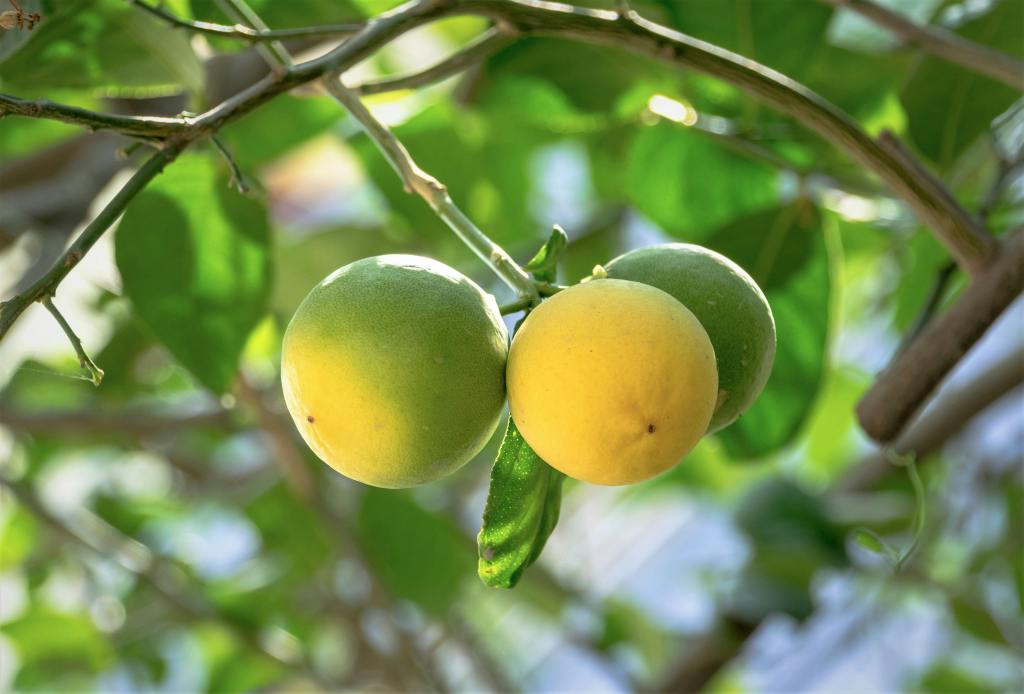
Lemon leaves bush the tree,
newborn limbs reaching out
pushing past the older ones.
I pull one of them sideways,
wondering if there might be
a round ripe lemon waiting for me.
Deep in the forest of varied greens
I catch sight of gold—then suddenly
I see plump balls clustered together,
hanging out in camouflage,
a harvest in the making.
One, two— wow! Five are huge!
They pop off into my hand.
Pruned by lightning years ago,
one side stripped and broken off,
the tree is coming to life,
fruitful as never before.

I think of you, Lord, coming to see
if there is anything worthwhile
growing in me.  I don’t want you
to ever have to look through the leaves
only to have your heart sink:  no fruit!
A certain fig tree comes to mind.
I want to bring a smile of deep
content to your hopeful face.
When lightning strikes and loss
leaves me momentarily undone,
may I stay firmly rooted,
nourished by your love and mercy,
branches living in your light,
finally ripening into exponential gold!
When lightening strikes a tree it can look as if all hope is gone. But a miracle can happen: it can recover and be even more fruitful! I saw it twelve years ago in my courtyard in Ferkessédougou, when I noticed that our lemon tree, fractured by lightening years ago, was getting extremely bushy. Yes! Lemons were even hiding inside! It had been pruned and was truly fruitful. That rebirth happened here in Detroit too: our redbud tree was struck several years ago and I personally felt ripped apart. I had given it to Glenn in 2004 on his birthday when we moved into our house, evoking memories of the beautiful redbuds lining the river at MSU when we were dating. The redbud in our lawn has now come back and is growing tall!
These are images of what can happen to those of us who are disciples of Jesus, too. Sometimes a storm hits, crushing us, leaving little hope. It may be in the form of difficult relationships, deep hurts, abuse, economic or medical hardships, losses. Life may seem barren as we trudge ahead, especially if the “strike” has set off a forest fire that seems to keep on burning. But when we are sons or daughters of God, serving our Lord, there can be deep meaning and benefit in such suffering: it is training. A good father does not just let his kids do whatever they want; he trains them up in the way they should go (Proverbs 22.6). He teaches his kids through punishment when they do wrong. But he also teaches them how to live life well and how to get through tough times. They may need encouragement to remember that it will take perseverance to get all their homework done and pass the final exam. If they are getting bullied, he can help them remember who they really are, what they are worth, and how to stand up to it. That is all training, or discipline.
This is a theme in Hebrews 12:
And have you completely forgotten this word of encouragement that addresses you as a father addresses his son? It says, “My son, do not make light of the Lord’s discipline, and do not lose heart when he rebukes you, 6 because the Lord disciplines the one he loves, and he chastens everyone he accepts as his son.” 7 Endure hardship as discipline; God is treating you as his children. For what children are not disciplined by their father? 8 If you are not disciplined– and everyone undergoes discipline– then you are not legitimate, not true sons and daughters at all. (Heb. 12:5-8 NIV)
Does that sound like a “word of encouragement”? Let’s dig into it. The Greek text talks about “sons” because under Roman law, a son was the heir, and his father could discipline him but was not allowed to discipline an illegitimate son.[1] In Christ, we are all heirs, male and female. When Father God disciplines us, he is showing that we are valued. And this should encourage us, because this refers to two kinds of formation: growing through hardship that is experienced in this broken world, and being “chastened,” which infers punishment.
We each have rough edges or deeply rooted issues that need to be dealt with. Some tough things can sand off those rough edges. One of my weaknesses was hyper-sensitivity. When I was mistreated by a friend the hurt simmered inside me; tears were uncontrollable. I even felt that way when I failed to be perfect (like in second grade when I misspelled “Wednesday” on a spelling test). But as I went through one failure after another, then also repeatedly dealt with personal hurts, I began to be able to deal with them better. I was maturing. And I was not only growing up, but I was learning to know my Father God better and listen to his loving wisdom, learning to lean on him when I walked through challenges. Those were hardships that are spiritual formation, internal maturation. They have been happening in my adult life too, that’s for sure!
If we are doing what is wrong, then the suffering comes as a consequence. If we pay attention, it can be a learning curve too. Our Father wants us to learn, not to stay stuck in wrongdoing. For example he does not want us to let anger spurt out of our mouths to tear into someone. That damages relationships. Instead, he wants us to love our neighbor—that person beside us—as we love ourselves. As a mom, that was also a learning curve for me. Speaking gently but firmly when reproving my child was far more effective than anger, even when punishment was a necessary consequence. As an adult, gentleness and self-control become fruit that God has been underlining as necessary all along the way:
But the fruit of the Spirit is love, joy, peace, forbearance, kindness, goodness, faithfulness, 23 gentleness and self-control. (Gal. 5:22—23a NIV)
So when we submit to the “Father of spirits,” which means that he is the “ultimate source of life,”[2] our spiritual father, we learn how to live according to his Kingdom principles so that we can actually “share in his holiness,” becoming like him, the God of love and peace and goodness:
9 Moreover, we have all had human fathers who disciplined us and we respected them for it. How much more should we submit to the Father of spirits and live! 10 They disciplined us for a little while as they thought best; but God disciplines us for our good, in order that we may share in his holiness. (Heb. 12:9-10 NIV)
When we realize that there is purpose in our suffering, that God is honing us to be like him, it incites us to keep on keeping on. We are not suffering for nothing! I appreciated the reference in a church blog this week to a quote from Nietzsche: “He who has a why can bear almost any how.” [3] Yes! None of what the Lord allows in our lives is meaningless. He is able to use it for our character development so that we become increasingly set apart, different like he is, no blemishes: holy! And that is not all, because what he does in us produces fruit. People will find goodness they did not expect, like that lemon tree that took the brunt of the lightening but became full of green leaves and began to produce lemons!
11 No discipline seems pleasant at the time, but painful. Later on, however, it produces a harvest of righteousness and peace for those who have been trained by it. (Heb. 12:11 NIV)
Righteousness is that inner goodness being grown in us, put there to be lived out. And a harvest of peace will be a wonderful consolation in our hearts but will also feed the hunger for peace in our community, our relationships. We can bring peace into situations where there was no peace—a peace that is not just quietness, but health.
A key truth here is the relationship between the word “disciple” and “discipline.” As my brother Pastor Brent Slater pointed out in his February message on this passage, they come from the same root. This makes it easier to see that a dedicated follower of Jesus, a disciple, has signed up for spiritual formation—discipline that has the goal of making the follower increasingly become more like the perfect example he has in his Master:
He decided beforehand who were the ones destined to be moulded to the pattern of his Son, (Rom. 8:29 NJB)
For those God foreknew he also predestined to be conformed to the image of his Son, (Rom. 8:29 NIV)
What long hard path are you struggling on these days? Or did you suddenly feel battered to bits by a “lightening” bolt? Be encouraged by the “why” that can actually help you to persevere during any tough season. God has purpose in what he is allowing to happen: he will use it as part of the transformation process he has started in you. Maybe you remember this classic hymn.[4] I often sang it without realizing the power of the prayer it sings:
O to be like Thee! blessed Redeemer;
This is my constant longing and prayer;
Gladly I’ll forfeit all of earth’s treasures,
Jesus, Thy perfect likeness to wear.

O to be like Thee! O to be like Thee!
Blessed Redeemer, pure as Thou art;
Come in Thy sweetness, come in Thy fullness;
Stamp Thine own image deep on my heart.

O to be like Thee! full of compassion,
Loving, forgiving, tender and kind,
Helping the helpless, cheering the fainting,
Seeking the wand’ring sinners to find.

O to be like Thee! lowly in spirit,
Holy and harmless, patient and brave;
Meekly enduring cruel reproaches,
Willing to suffer, others to save.
[1] Luke Timothy Johnson, Hebrews: A Commentary, ed. C. Clifton Black, M. Eugene Boring, and John T. Carroll, 1st ed., The New Testament Library (Louisville, KY: Westminster John Knox Press, 2012), 321.
[2] F. F. Bruce, The Epistle to the Hebrews, Rev. ed., The New International Commentary on the New Testament (Grand Rapids, MI: Wm. B. Eerdmans Publishing Co., 1990), 342.
[3] “How does Adversity Become Opportunity?” Jacob Ley, Woodside Bible Church blog, August 20, 2024 woodsidebible.org
[4] Thomas Obediah Chisholm (1866-1960)
 Linnea's Lines