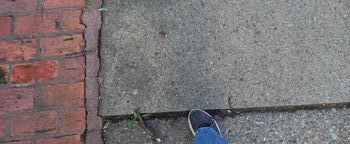
I was just walking briskly in the early morning light
when I let my eyes shift left, forgot to lift my feet,
and tripped on a ridge of ancient sidewalk,
falling on rocks and pebbles
embedded in decades-old cement.
Ouch! Not again! Knees throbbing . . .
Yes, again! Whenever I look away
from your directives, Abba,
even for a moment,
it’s so easy to stumble.
I really need focus, inner eyes
wisely contemplating what you say,
avoiding the distractions
that only trip me up. Your smooth path
is mapped out in your Word;
your Spirit prompts the application
to the journey you’ve laid out,
personalized, for me to travel.
There are times when I’m to take
a different path, avoiding danger.
Leave the sidewalk; walk in the street!
You know what lies ahead, and eyes on you,
I can find that way you’ve leveled
just for me, walking with you.
I love walking alone just after dawn in these ancient Detroit streets of my neighborhood. Later I join walking partners, but the quiet moment when I start off, walking briskly while meditating on what I’ve just been reading in the Word, is a blessing. Some sidewalks here were put in place over 100 years ago and require careful attention to unexpected cracks and angled ridges—it’s why most of the time we walk in the streets here! But today I forgot to be that careful. I fell, and I’m dealing with scrapes and painful bruises.
That brought to mind a verse that had required much digging into meaning and vocabulary options in the West African language, Nyarafolo, a few days ago. (Yes, I’m now back to working as an exegete in Bible translation, using the Internet to help my Nyarafolo translator draft passages!) My fall was making this verse unexpectedly relevant! Was this a prompt from Abba?
The path of the righteous is level; you, the Upright One, make the way of the righteous smooth. (Isa. 26:7 NIV)
What does it mean to walk a level path? Aren’t there usually rocks and unexpected bumps in the road, especially in the African countryside, a little like these city sidewalks? When the Lord makes the way smooth, how does he do it as we walk forward in our lives? There are traps and challenges, right? However, I can understand that the path my Lord has prepared is the right one.
Trust in the LORD with all your heart and lean not on your own understanding; in all your ways submit to him, and he will make your paths straight.(Prov. 3:5-6 NIV)
Forgetting to watch out for those not-level ridges today was a powerful object lesson. If I’d just kept my eyes on the path, then moved onto the pavement to avoid this rough patch, I would not have fallen. If I stay on the straight path, the righteous path, doing what the Lord says to do, I will be walking in the right direction without straying. I kept meditating on the applications as I moved ahead.
It turns out that is an example of practicing meditation as spiritual formation. That practice has taken on other meanings in our world, especially as its use in Eastern religions has gained the spotlight. Christ-followers have different goals, the main one being “simply a loving attentiveness to God. Through the prophet Isaiah, God urges us to ‘Incline your ear, and come to me; listen, so that you may live.’1 Listening is the key. Hear the life-giving counsel of Francois Fenelon: “Be silent, and listen to God. Let your heart be in such a state of preparation that his Spirit may impress upon you such virtues as will please him. Let all within you listen to him. This silence of all outward and earthly affection and of human thoughts within us is essential if we are to hear his voice.’2“
Through meditation we are growing into what Thomas à Kempis called “a familiar friendship with Jesus.”[1]
Paying attention to the Voice, listening—staying tuned in does mean preventing the distractions of life from interrupting that intimate connection. So it does include detachment, but Christians do it for a different reason:
“If the believer disengages from the distractions and allurements of the world, it is in order that he/she might engage with the Father, Son, and Holy Spirit. Unlike eastern meditation, which advocates visualization in order to create one’s own reality, Christian meditation calls for visualization of the reality already created by God. Unlike eastern meditation, which advocates metaphysical union with ‘god’, Christian meditation calls for spiritual communion with God. Unlike eastern meditation, which advocates an inner journey to find the center of one’s being, Christian meditation calls for an outward focus on the objective revelation of God in Scripture and creation. Unlike eastern meditation, which advocates mystical transport as the goal of one’s efforts, Christian meditation calls for moral transformation as the goal of one’s efforts.”[2]
The practice has been promoted in the Scriptures for centuries:
Keep this Book of the Law always on your lips; meditate on it day and night, so that you may be careful to do everything written in it. (Jos. 1:8 NIV)
Within your temple, O God, we meditate on your unfailing love. (Ps. 48:9 NIV)
I will consider all your works and meditate on all your mighty deeds. (Ps. 77:12 NIV)
Oh, how I love your law! I meditate on it all day long. (Ps. 119:97 NIV)
My eyes stay open through the watches of the night, that I may meditate on your promises. (Ps. 119:148 NIV)
Finally, brothers and sisters, whatever is true, whatever is noble, whatever is right, whatever is pure, whatever is lovely, whatever is admirable– if anything is excellent or praiseworthy– think about such things. (Phil. 4:8 NIV)
And there are many more. Thomas Merton, a pilgrim who has gone before us, clarifies the goal this way: “This is the real end of meditation—it teaches you how to become aware of the presence of God; and most of all it aims at bringing you to a state of almost constant loving attention to God, and dependence on Him.”[3]
The world around us has many lessons for us, often revealing truths that take our understanding of the Word even deeper. Once, for me, it was a spider hanging on a fragile web in my “Sacred Grove” back in Ferkessédougou: I realized that the Lord was telling me to “hang in there,” just trust him with how to get through a fragile situation. When we go to the beach for rest, I need to have a notebook and pen handy; I am amazed at the new things made clear each time by waves, undertow, even garbage scattered around. Sometimes it is the sight of people with a particular gift, activity, or even need, that trigger insight into a Scriptural principle and how to apply it.
As Adele Calhoun says, putting ourselves in a posture of “seeing beyond a first glance and first impression to the heart of God” and “experiencing calmness, serenity and quietness stemming from an awareness of the presence of God” are examples of the God-given fruit of meditation.[4] To accomplish this we have to pay attention, our mind and the eyes of our heart focused on his nearness and intention.
What is Abba showing me today? Am I watching? Am I really listening? Am I ruminating on what he has been showing me in his Word? Have I been making space for him to speak into my life, quieting the noise all around me so that I can meditate on his acts, his commands and his promises—even his character? Do I want to stay on the smooth, level path he has prepared for me?
It’s far better than stumbling or straying!
[1] Foster, Nathan. The Making of an Ordinary Saint. Excerpt published by Richard J. Foster in “Understanding Meditation,” https://renovare.org/articles/understanding-meditation . Footnotes: [1] Isaiah 55:3
[2] Quoted in Foster, Sanctuary of the Soul.
[2] Storms, Sam. Quoted in https://www.crosswalk.com/faith/spiritual-life/10-things-you-should-know-about-christian-meditation.html.
[3] Merton, Thomas. New Seeds of Contemplation. (New York: New Directions Publishing Corporation, 1972), 217.
[4] Calhoun, Adele Ahlberg. Spiritual Disciplines Handbook: Practices that Transform Us. (Downers Grove, Illinois: IVP Books, 2005), 170.
 Linnea's Lines
This is so insightful (like all the Lines you and our God bless us with), but I love how you differentiate between Eastern religion meditation and the true meditation that draws us closer to our Heavenly Father. And, praying you will heal quickly from the injuries that brought this to mind! 🙂
LikeLike
Thank you so much! And yes, I am healing well. Sore elbow now mobile, bruised knees walking well (just complaining a bit on stairs). Your prayers are answered! linn
LikeLike
Thank you, Lynne. And yes, I am astonished at how quickly my painful elbow is now mobile and just fine, and my bruised knees work for walking (just ouch slightly on stairs). Prayers answered!
LikeLike