The words come crashing in
like chattering kids.
They're only in my head
but they are deafening.

I cannot stem the tide.
A billion babblings
jostle for position.
One sinks, one bubbles up.

He says, "Be silent,"
and I long for quiet
to listen for his voice,
to know that he is God.

I'm desperate to hear him
through the clatter,
within static and
underneath the noise,

Somewhere at a center point
is silence, deep inside
my cluttered cave.
And he is there.
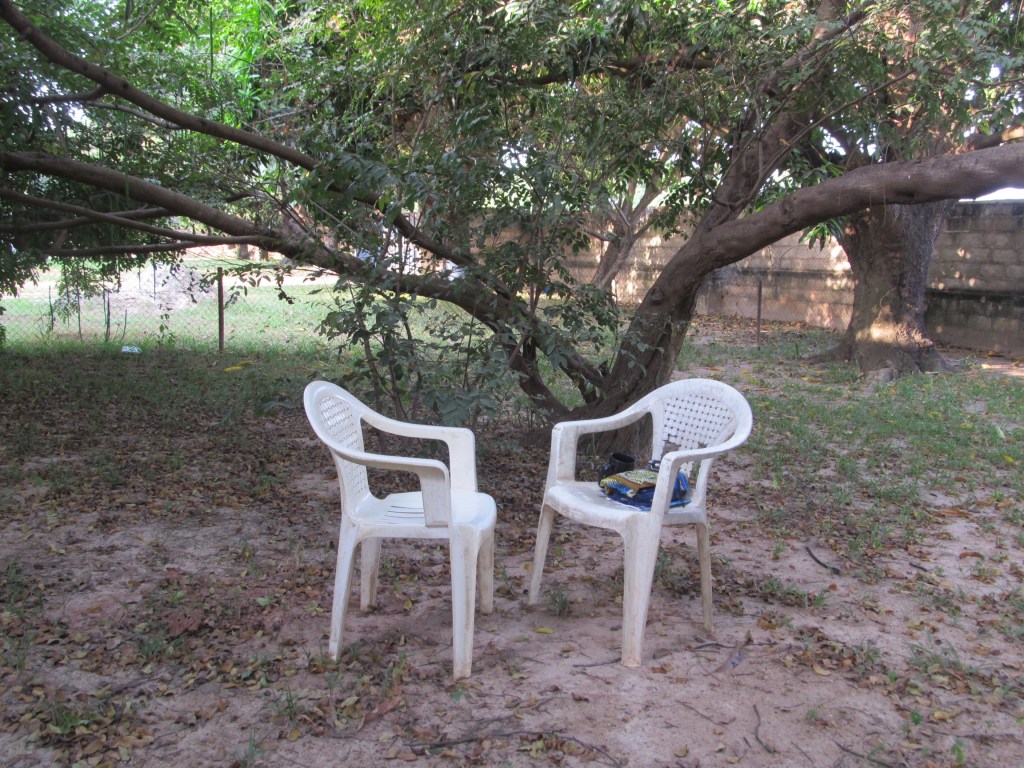
If you’ve been following my journey, you’ve heard about my “sacred grove,” the space in my courtyard in Ferkessédougou, Côte d’Ivoire, where I retreated for about three hours early Saturday mornings. Why was it “sacred”? Because it was “set apart,” consecrated for a spiritual discipline I knew I desperately had to observe. There I could be alone for a small slice of time, and practice being quiet. Well, not really “alone”! I was there with my Lord.
It was essential for my well-being. I needed respite from interactions and from my work in Bible translation that involved delving into several languages. As exegete, I studied the original language versions of texts, Greek or Hebrew, using resources in English, then I explained them in French and Nyarafolo to my coworker, who suggested the Nyarafolo equivalent of that original meaning. It was deep and challenging, and I loved it. But it left my head swirling with concepts and words. And we lived in a culture that valued community highly, so we either had visitors or went visiting many times, and often shared our home with others. It was all a huge blessing., even if we longed for that introvert solace that would strengthen us for the next day.
We were learning that life needs to have sacred rhythms. We need community, we need to love others with our time and energy. Working with words and the Word was (and is) my passion. On the other hand, it can become overwhelming. It’s like running a marathon and not getting rest before taking off in another direction, or like eating constantly without a few hours between meals. The soul needs time to rest, to find space where the deluge of noise retreats and leaves behind a refuge of quiet—like how it feels to leave a busy city and sit under a tree beside a river.
While practicing lectio divina, I was struck by the requirement to be silent that is listed as the final element in the fourth step. After reading the text, meditating on it, asking God for illumination, then comes contemplation. It includes thoughtful prayer, but also listening for God to speak. And in order to hear the other person clearly when in conversation, we need to stop talking.
Do you have an acquaintance who is a non-stop talker? Can you get a word in edgewise? I was convicted, several years ago, of being that kind of a pray-er. I was blabbing my praise, my petitions, my plans to the Lord. Then I went on my way. I was not listening. Brad Jersak uses this illustration: what would it be like to have a friend or loved one call you, give you news, but never give you a chance to respond before they hang up?[1] I was convicted.
When I read Invitation to Solitude and Silence, by Ruth Haley Barton, I knew that I needed to find a way to practice those two aspects of spiritual formation. Without them I was at a blockade, no way forward. The are practices of abstinence, of letting go of something to make space for the Lord to work. I needed to give up my own obsession with thinking, writing, interacting with people and being productive.
When I still had kids at home it was a challenge even to find space for a “quiet time” in the morning. Most times I could squeeze it in while a little one played beside me on the front porch, or the older ones got into their books. Now they were gone, but if I sat on the front porch I would get visitors, kind people coming to greet on their way to work or to go use the well in our back yard. I finally told everyone in our courtyard that on Saturday mornings, if I was sitting under the golden rain trees by the front wall, I was not to be bothered except if something was urgent. I had solitude there, something that is the twin of silence. Sure, there was still the noise of city trucks and people across the road in the town square, but I could learn to switch off my attention to those and learn to be silent. I longed to find peace in the noise, to shut off the tumult of noise in my own inner being, to find silence, and listen.
It took practice, every time. The words roiling within were like a muddy pool after a strong rain—eventually the mud would settle, but it took time. After about an hour I would begin to experience inner quiet. And over and over, I would suddenly feel a prompting about some Scripture I had been reading, how it applied to me or to my work. Or nature around me would speak the Voice. When I grabbed my little notebook and my pen, often a poem would appear on the page. That was how I could “hear” the Voice most clearly.[2]
I know others who find that it is journaling that makes the whisper of the Lord heard to them. For one person, it is graphic art!
Of course what we think we “hear” needs to be measured for authenticity: is this just my own reasoning, or am I really becoming aware of the Lord’s part in this conversation? Does this line up with the Scriptures? Do I sense his reproval, or approval, or a challenge to move in a direction in line with his will? Is he just affirming his love, his presence? The message can take many forms. But as we listen, it draws us closer to our Lord, getting to know him personally as opposed to knowing about him.
As Dallas Willard says, “Only silence will allow us life-transforming concentration upon God.” He cites this verse: in quietness and trust is your strength (Isa. 30:15 NIV).[3]
In order to find a silent space, we need solitude, or at least a company of others who agree to practice silence. My husband and I found a way to do this together as the new year came upon us, parking our car down by the Detroit River, on Belle Isle, with no conversation for a couple of hours. There was peace and safety, but also silence as we watched the water and waited for the Whisper.
And when we practice this appropriately, even alone, we are never alone. After a few years I began calling it “the solitude of two.” Jesus is always there. I was just shaving away the distractions and concentrating on waiting, being quiet, making space for him to do or say what he might be waiting to do in me or say to me.
Practicing that silence during contemplation of Scripture is another essential application of this discipline. We are not only studying what is there, and asking God to keep his promises to us or to work this out in a loved one’s life, etc. It is important to wait, to hear how he wants the text to impact us. We can shut down our constant word-factory and wait, listening.
It can be a daily practice, and also a deeply meaningful one when we carve out a retreat, away from whatever is “normal” for us: busyness, work, physical activities, You-Tube, pleasure reading, games, community, hobbies–even music or conversations.
“From the dawn of time, we have needed our respites. Even the God-man himself was “led by the Spirit into the wilderness” (Matthew 4:1), “went out to a desolate place” (Mark 1:35; Luke 4:42), and “went up on the mountain by himself to pray . . . alone” (Matthew 14:23).”[4]
If I had not obeyed the impulse to spend that time in solitude and silence in my “sacred grove,” there is so much that I would not have heard. My journals are full of notes added after those hours. I know that I would never have had that collection of poems to publish in my book, When He Whispers: Learning to Listen on the Journey ! I also would have missed several lessons he was teaching me, that I was not paying attention to in the middle of the noise. Silence was a learning curve, an important one.
[1] Jersak, Brad. Can You Hear Me: Tuning in to the God Who Speaks. (Fresh Wind Pr; Revised edition, January 1, 2003).
[2] My learning curve is traced in my book that contains some of that poetry: Boese, Linnea. When He Whispers: Learning to Listen on the Journey. (Westbow Press, 2021).
[3] Willard, Dallas. The Spirit of the Disciplines: Understanding How God Changes Lives. (HarperSanFrancisco, 1991),163
[4] Mathis, David. https://www.desiringgod.org/articles/take-a-break-from-the-chaos
 Linnea's Lines
Thanks again Linn for blessing us all with your insights and experiences. I especially love the last line of this poem–brings such warmth and peace!
LikeLike