Exhaustion depresses
like bricks on foam
squeezing out air,
leaving you heavy,
squished, flat-out dense.

Sleep and love,
contemplation,
are nectar, nutrients
(just eat what fits).
Breathe in, exhale.

Find a place
deep inside
a favorite space:
grab a book; take a look
at what brings you joy.

In time you’ll stretch,
get back up
and power up
for life as usual,
ready to go, restored.

When you feel like you really need a break from “life as usual,” whatever that is for you, how do you get re-energized?  There are phases of life when it seems next to impossible, like when a mom is dealing with a newborn, or you’ve taken on a second job to make ends meet, or sickness has changed all plans. What a blessing it is if you live in a family or community where you can get some help!

But some of us are also prone to saying “yes” to too many things, or to viewing everything else as more important than ourselves. We may be in ministry and feel selfish if we take time off. Missionary life often had us in that kind of grip. Sometimes burnout was actually hovering, waiting for us to collapse. And I began to wonder: why did Jesus leave the crowds and go off to a mountain, on his own or with just a few friends? Of course, he was a man of prayer and needed that time with the Father. But he also was modeling a change of pace.

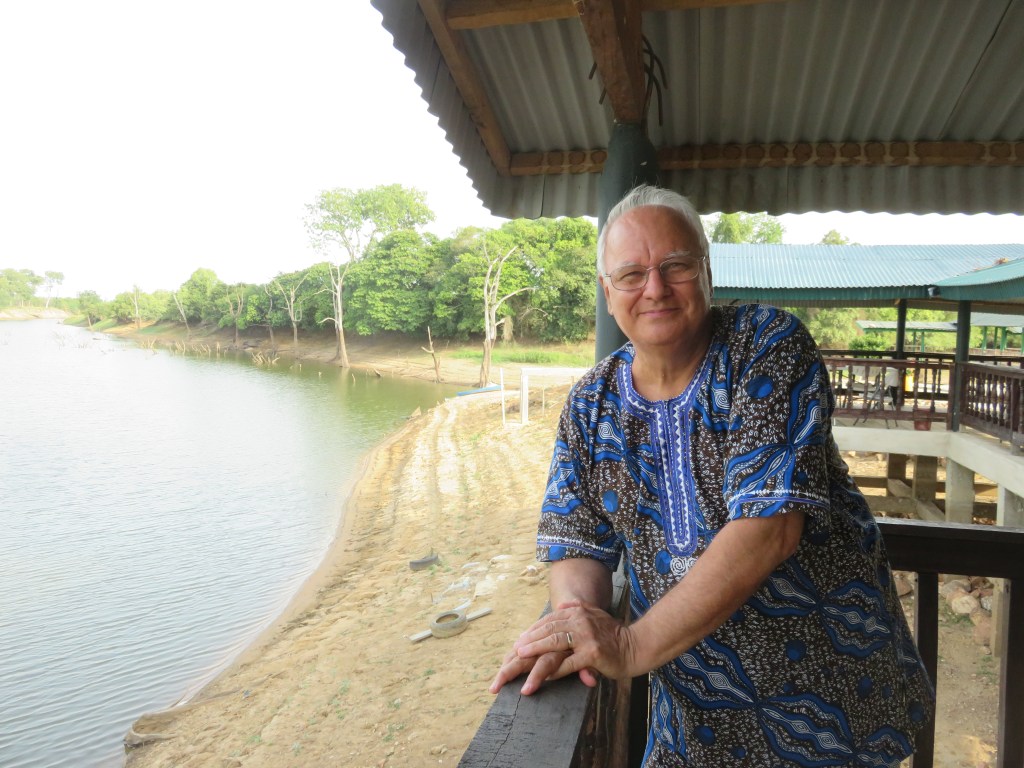
We often felt that we had to drive to a place far away to find that kind of protected environment, like the beach down south in Côte d’Ivoire. But then during our last decade there a new safe spot opened up: a place called “EcoFerme,” featuring an open-air restaurant with a deck built over the Bandama River just about  a half hour from home. If we went early in the day, no other guests were there. We could watch the water flowing by, listen to birdsong, talk quietly to each other. Ahhhhh! (The photo above was taken there on one such retreat.)

It was hard not to question whether it was right to take the time to do something like that. It did feel "less selfish" when we would take national friends or mission coworkers and share the delight. But we were also well aware that we needed to take care of ourselves in order to stay healthy in body and in our inner being, and for us, sometimes that meant time alone!

God made each of us, knowing us from the day we were conceived:
13 For you created my inmost being; you knit me together in my mother's womb. 14 I praise you because I am fearfully and wonderfully made; your works are wonderful, I know that full well. 15 My frame was not hidden from you when I was made in the secret place, when I was woven together in the depths of the earth. 16 Your eyes saw my unformed body; all the days ordained for me were written in your book before one of them came to be.  (Ps. 139:13-16 NIV)

When we make something, we care about it. If I have baked a cake and left it cooling on a rack, I don’t want some careless child to hop through the kitchen swinging a toy and knock it off the counter. When my husband spent days installing laminate on the floors of our old house, replacing worn carpet, we all began to make special efforts to wipe up any liquid that fell on it. God made our bodies and our inner being, and cares about how we use them. He even wants us to take good care of them. I think of Psalm 23, and how the Good Shepherd leads his flock beside still waters and in green pastures; he also spreads a table of food before his dear ones and fills their cup to the brim. So should we not cooperate with him?

This does not give us license to waste our time and money in lavish ways that take no consideration of how he is guiding us. It does not mean caving in to addictions that may drive us, such as unhealthy use of food or drink or drugs, entertainment, or adrenaline-soothing activities.

But he made it a rule that one day out of seven should be a day of rest. And he wants us to take care of the bodies he made for us. By turning away from harmful activities and following his counsel, we can thrive:
Do not be wise in your own eyes; fear the LORD and shun evil. 8 This will bring health to your body and nourishment to your bones. (Prov. 3:7 NIV)

Another command that always comes to my mind when I reflect on self-care is the one to “love your neighbor as you love yourself,” referenced over and over (Lev 19:18,34; Mat 19:19 and 22:39; Mark 12.31,33; Luke 10:27; Rom 13:9; Gal 5:14; James 2:8). If it is repeated that many times in all those contexts, it is indeed essential for living in a way that conforms to God’s values. And it is impossible to love one’s neighbor appropriately if one does not love themselves and take care of themselves as they should.

You have probably heard much of what is out there about taking good care of yourself physically, mentally and emotionally. Weighing what we read or hear against what the Word says is necessary. Listening to a wise mentor or prayer partner, sharing our challenges also can smooth the path. Physical and emotional issues change with seasons of life and have their impact. But we can choose to do what is right to keep ourselves healthy and useful to the Lord for his purposes. If we don’t take care of ourselves it will wear us down. So it is right to exercise, pay attention to nutrition, work at getting good sleep and take a break when needed. It is right to thank God for who he made us to be, how he designed us, and to honor those gifts.

Jesus loved us so much he gave himself for us. Part of being grateful for his love, and for the gift of life, is to treat that gift with respect. When we value ourselves the way that he does, we can then value others that way too. I see that as another way to understand loving ourselves and then loving others the same way. Just as we do not want to do harm to ourselves, we don’t want to do harm to others. Instead, we want health to reign in every way possible. When it is not possible to change a situation, we need to lean on our Father, Lord, Shepherd, Guide. He will direct our steps. When I am his, he lives in me, and will show me how to take care of this shared dwelling.

I am glad that he values rest, sustenance and loving relationships. He intended the world to be founded on those. Because of its brokenness, we will go through times when suffering, deprivation or evil actions cut into them. But each of us can do our part to live by his values, honoring the bodies he gave us and our needs for well-being, respecting the opportunities given to us.

As Adele Calhoun puts it, self-care that accompanies spiritual formation is “practicing self-awareness rather than self-absorption,” and “valuing yourself as Jesus values you.”  Is is to “intentionally receive ourselves as God’s own beloved,”[1]  which empowers us to love and forgive both ourselves and others.  This gives me permission to work at having healthy limits and to take advantage of the opportunities that he gives me to take care of myself – even sitting by a river in the company of birds instead of always being hard at work!

[1] Calhoun, Adele Ahlberg. Spiritual Disciplines Handbook: Practices that Transform Us. (Downers Grove, Illinois: IVP Books, 2005), 71,72.
 Linnea's Lines
This was a great poem 🙂 Thanks for this! Blessings
LikeLiked by 1 person
I appreciate your kind comment–may you be blessed as well!
LikeLike
Read this on FB and responded there. Beautifully expressed, Linnea. ken Ken and GiGi Wyatt 750 Swains Lake Dr Concord MI 49237 517-524-7163
LikeLike
I truly appreciate your thoughtful interaction!
LikeLike