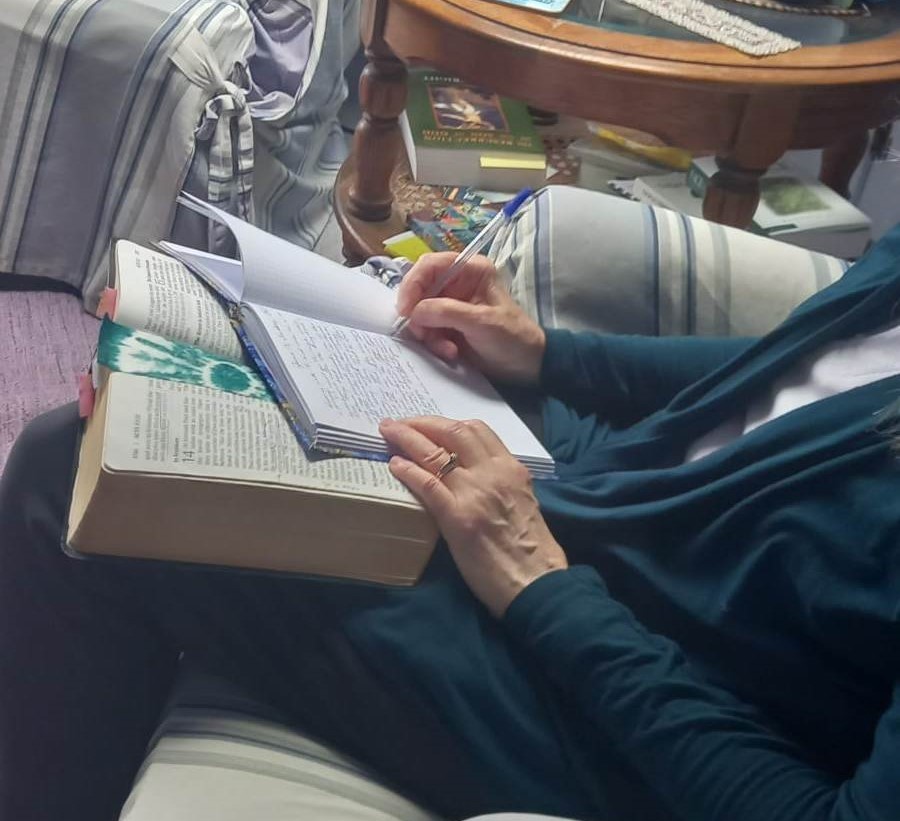
pen in hand
the words press out
anxious for paper
a place to live

the silence sizzles
sentient and longing
standing on tiptoe
to read the news

what I am hearing
what has been forming
in hidden spaces
how I’ve been growing

invisible
the thoughts take on
colors and edges
given a page
Yes, my pen is a tool, an instrument that provides a way to notice what is going on in my life and in the world. Every morning I pick up the notebook set aside for this time in my life and write a summary of what matters to me: what’s been happening, what I am grateful for, what is challenging, what I am learning. And I write at least one prayer that issues from all that, setting it apart with a little symbol I’ve chosen. Then I wait. When I believe that Abba has reminded me of a truth, spoken to my heart in response, I write that down with a symbol for “what I heard him say.” Then, when reading Scripture or another book that is helping me grow spiritually, I often write down those verses or words that have been underlined as important for me.
This has helped me to consistently pay attention to what I am learning, when I have stumbled, and what my Lord is teaching me. I know not everyone finds a pen to be that friendly and helpful—even my husband and son have not been able to get into it. They prefer sharing audibly with someone close to them, or just contemplation done in privacy. What is important is discovering what practice prevents life from just slipping by. We miss out when we do not notice major themes our Counselor is highlighting, or even the smallest fingerprints of God on our lives and our spiritual growth.
He knows all that is going on, inside and out in the world around us, and he cares about it all. Do I pay attention?
You have searched me, LORD, and you know me. 2 You know when I sit and when I rise; you perceive my thoughts from afar. 3 You discern my going out and my lying down; you are familiar with all my ways. 4 Before a word is on my tongue you, LORD, know it completely. 5 You hem me in behind and before, and you lay your hand upon me. 6 Such knowledge is too wonderful for me, too lofty for me to attain. (Ps. 139:1 NIV)
To even gain an inkling of how Yahweh is paying attention to me, I need to return that focus. I journal with my pen, and often the deepest insight comes to me when a poem begins to sing in my heart and I follow through, writing it down. Most days it is just words on paper, a recounting of what has happened, especially any hurts or struggles, any joys or successes, any words of Scripture or a song that are making my heart take a leap.
A prayer journal that notes requests and answers is another great instrument.
There are other ways to keep track of such things if writing is not your thing. Calhoun suggests making scrapbooks, for yourself or for others.[1] I found a very worn scrapbook handed down through several generations while cleaning up at the heritage cabin in the forest left to me and my siblings by our parents. It was a collection of clippings, poems, verses, sermon notes, and poems. We don’t know who put it together, but it obviously represented what had been meaningful to them over the years.
For some, it is drawing that gives them that outlet, art as a “pen.” That is a gift.
For people who need personal exchanges, finding a prayer partner who also revels in that kind of mutual sharing can be deeply meaningful. The trick is remembering to be open, sharing one’s spiritual learning curve and preoccupations.
Calhoun’s list of “God-given fruit” that comes from this practice is stimulating:
- keeping company with Jesus through reflection
- listening to God, praying your life
- slowing down and noticing where God shows up in the “ordinary”
- noting God’s faithfulness in your life journey
- becoming aware of phases and stages of your own pilgrimage[2]
Sometimes journals become a legacy for others. Have you read published journals that inspire? I was actually afraid that someone might read my journals, and for a moment it kept me from being “too open” in what I write. After years of filling small notebooks I began to tell myself that no one would ever have the patience to read them anyway. I still used some personal coding for certain reflections or episodes, but mostly I experienced new freedom in confessing my faults as well as my progress. If anyone ever reads them they will need to have a deep motivation that doesn’t seem likely at all!
On the other hand, some of what I journal becomes the fruit that the Lord prompts me to share with others, such as the poetry that came from those moments that I published in When He Whispers: Learning to Listen on the Journey. And some of my growth moments get shared when I am asked to speak. Either way, that is God at work, using this daily spiritual discipline for his purposes.
It is possible to reserve journaling for special moments like a spiritual retreat, or to do it weekly or monthly, whatever is appropriate for one’s instincts or time availability. When I had babies, I definitely found it tough to count on much private space! Later I found that I really needed to journal when going through deep waters; it was a way to debrief after evacuation from a war zone, and after going through a season of relational ruptures. I often added notes from key discussions or meetings. All of them are resources for my own contemplation now, a long shelf in my library holding a row of a huge variety of large and small notebooks. (They are very helpful for writing those phases of life in my memoir!)
David Mathis, executive editor at desiringgod.com, summarizes a key goal of journaling this way: “What if journaling wasn’t simply about recording the past, but preparing for the future? And what if, because of God’s grace in our past and his promises for our future, journaling was about deepening your joy in the present?”[3]
He goes on to say, “Journaling is a way of slowing life down for just a few moments, and trying to process at least a sliver of it for the glory of God, our own growth and development, and our enjoyment of the details. Journaling has the appeal of mingling the motions of our lives with the mind of God. Permeated with prayer, and saturated with God’s word, it can be a powerful way of hearing God’s voice in the Scriptures and making known to him our requests. Think of it as a subdiscipline of Bible intake and prayer. Let a spirit of prayer pervade, and let God’s word inspire, shape, and direct what you ponder and pen.”[4]
I love the way he puts it, and I can testify that journaling has done this powerful work for me.
However you implement such practices to attain these spiritual goals, may the Lord use that instrument to bring you joy and a safe space for processing your journey!
[1] Calhoun, Adele Ahlberg. Spiritual Disciplines Handbook: Practices that Transform Us. (Downers Grove, Illinois: IVP Books, 2005), 56.
[2] Ibid.
[3] Mathis, David. Journal as a Pathway to Joy, July 30, 2014. https://www.desiringgod.org/articles/journal-as-a-pathway-to-joy
[4] Ibid.
 Linnea's Lines
Linn, as always your writings speak so much to me! Thanks so much for sharing your amazing gift with all of us!
LikeLike
Thank you for your encouragement, Lynne!
LikeLike