My Congo!
Oh, to be out in your cold morning air,
To feel the chill bite of your wind,
To see the red sun peeking over your pines
Hear hummingbirds humming a hymn!

I long to be there when the sun spreads her warmth
To the black, rich dirt at my feet,
To walk between violets, and pansies, and moss,
To hear a young lamb’s hungry bleat.

I long to climb into the sheltering cave
Of a giant, loose-hanging vine,
To pick a “matunda” and taste its sour tang--
Oh, I wish you were once more mine!

When the sun says good night at the close of the day,
Turning pink your blue mountains of snow,
I’ll wait for your stars and your moon to come out,
And watch for your sky’s midnight glow.

The beauty of Congo – there’s nothing can match
Your mountains, your jungles, your plains.
Who can blame me, my Congo, if the one thing I want
Is to see you, be with you, again!

© Linnea Slater   (1965)


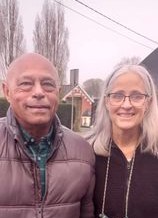
When I drafted this blog I was sitting in a home in Belgium, but Congo was all around me. We were visiting Philip (with me in the photo above), someone who had meant a lot to me when I lived there where my parents served as missionaries until we were evacuated in 1961. I felt like I was going back to Congo as memories and a key relationship were renewed.
When I was yearning for my first childhood homeland and wrote that poem, I was just 13 and it was the landscapes that I focused on. War had forced us to change countries, and although Côte d’Ivoire was beginning to work its way into my heart, I was longing for the beauty of my Congo nature playground. My new “home” was so dry and flat, such a contrast. It took some years of digging, of letting my feet run in the dust, to uncover new treasures. Later I began to realize that what I missed even more about Congo was my friends.
It was much harder as a child to find African playmates in Côte d’Ivoire where we moved in 1961. The hospital compound was outside the town and children were not encouraged to come our way. In Congo we not only had many comrades from the village right next door, but there was also the close relationship with Philip, our big “brother.” He was sent to our family during the vacations from his boarding school from 1957-59, when I was 5-7 years old. Our mission had started the school for mixed-race kids, called “métisse” there in Belgian Congo. They were denigrated by both whites and blacks in that culture and usually ended up abandoned, like orphans. We found it a delight to welcome Philip. He was eight years older than I was, so already a teen, but had a gentle fun way with us kids.
When independence came to Congo in 1960 unrest was rising all around, especially in the eastern region where we lived. My dad and his brother, Dwight and John Slater, had taken our families out of Katwa, Congo, to spend some of the summer in Kampala, Uganda, for safety; they had stayed behind to continue their medical work. The missionaries working with the métisses had evacuated those kids to Kampala as well, given the dangers heating up. They were given the choice of going to America or Belgium. Philip and his younger brother chose Belgium, and off they flew. It was the beginning of many long-distance separations.
I didn’t see Philip again until December of 1978, when Glenn and I were studying French before heading to Côte d’Ivoire as missionaries ourselves. We left Albertville, France, to travel to Brussels, Belgium, to meet up with Philip. It was refreshing for me, and the immersion in French really helped Glenn’s language facility take off.
Then life took over for us all. Philip was now a high school math teacher, and a couple of years later he married a widow who was also from Congo, Léontine. Family became a wonderful, major focus for each of us. We were focused on our new ministries: the hospital in Ferkessédougou, Nyarafolo learning and linguistic endeavors, church development in “our” village, Tiepogovogo, and our children. Philip and his wife ended up with five children.
After a while we lost touch with Philip. Mom and Dad Slater visited him, but the last time he saw them was when they were retired and returning from a visit to Uganda—Mom was hospitalized in Brussels with severe malaria. Then their retirement life in the Upper Peninsula of Michigan, followed by the challenges of old age, quieted their communication with him as well.
Glenn and I retired in 2019, not ever having stopped by to see Philip all those years. I so wish that we had; I had lost all of his contact information. I was astonished and delighted when I suddenly got a WhatsApp message from him last August! He had been trying to contact Mom and Dad by their email address, not realizing they had already passed away in 2017. Then he got in touch with the daughter of other former Congo missionaries and she gave him my phone number, so he reached out to me on WhatsApp! When he urged us to stop by the next time we traveled the U.S./Côte d’Ivoire/U.S. route, it really hit home. “Home” in more ways than one! Here was my “big brother,” lost to me for so many years, longing to see me and get family news. So this time, we chose to spend a week in Belgium with him as we returned from our two months in Africa.
I was so glad we did that! We caught up on details I didn’t remember, since I had been so young back when he spent time with us in Congo. He says it was my mom who really made the Good News about Jesus clear to him, and who made sure that Pastor Berg was the contact he had in Belgium when he evacuated there. The Bergs took him in, as well as his brother, giving them the support they needed as they finished high school and took further training. Philip was baptized at his church. His brother is no longer alive, and neither are the Bergs. But Philip’s faith has stayed strong over all the years.
I have never been back to Congo, physically. But Philip and Léontine went back in 2000 for a visit. Some of their children have also gone to visit, and even to work there for a time. Philip has become a connector for other métisses and Congolese immigrants in the Brussels area, so they are constantly receiving gifts from Congo from any who travel back to visit. Here in their house there is Congolese art all around, in addition to all the family photos. And Léontine keeps sharing delicious food treasures given to them—like smoked chicken!
They took us to the Matonge quarter in Brussels, a basically Congolese-style market area with so many stalls and shops with Congolese goods that, if it weren’t for the ancient European buildings, one could find themselves with feet back on the ground, back there. I felt it. And Léontine came alive. It was “home.”
So there we were, “family” reunited, sharing our Third Culture life stories. Probably most of you are familiar with the term “Third Culture Kid (TCK),” which describes especially a child who grows up in a culture different than his parents’ original culture and develops a personal mixture of those cultures. I am one of those, I was born to American parents and was periodically re-entering the U.S. but spent most of my growing-up years in Congo and then Côte d’Ivoire. Philip was born to a Belgian father and Congolese mother (that he didn’t know), raised by Americans in his boarding school and our Slater family home, then transferred to life in Belgium.
Having this kind of mixture can be challenging, because you don’t fit completely into any one of those cultures that have formed you. You are different. But it can be viewed as a rich treasure that brings unique understandings of different cultures, often with skills about living cross-culturally. And I see the same kind of Third Culture development in adults that adapt to different cultures that they integrate into this way—like in my husband Glenn.
It is very evident in Philip. There is constant African music playing in the dining room. When their toddler grandson comes over for the day, French/Lingala/Swahili children’s programs play on the tv. The phone rings, and the conversation might be French, might be Swahili. But the house is Belgian in furniture and equipment. The neighborhood stores are Belgian, so most food is as well. Philip had taught high school math there in public high schools until retirement.
I was not only delighted to be found by my brother again, but to be able to tie our bonds more firmly now that we are in the evening of our lives. It was amazing to discover how many ways we share the same values and worldviews!
A psalm that has spoken to me in a personal way concerning this kind of multi-cultural lifestyle is Psalm 139. Ever since a friend studied it with me while we were both at Wheaton Graduate School in 1977, I have resonated with its strong message that Yahweh is present no matter where his people are, in the far east (where the sun rises) or the far west (where it sets). For me, that was Africa and America.
5 You fence me in, behind and in front, you have laid your hand upon me. 6 Such amazing knowledge is beyond me, a height to which I cannot attain. 7 Where shall I go to escape your spirit? Where shall I flee from your presence? 8 If I scale the heavens you are there, if I lie flat in Sheol, there you are. 9 If I speed away on the wings of the dawn, if I dwell beyond the ocean, 10 even there your hand will be guiding me, your right hand holding me fast. (Psalm 139:5-10 NJB)
I can’t escape his accompanying presence, and that is great comfort for me. He will always guide me and hold me securely in his grip. He has done that for me in the 46 years since I last saw Philip, He has held Philip in the same way. And he made both of us, created us, with our life stories in mind. Philip, who had no close relationship with his original father or mother, learned to deal with that trauma by sharing life with other kids who had the same experience. He says that boarding school experience was healing for him, and it shows up now in the way that he reaches out to others to be sure that they feel familial love. God knew him and shaped him, bringing healing even after he had gone through so many wrenching losses.
13 You created my inmost self, knit me together in my mother’s womb. 14 For so many marvels I thank you; a wonder am I, and all your works are wonders. You knew me through and through, 15 my being held no secrets from you, when I was being formed in secret, textured in the depths of the earth. 16 Your eyes could see my embryo. In your book all my days were inscribed, every one that was fixed is there. 17 How hard for me to grasp your thoughts, how many, God, there are! 18 If I count them, they are more than the grains of sand; if I come to an end, I am still with you. (Psalm 139:13-18 NJB)
Yahweh has used Philip in Belgium to help other immigrants find their way forward, and to keep close connections to those in his expanding family (many who now live in several other countries!). He who had no relationship with his birth parents found acceptance in Mom and Dad Slater, and then the Bergs. Now he fervently lives out family love.
Yahweh formed me to live my life in Congo and Côte d’ivoire, preparing me to reach out to the Nyarafolo, and in retirement to live out his truth in Detroit. He also put that same extended family love in my heart through my parents’ open arms and open home.
Father Yahweh knows our days and what he has planned for us. And that is true whether we grow up in a strong, stable family or go through the kind of challenges that Philip faced all his life. Our part in the story is how we respond to his guidance, whether we trust him and his unending love! How can you trace his design?
 Linnea's Lines