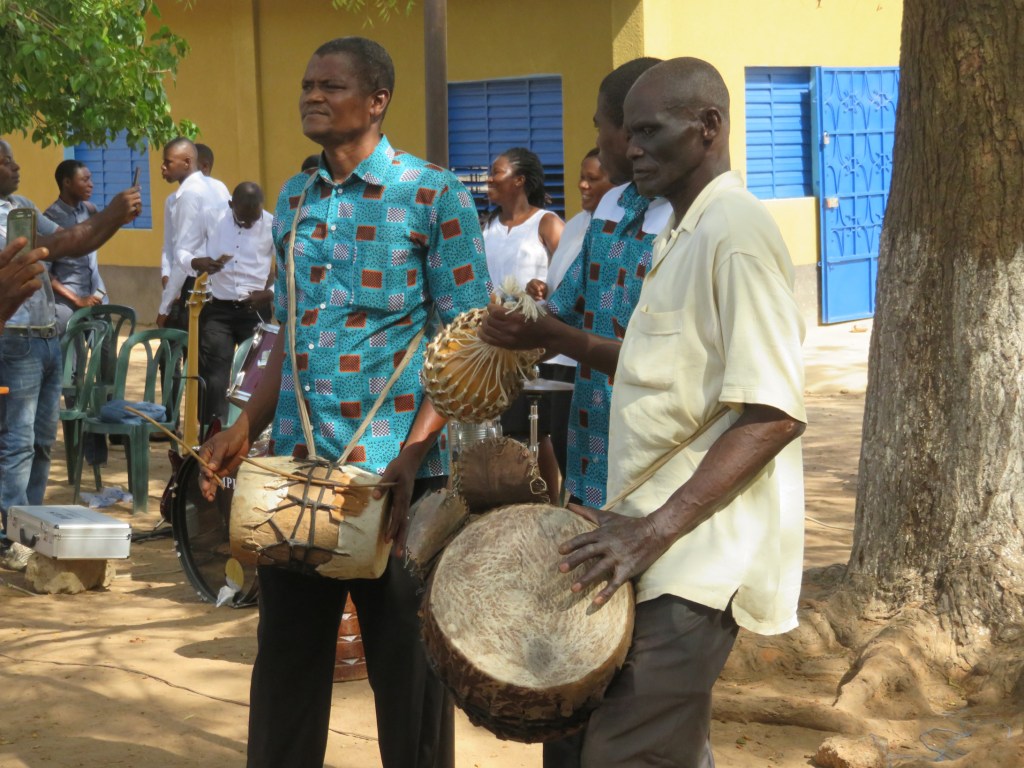
They were shoved to the margins,
viewed as insignificant,
poor people scattered
in little bush villages,
living off infertile land.

But some had been waiting
to hear the Good News,
and when it arrived
their hearts opened wide,
fertile, welcoming seed.

“Now how can we sing
praise to our new King?”
Other peoples had songs,
but this language had tones
that required their own fit.

Then it began, launched
one Christmas night,
hands clapping along.
Enthusiasts gathered
to create some more.

Still shoved to the shadows,
spotlight on the others,
they pressed on for years
with just one balafon.
But it died. What to do?

No funds for repair. But
they found new direction,
and turned to tradition:
a unique pair of drums
used to energize work.

And it worked! Their new music
was tuned to the beat
that incited all feet
to delight in the heat,
arms threshing the air.

Praise lifted, encouragement
flowed like a current!
It now shouted out:
“Let’s work for the Lord!”
Now, spotlight on them!!
Ever since we attended the music festival Sunday afternoon my heart has been contemplating this Scripture:
7 He raises the poor from the dust and lifts the needy from the garbage pile 8 in order to seat them with nobles– with the nobles of His people. (Ps. 113:7-8 CSB)
That is what our God has done for the Nyarafolo! He has lifted them up and placed them in a high position of respect that no one would have predicted!
You know what happened this past Sunday if you saw my Facebook post about the concert, and if you took a few minutes to sample the music shared on my YouTube channel: https://youtu.be/vlZZy-mMYQM?si=2ZvcntE3HpdC5QF9
Here is a summary. A group associated with the national Ministry of Culture invited chorales from churches in various language groups to gather together, highlighting those that are using traditional instruments rather than Western ones. We were excited that the Nyarafolo Chorale was representing the area where we work, Ferkessédougou, and that for a second time they had been chosen to sing at the concert in the large town west of here, Korhogo. When we were still out here full-time, I had participated in that chorale. Now I was an observer there to support them and enjoy the many varieties of other ethnic music.
The billboard at the gate advertised the title: “Afrik Arts: Concert Balafon et autres instruments!” The balafon is one of the most well-known West African instruments, originating from northern Mandinke ethnic groups and borrowed by many other peoples. It was often used in traditional occult ceremonies. We all remember when there was a three-year-discussion in our area on whether such an instrument could be used by Christians in our Baptist churches—a lot like the long process of debating whether guitar music was acceptable in American churches. The verdict was that instruments could be redeemed for the glory of God. The balafon is loved by many Christians here, widely used.
There were several groups that performed first in the hot afternoon sun as the concert began, using balafons, and the crowd was slowly gathering (this is not a time-oriented culture), listening quietly. Then the Master of Ceremonies announced that the Nyarafolo from Ferke were next and asked the crowd to shout their name out loud after him, twice: “Nyarafolo! Nyarafolo!”
They came on stage, about twenty singers accompanied by the unique set of drums (the “pire” (pronounced “pray,” a tenor and a bass) that had captured the attention of the Afrik Arts coordinators. The chorale lined up, their paired drums next to them along with a shaker (a gourd laced with shells or beads). The singing began, the song composer leading out, her verses punctuated by a repeated response chorus from the chorale as they danced in place, shuffling feet and swishing arms back and forth as though working in a field.
Suddenly people began popping out of their chairs, swaying, dancing, enthralled! As my husband Glenn said, it was as though they had been given some kind of energy shot. After the Nyarafolos had sung two songs, other groups took their turns. Nowthe crowd remained actively involved.
The whole concert was being recorded by a drone camera swooping over them; another video camera held by a man was following the groups on stage. The performances will be viewed by many more people too!
I couldn’t help but be amazed. For years the Nyarafolo had been marginalized as insignificant poor farmers with little education or standing in the community, even by Christians from other ethnic groups. We had tried unsuccessfully for years to have some services in Nyarafolo begin in our association of town churches that are multi-ethnic, but were always turned down. Things started changing as their music gained traction in the community, and then when their printed Scriptures arrived (the New Testament, plus Pentateuch and Psalms) they had even more respect. Now there are two Nyarafolo pastors in the four Baptist churches in Ferke, and in one of the other two churches the Nyarafolos have been accorded their separate service as well. It’s a revolution!
Yes! This is what our loving God does!
7 He raises the poor from the dust and lifts the needy from the garbage pile 8 in order to seat them with nobles– with the nobles of His people. (Ps. 113:7-8 CSB)
My assessment was confirmed when a pastor here in Ferke from a different language group, one who had cooperated in organizing the concert, came into the translation office where I was working on Monday.
Two members of the team there are leaders in the group that has formed the Nyarafolo Chorale, one as a key musician and the other as an organizer. The pastor wanted to confer with them about some plans, but he first stood among us all and said, “Just think about what has happened! The Nyarafolo, who were viewed as insignificant, are now nationally famous!”
It took years for them to be seen as worth paying attention to. But God had a different plan, one that included sending us (!!) to them and calling more and more Nyarafolos into his Family. One of his key instruments is Moïse, who began working with me in translation 24 years ago and also composed that first Christian song so that the small group of Nyarafolo believers in Ferke would have one to contribute at the churches’ combined Christmas celebration. He then invited them to continue meeting Sunday afternoons, one of their main goals being to be able to pray and worship together in their heart language. Another one was to keep making their own songs.
It took off and grew much larger. Glenn had a large gazebo built behind the house where we lived so that they would have a good place to meet. And they are still doing it, creating more and more music in their traditional style, learning to read their language and getting solid teaching in it, building strong community as they work together. Now their influence is spreading, mainly through their music. May it incite many others to live out Psalm 150 the way that these believers have learned to do:
Praise Him, Praise Yah!
1 Praise Yah![1]
Praise God in His sanctuary;
Praise Him in His mighty expanse.
2 Praise Him for His mighty deeds;
Praise Him according to the abundance of His greatness.
3 Praise Him with trumpet blast;
Praise Him with harp and lyre.
4 Praise Him with tambourine and dancing;
Praise Him with stringed instruments and pipe.
5 Praise Him with resounding cymbals;
Praise Him with clashing cymbals.
6 Let everything that has breath praise Yah.
Praise Yah! [2]
[1] “Praise Yah” is a translation of the Hebrew word usually written in English translations as “Alleluia”. “Yah” is a short form for Yahweh.
[2] Legacy Standard Bible (Three Sixteen Publishing, 2022), Ps 150:1–6. The LSB is a joint-venture product of The Lockman Foundation, Three Sixteen Publishing, and the John MacArthur Charitable Trust. The translation committee consists of a group of biblically qualified, faithful men from the Master’s University and Seminary, all of whom are scholars and preachers.
 Linnea's Lines
Love the history behind this exciting event. And, I am praying for you and Glen! Love, Donna ________________________________
LikeLike
Thank you for your prayers and encouragement! And I was just praying for you this morning on my walk! Much love to you–Linn
>
LikeLike