
You’ve made me your heifer, pulling the plow,
you’ve shaped me and trained me, showing me how
to lean to the left when your strong hand presses,
to walk straight ahead, cleaning up messes
and tearing out weeds, preparing the way
for planting the seed in that soil on the day
when all is in readiness, soft dirt tilled,
and we press in the seeds till the rows are all filled.

You bring out the seed: it’s sorted, it’s good;
it’s all about health and the way that we should
be loving our neighbor, helping the torn,
the poor, the lost, the hungry, the worn,
carefully living, meticulously,
the love of the Father for you and for me
and for all the husbandless, all those alone,
for all of the fatherless needing a home.

You must give the seed; my own is diseased.
Show me how to plant it, then as I wait, please –
you must send the rain that will make the shoots thrive,
the rain of what’s right and of hope that’s alive.
The roots will go deep, the stems will grow tall,
the leaves will shout green and the blossoms will fall
to make way for grain that is bred up above:
a life-giving harvest of unfailing love.
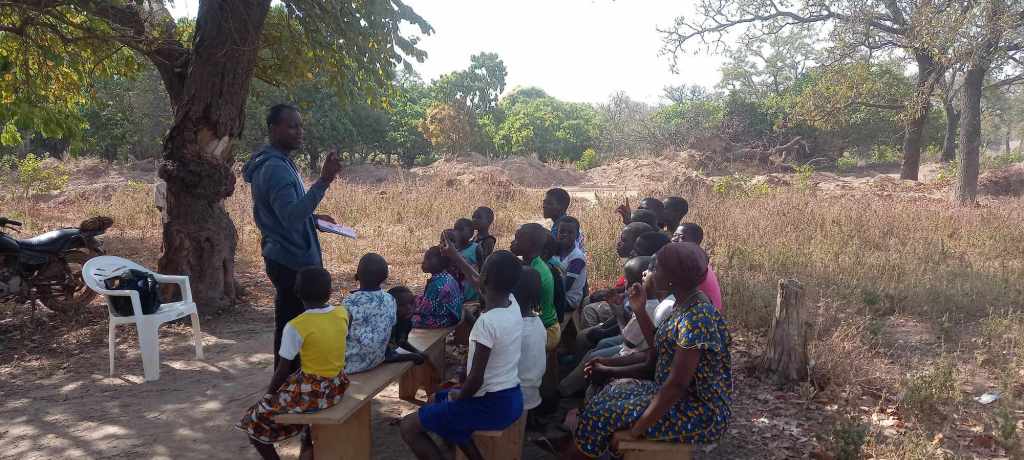
That line of kids sitting on the long exposed root of an old tree in the village of Tiepogovogo keeps coming to my mind these days. Why? Because that was Sunday School back in the early days, when the group of believers there was beginning to grow. I saw the kids hanging out and wondered how they could be reached. My fluency in Nyarafolo was nowhere good enough to teach them. But I knew a young woman, Mariame, who might come with me to the village and do it. It worked! She had a gift for teaching! I would help her plan the lesson, but she taught them. The adults were meeting in a temporary thatched shelter. We just used the shade of that huge tree nearby for Sunday School; the root served as a bench. The kids were enthralled.
And now, a little boy who came to Sunday School a couple of years before those in the row in the photo is the Sunday School teacher at Tiepogovogo. In addition he works in the Nyarafolo Translation Team, translating a Sunday School curriculum into the language as well as working in many other ways.
I did not know back then what fertile soil was in his heart, and in others there, or what fruit would come from that simple beginning. But we were sowing seed where the Lord had told us to, and he was making it grow.
When I wrote that poem likening myself to the heifer it was twelve years ago; we had finished three decades of ministry and were pressing forward. There were, however, many ongoing challenges. I was increasingly realizing how imperative it is to keep letting the Master direct me constantly. Only he knew which soil was fertile, where to go, what to do, and how to plant the seed of the Good News (think about his parable of the Sower in Matthew 13).
The following verses had spoken to me in a new way:
Ephraim is a trained heifer that loves to thresh; so I will put a yoke on her fair neck. I will drive Ephraim, Judah must plow, and Jacob must break up the ground. 12 Sow righteousness for yourselves, reap the fruit of unfailing love, and break up your unplowed ground; for it is time to seek the LORD, until he comes and showers his righteousness on you. (Hos. 10:11 NIV)
My spiritual gifting is not evangelism, but I was seeing ways that the Lord was using me as part of a team to make his Good News clear to people who were from a culture traditionally resistant to the Good News, the Nyarafolo. It was like “unplowed ground” that had become hardened, no one cultivating it. That meant hard work, most of all the kind of work that softens the soil so that it can accept seed and even produce a crop.
Preparation of the soil is actually necessary. So how could that be done? These verses pointed out some essentials: living out God’s commands for right living that demonstrate “unfailing love.” That covers just about everything! For me, it included showing those kids that they were important and deserved to hear the Word too. God had put it on my heart. It is necessary for the worker to be led by the Spirit—the “yoke” that guides the heifer, God’s hand pressing his servant to move in certain directions.
Derek Kidner’s comments on these verses clarifies the background and their application:
“The point about the heifer in the opening verse (11) is that threshing was a comparatively light task, made pleasant by the fact that the creature was unmuzzled and free to eat (Dt. 25:4) as it pulled the threshing-sledge over the gathered corn. This owner’s pride in his beast, and his consideration for it (cf. Pr. 12:10), together with the creature’s obedience and contentment, provides one of the many affectionate touches in these troubled chapters . . . But the idyllic scene had to change. Perhaps we are meant to see that in any case there must be a transition to hard and testing work, in any worth-while enterprise and for any growth to maturity: ‘Although he was a Son, he learned obedience through what he suffered’. ‘For the Lord disciplines him whom he loves’ (Heb. 5:8; 12:6).’ . . . Yet the picture is not one of unrelieved or pointless gloom. The yoke, after all, is there to serve the best of ends, the harvest, through the best of means, the plough and harrow. So verse 12a is as positive as it is practical, and 12b as generous as it is urgent.”[1]
What we are supposed to do is to keep at what he is telling us to do, all the time. We are not in charge; a true servant is like the yoked heifer. Only the Master knows what is to come next in the planting project:
As you do not know the path of the wind, or how the body is formed1 in a mother’s womb, so you cannot understand the work of God, the Maker of all things. 6 Sow your seed in the morning, and at evening let your hands not be idle, for you do not know which will succeed, whether this or that, or whether whether both will do equally well. (Eccl. 11:5,6 NIV)
There is another truth about being in the yoke that is chosen for us: it is actually directed by the kindest Master there is, who cares about how much we can bear. Jesus himself said:
Take my yoke upon you and learn from me, for I am gentle and humble in heart, and you will find rest for your souls. 30 For my yoke is easy and my burden is light.” (Matt. 11:29 NIV)
May we be part of the workforce that is being guided by Jesus, bringing in a life-giving harvest of unfailing love!
[1] Derek Kidner, The Message of Hosea: Love to the Loveless, ed. J. Alec Motyer and Derek Tidball, The Bible Speaks Today (England: Inter-Varsity Press, 1976), 97.
 Linnea's Lines